


Written by Joseph Berridge, Founder of Joga Yoga
The best yoga poses for sleep are slow, restorative ones you can hold for a minute or more, such as Child’s Pose, Legs Up the Wall, a supine twist and Corpse Pose. The 15-minute routine below moves from kneeling to lying down, so you finish ready for bed.
A 15-minute bedtime yoga routine
This routine moves from kneeling to seated to lying down, so you finish on your back and ready for bed. Do it on a mat, a rug or on your bed for the last few poses. Hold times are a guide. Stay longer in any pose that feels good.
| # | Pose | Hold |
|---|---|---|
| 1 | Hero Pose (Virasana) | 1 minute |
| 2 | Child’s Pose (Balasana) | 2 minutes |
| 3 | Butterfly Fold (Baddha Konasana) | 2 minutes |
| 4 | Supine Twist (Supta Matsyendrasana) | 1 minute each side |
| 5 | Bridge Pose (Setu Bandha Sarvangasana) | 1 minute |
| 6 | Knees-to-Chest Pose (Apanasana) | 1 minute |
| 7 | Legs Up the Wall (Viparita Karani) | 3 minutes |
| 8 | Corpse Pose (Savasana) | 3 minutes or longer |
You need a wall, one or two cushions, and a yoga block or firm pillow for the supported Bridge.
What kind of yoga is best before bed?
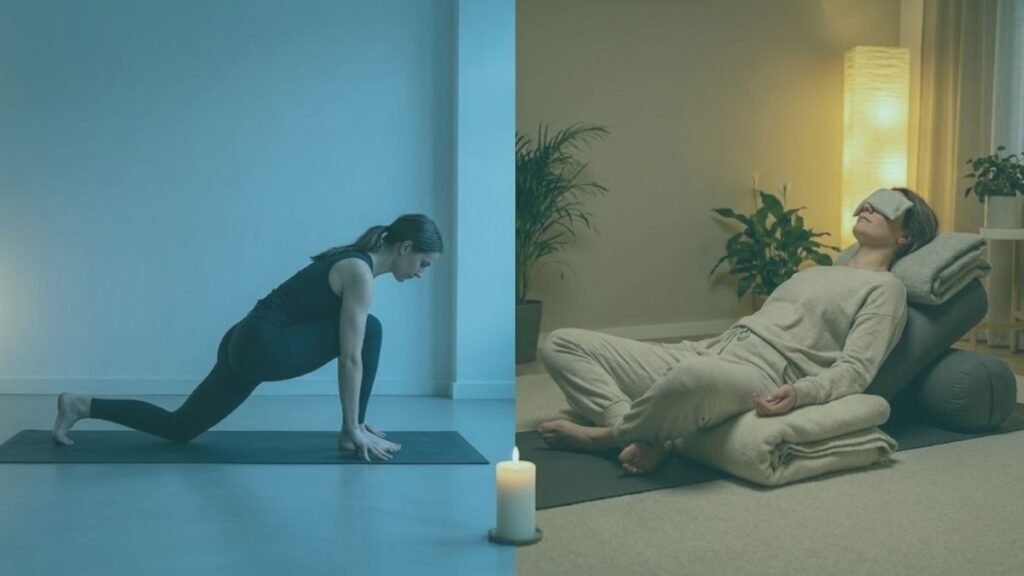
Slow, restorative poses held for a minute or longer suit the end of the day. Save energising poses such as deep backbends, inversions and fast flows for the morning. Our guide to morning vs evening yoga explains the difference.
Breathing matters as much as the poses. Throughout the routine, breathe through your nose and let each exhale be a little longer than the inhale. If you want to add a breathing practice at the end, Nadi Shodhana (alternate nostril breathing) is a gentle option, and our pranayama guide covers others.
1. Hero Pose (Virasana)

Start by sitting still and slowing your breath. Hero Pose gives you a steady, upright seat to do that.
Hold: 1 minute
- Kneel with your knees together and feet slightly wider than your hips.
- Sit back between or on your heels. Place a cushion or block under your seat if your knees feel strained.
- Rest your hands on your thighs, close your eyes and breathe slowly through your nose, letting each exhale run a little longer than the inhale.
If kneeling hurts your knees, sit cross-legged on a cushion instead.
2. Child’s Pose (Balasana)

Child’s Pose is one of the most common poses on bedtime yoga lists. It folds the body forward and lets the back and hips soften.
Hold: 2 minutes
- From Hero Pose, widen your knees and walk your hands forward.
- Lower your chest toward the floor and rest your forehead on the mat, a cushion or your stacked hands.
- Let your arms rest forward or alongside your body, whichever feels more relaxed.
3. Butterfly Fold (Baddha Konasana)

A gentle hip opener, done slowly and without forcing the stretch.
Hold: 2 minutes
- Sit with the soles of your feet together and let your knees fall out to the sides.
- Hold your feet or ankles and lengthen your spine.
- Fold forward only as far as feels comfortable. Rest your head on a cushion or block if it does not reach your feet.
You can also do this lying on your back, with cushions under each knee. That version is called Reclined Bound Angle (Supta Baddha Konasana).
4. Supine Twist (Supta Matsyendrasana)

Twists are a common way to release the back after a day of sitting. Lying down keeps this one passive.
Hold: 1 minute each side
- Lie on your back with your arms out to the sides in a T shape.
- Draw your knees toward your chest, then let them fall slowly to the right.
- Keep both shoulders on the floor and turn your head to the left if that is comfortable. Change sides after a minute.
5. Bridge Pose (Setu Bandha Sarvangasana)

Before bed, the supported version of Bridge is the one to use. A block under the hips lets you rest in the pose instead of holding it up with your muscles.
Hold: 1 minute
- Lie on your back with knees bent and feet flat, hip-width apart.
- Press into your feet and lift your hips.
- Slide a yoga block or firm cushion under your sacrum, the flat bone at the base of your spine, and let your weight rest on it. Lower your hips before removing the block.
Skip this pose if you prefer to keep the routine completely floor-based. It is the most active pose in the sequence.
6. Knees-to-Chest Pose (Apanasana)

A simple way to release the lower back after Bridge.
Hold: 1 minute
- Lie on your back and hug both knees toward your chest.
- Hold your shins or the backs of your thighs.
- Rock gently from side to side, or stay still and breathe into your lower back.
7. Legs Up the Wall (Viparita Karani)
Legs Up the Wall appears on most of the bedtime yoga lists that rank in search. It is easy to hold for several minutes and needs no strength.
Hold: 3 minutes
- Sit sideways with one hip against a wall.
- Swing your legs up the wall as you lower your back to the floor. Shuffle your hips as close to the wall as feels comfortable.
- Rest your arms by your sides, palms up, and let your legs relax against the wall.
If you have been told to avoid inversions, for example because of glaucoma, check with your doctor first. You can rest your calves on a chair or the edge of the bed instead.
8. Corpse Pose (Savasana)

Finish lying completely still. You can do this last pose in bed and simply stay there.
Hold: 3 minutes or longer
- Lie on your back with your legs extended and slightly apart, arms by your sides, palms up.
- Close your eyes and let your breath return to its natural rhythm.
- Scan your body from feet to head and let each area soften. If you fall asleep, the routine has done its job.
Tips for a bedtime yoga routine
Practise at roughly the same time each night so the routine becomes part of winding down. Dim the lights and put your phone away before you start. Keep the room warm enough that you do not tense up while lying still.
Stop any pose that causes pain. If you are pregnant, avoid lying flat on your back for long periods later in pregnancy and ask your doctor or midwife which poses suit you. If you are new to yoga, our beginner yoga guide covers the basics, and our explainer on what asana yoga is explains the pose names.
If a busy mind is what keeps you awake, our yoga for overthinking routine pairs well with this one.
Frequently asked questions
Which yoga pose is best for sleep?
There is no single best pose, but Legs Up the Wall (Viparita Karani) and Child’s Pose (Balasana) appear on most bedtime yoga lists. Both are easy to hold for several minutes without effort.
Can yoga help with insomnia?
A gentle routine can help you relax before bed, but it is not a treatment for insomnia. If poor sleep lasts for weeks or affects your daytime life, speak to a doctor.
What yoga poses should you avoid before bed?
Avoid energising poses late at night, such as deep backbends like Camel or Wheel, strong inversions, and fast Vinyasa flows. Save those for the morning.
How long should you do yoga before bed?
Ten to fifteen minutes is enough for most people. The routine above takes about 15 minutes. A shorter version of Child’s Pose, Legs Up the Wall and Corpse Pose works on nights when you are short of time.
Deepen your practice in Bali
Joga Yoga’s 200-hour teacher training in Canggu includes daily Hatha and Vinyasa practice plus a daily Yin class, so you learn slow, restorative practice as well as how to teach it.
Register for teacher training