


The root chakra, or Muladhara, is the foundation of the traditional chakra system. It is linked with safety, stability, belonging, and your connection to the physical world. When it feels steady, life usually feels a little less shaky.
If you have already explored the navel point and the solar plexus chakra, the root chakra is the layer underneath both of them. It is the base that supports confidence, direction, and personal power.

What is the root chakra and what does Muladhara mean?
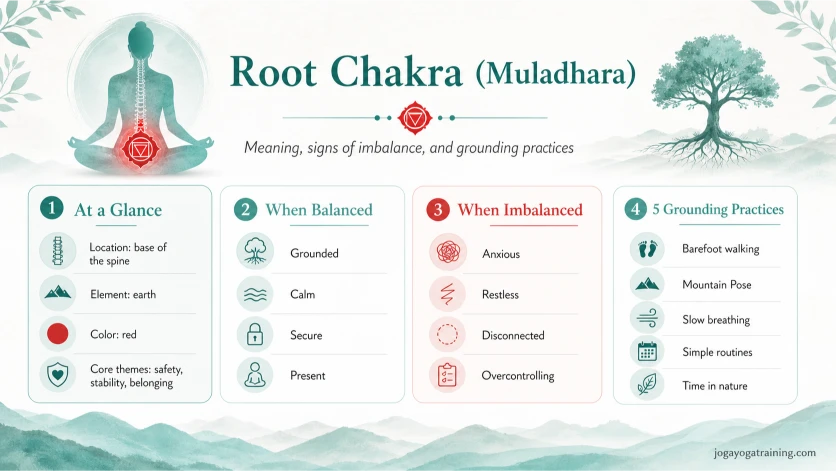
Muladhara is the first chakra in traditional yogic philosophy. It sits at the base of the spine and is associated with safety, survival, groundedness, and the feeling that you are supported in your body and daily life.
The broader idea of chakras comes from Indian spiritual traditions, where chakras are understood as energy centers within the subtle body, not anatomical structures in the medical sense, as noted by Britannica. The Sanskrit name Muladhara is commonly translated as “root support” or “base support,” which matches its role as the foundation of the chakra system.
In simple terms, the root chakra is about your most basic human needs. Food. Shelter. Rest. Safety. Trust. The sense that your feet are on the ground and your life is not constantly tipping sideways.
What does the root chakra symbolize?
The root chakra symbolizes grounding, steadiness, and the instinct to survive and belong. In traditional chakra imagery, it is connected with the color red, the earth element, and a stable base that supports all the chakras above it.
Its symbolism is usually built around a few repeating elements:
- Red, which represents vitality, life force, and physical presence
- Earth, which points to stability, structure, and support
- A square, which suggests steadiness and a strong foundation
- Four petals, which are often used in traditional depictions of Muladhara
- The seed mantra “Lam,” commonly associated with this chakra in yogic practice
This is one reason the root chakra is often the first place people begin when working with chakra balance. Before moving upward into emotion, expression, or insight, the system points back to stability first.
What does a balanced root chakra feel like?
A balanced root chakra usually feels steady, practical, and calm. You may still have stress, but it does not run the whole show. There is more trust in your body, your routines, and your ability to handle ordinary life.
People often describe a balanced root chakra as feeling:
- Grounded instead of scattered
- Safe instead of constantly braced
- Present instead of checked out
- Connected to the body instead of floating above it
- Able to rest, eat, work, and recover with more consistency
Balance here is not about being perfectly calm all the time. It is more about having a stable inner base. You can bend without snapping. You can respond without spiraling.
What are the signs of an imbalanced root chakra?
An imbalanced root chakra is usually described as fear, instability, disconnection, or overcontrol showing up in daily life. In chakra-based traditions, the common thread is that safety feels uncertain, either emotionally, physically, or practically.
This can show up in different ways. Some people feel ungrounded, anxious, or chronically unsettled. Others go the other direction and become rigid, possessive, or overly focused on control.
Common emotional and behavioral signs include:
- Ongoing worry about money, security, or survival
- Feeling restless, spacey, or disconnected from the body
- Difficulty relaxing, trusting, or settling down
- Clinging to routines, possessions, or people out of fear
- Irritability when plans change
- A feeling of not belonging anywhere
Some traditions also connect root chakra imbalance with tension in the legs, feet, hips, pelvic floor, or lower back. That said, physical symptoms can have many causes. Chakra language can be helpful for self-reflection, but it should not replace real medical care. Healthline makes the same point when discussing chakra practices and their limits as healthcare tools: root chakra work may support well-being, but it is not a substitute for treatment.
Why does the root chakra become imbalanced?
The root chakra is said to become imbalanced when your system stops feeling safe, supported, or settled. That can happen because of stress, instability, exhaustion, major change, or unresolved fear that keeps the body on alert.
Sometimes the cause is obvious. A move. Burnout. Financial pressure. Grief. Relationship upheaval. Too much travel. Not enough sleep. A life season where everything feels uncertain at once.
Sometimes it is quieter than that. You may be functioning well on the outside while feeling internally unanchored. Your routine slips. Meals get irregular. You stop resting properly. Your body starts living in reaction mode.
From a practical perspective, root chakra work tends to help most when it is paired with real-world support. Better sleep. More predictable meals. Less overstimulation. More time outside. A routine that makes your nervous system feel less chased.
How can you balance the root chakra with grounding practices?
Balancing the root chakra usually starts with simple grounding practices that bring attention back to the body, breath, and physical world. The goal is not to force a spiritual breakthrough. It is to create steadiness first.
A helpful root chakra routine does not need to be elaborate. It usually works better when it is repeatable.
1. Start with the body
The root chakra is linked with physical presence, so begin with things that make you feel embodied.
- Stand barefoot on the floor or outside
- Take a slow walk without your phone
- Eat a nourishing meal without multitasking
- Notice the weight of your body in a chair or on a mat
These are small actions, but they matter. Grounding is often less dramatic than people expect.
2. Use slow, steady breathing
Breathwork for the root chakra should feel calming, not intense. Try a simple pattern such as inhaling for four counts and exhaling for six. Longer exhales often help the body soften its threat response.
If you already practice breath awareness, you can pair it with a quiet repetition of “Lam” or a visualization of red light at the base of the spine. Yogapedia’s Muladhara overview also notes the traditional link between this chakra and the seed mantra “Lam.”
3. Keep your routines boring in the best way
Root chakra balance often grows through repetition. Waking up at a similar time. Moving your body most days. Eating regularly. Going to sleep before your second wind convinces you it is a great time to reorganize your life.
Predictability is not glamorous, but it is grounding.
4. Spend time with the earth element
Because Muladhara is associated with earth, practices that reconnect you with the natural world are often used to support it.
- Sit under a tree
- Garden
- Walk on grass or sand
- Practice outdoors when possible
- Hold your attention on physical sensations instead of racing thoughts
This is also why grounding meditation and simple nature-based rituals show up so often in root chakra practices.
Which yoga poses support the root chakra?
Root chakra yoga practices usually focus on stability, contact with the ground, and awareness through the feet, legs, hips, and pelvic base. The best poses are often the simplest ones you can breathe in without rushing.
A few useful options are:
- Mountain Pose
- Garland Pose
- Child’s Pose
- Warrior II
- Standing Forward Fold
- Easy Seat with grounded breath
If you want a fuller sequence, Joga’s guide to grounding poses in yoga fits naturally with root chakra work because it emphasizes stability, breath, and contact with the ground.
While practicing, keep the cue simple: press down to steady yourself, then breathe.
How does the root chakra relate to the navel and solar plexus chakras?
The root chakra supports the lower energy centers above it by creating a base of safety and stability first. In practical terms, it is easier to build confidence, direction, and personal power when you do not feel fundamentally ungrounded.
That is why this topic pairs well with Joga’s existing articles on the navel point and personal vitality and the solar plexus chakra. The navel point speaks to energy and inner fire. The solar plexus often points to confidence, will, and self-belief. The root chakra is the base layer that helps both of those qualities feel stable instead of forced.
You can think of it this way:
- Root chakra: I am safe here
- Navel point: I have energy here
- Solar plexus: I can act from here
That sequence feels a lot more useful than jumping straight to confidence when your body still feels on edge.
When should chakra practices be paired with real-world support?
Root chakra practices work best when they are paired with grounded action in everyday life. If your stress is coming from burnout, trauma, instability, or health concerns, meditation alone may not be enough.
Sometimes balance looks spiritual. Sometimes it looks like sleeping more, asking for help, making a budget, taking a break, or speaking with a qualified therapist or clinician.
That does not make the practice less meaningful. It makes it more honest.
The root chakra is not really asking you to become mystical overnight. It is asking whether your foundation is solid enough to hold the life you are trying to build.
FAQ
Can the root chakra be overactive, not just blocked?
Yes. In chakra-based practice, an overactive root chakra is often linked with rigidity, possessiveness, fear of change, and a strong need to control people, money, or routines. It is still an imbalance, just expressed through excess rather than depletion.
How long does it take to balance the root chakra?
There is no fixed timeline. Some people feel more grounded after one practice, while others need a few weeks of steady routines, yoga, breathwork, and rest before they notice a real shift. Consistency matters more than intensity.
What foods are associated with the root chakra?
Many chakra traditions connect the root chakra with grounding foods such as root vegetables, warming soups, beans, protein-rich meals, and naturally red foods like beets, tomatoes, and strawberries. The goal is nourishment and steadiness, not a strict “chakra diet.”
Which crystals are commonly used for the root chakra?
Red jasper, black tourmaline, hematite, smoky quartz, and garnet are often associated with root chakra practices. People usually use them during meditation, keep them nearby during journaling, or place them in a calm corner of the home as a grounding reminder.
What affirmation works best for the root chakra?
Simple affirmations usually work best. Good examples include: “I am safe,” “I am supported,” “I belong here,” and “My body is my home.” Choose one line that feels believable enough to repeat without forcing it.
Is the root chakra connected to money and work stress?
In many modern chakra interpretations, yes. Because Muladhara is associated with survival, shelter, and security, financial stress and job instability are often discussed through a root chakra lens. It does not mean money problems are spiritual failures. It just means practical stress can affect your sense of inner safety.
What is the difference between the root chakra and the sacral chakra?
The root chakra is about safety, stability, and basic support. The sacral chakra is more often linked with emotion, creativity, pleasure, and connection. A simple way to separate them is this: root says “I am safe,” while sacral says “I can feel.”
Should beginners start with the root chakra first?
Usually, yes. Many teachers begin with the root chakra because it is seen as the base of the system. Starting there can make later work on confidence, expression, or intuition feel less abstract and more stable.
Can root chakra practices help with sleep and rest?
They can support better rest for some people, especially when restlessness comes from stress or feeling ungrounded. Gentle evening practices like long exhales, legs-heavy poses, warm meals, and a simple night routine may help the body settle.
When is the best time to practice root chakra balancing?
Morning is often best if you want to feel steady and focused for the day. Evening can also work well if your goal is to unwind and feel safe enough to rest. The better choice is the one you can actually keep doing.