
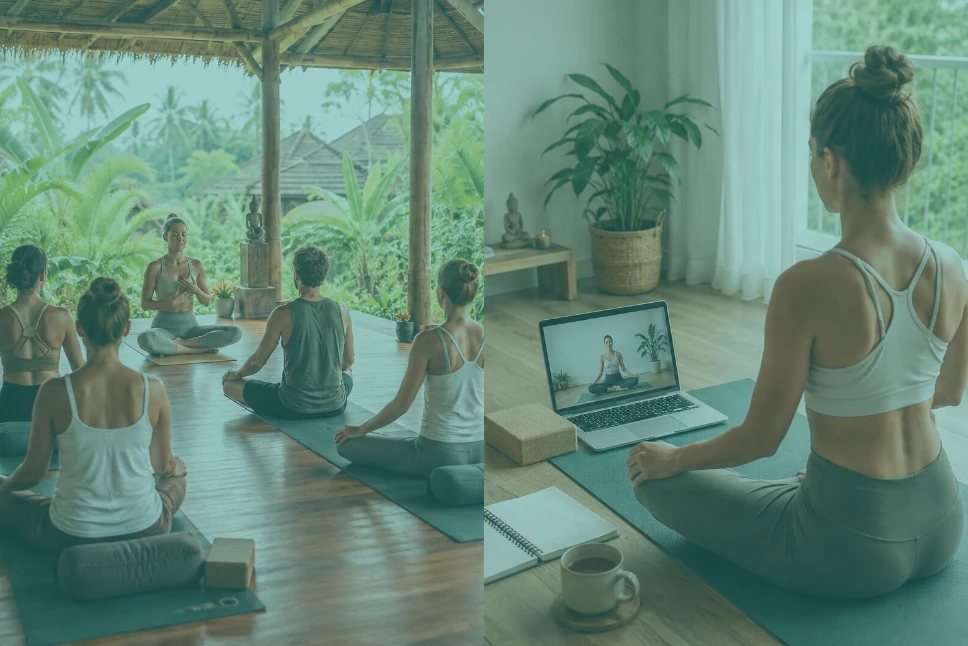
 Written by Joseph Berridge, Founder of Joga Yoga
Online yoga teacher training gives you schedule flexibility. In-person training gives you a trainer who can watch you teach and tell you what to fix. The right format depends on which one you’re missing, not which one sounds easier or cheaper.
This guide compares both across certification, cost, feedback, and teaching readiness, and covers hybrid programs too.
Is Online or In-Person Yoga Teacher Training Better?
In-person training is the stronger choice if you’ve never taught a class and want to walk out ready. You get live correction, you teach real people, and a trainer watches you do it and tells you what’s off. Online training works well if you already have a steady practice and mainly need flexibility.
You’ll see this framed the opposite way too. Some long-running online schools now argue that in-person training tries to cram too much physical and emotional work into a short window, and that people would be better off doing the training online and saving in-person time for a retreat instead. That’s a fair point about intensity. It’s not a fair point about readiness to teach.
A retreat doesn’t put you in front of a room and ask you to cue a sequence while a trainer watches your alignment, your pacing, and your voice, then tells you exactly what to change. That loop, teach, get corrected, teach again, is what actually builds the confidence to stand in front of strangers and lead a class. You can get some of it on a screen. You can’t get all of it.
If your goal is personal deepening rather than teaching, online can absolutely be enough. But the program still needs live hours. Yoga Alliance has required registered schools to deliver at least 15% of training hours synchronously since 2024, meaning real-time contact with an instructor, not just pre-recorded video. A course built entirely on playback doesn’t meet that bar.
For a wider look at what any YTT actually covers, the YTT guide on Joga’s site breaks down each training category.
What’s Actually Different Between Online and In-Person Training?
The real difference is how fast you get corrected and how many times you get to teach a real person before certification. Online gives you control over your schedule. In-person gives you a trainer in the room, teaching reps with classmates, and the kind of shared routine, meals, early mornings, philosophy talks, that builds confidence outside the curriculum itself.
| Factor | Online YTT | In-Person YTT | Hybrid YTT |
|---|---|---|---|
| Schedule | Flexible or self-paced | Fixed dates, one location | Theory online, practice in person |
| Feedback | Video or live calls | Immediate, in the room | Partial, depends on the school |
| Teaching reps | Varies a lot by program | Built into every day | Concentrated into the in-person block |
| Cost | Lower upfront | Higher with travel and stay | Moderate |
| Best for | Experienced, self-motivated students | First-time teachers | Working students who can’t take a full month off |
What a real online program includes
Pre-recorded lessons, live video calls, written work, and a community group chat. The better ones add structured teaching labs with actual feedback on how you cue and move. The weak ones are a stack of videos you watch alone and hope it sticks.
What in-person training includes
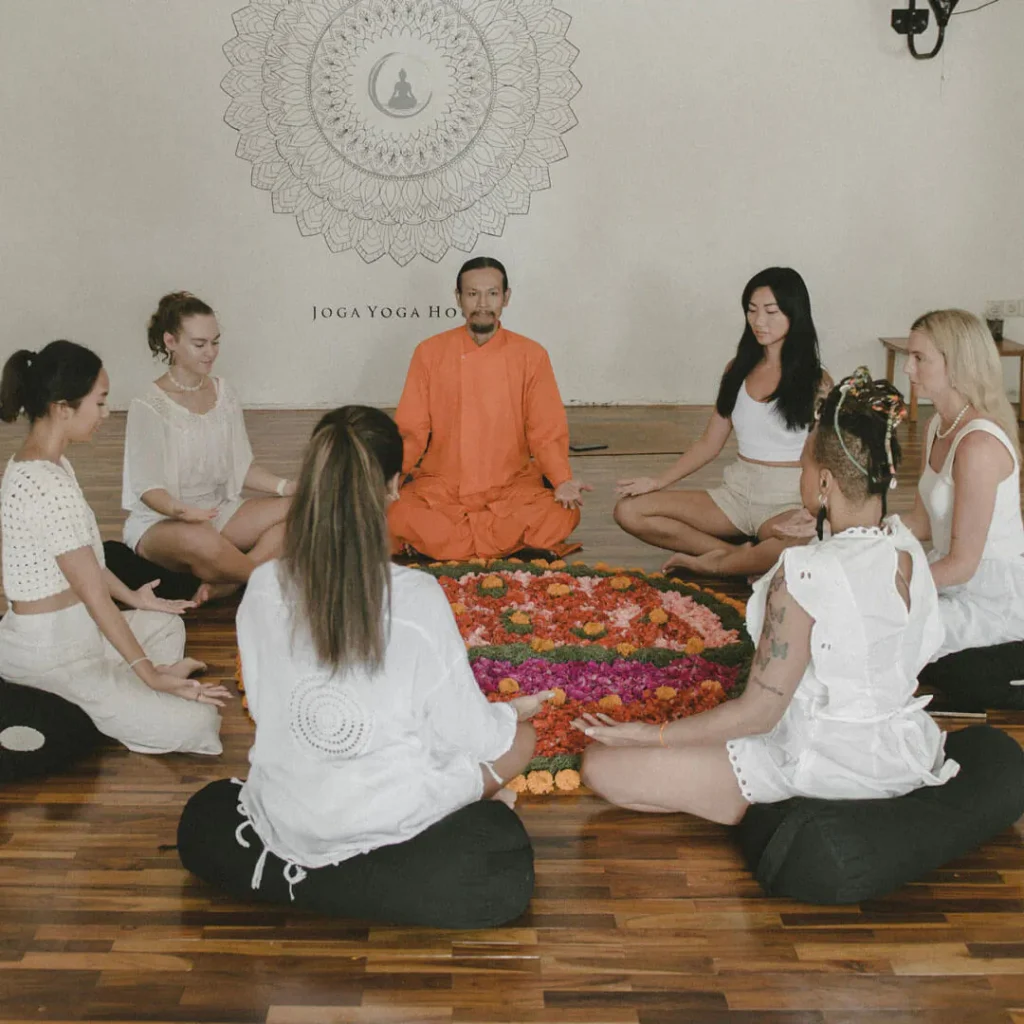
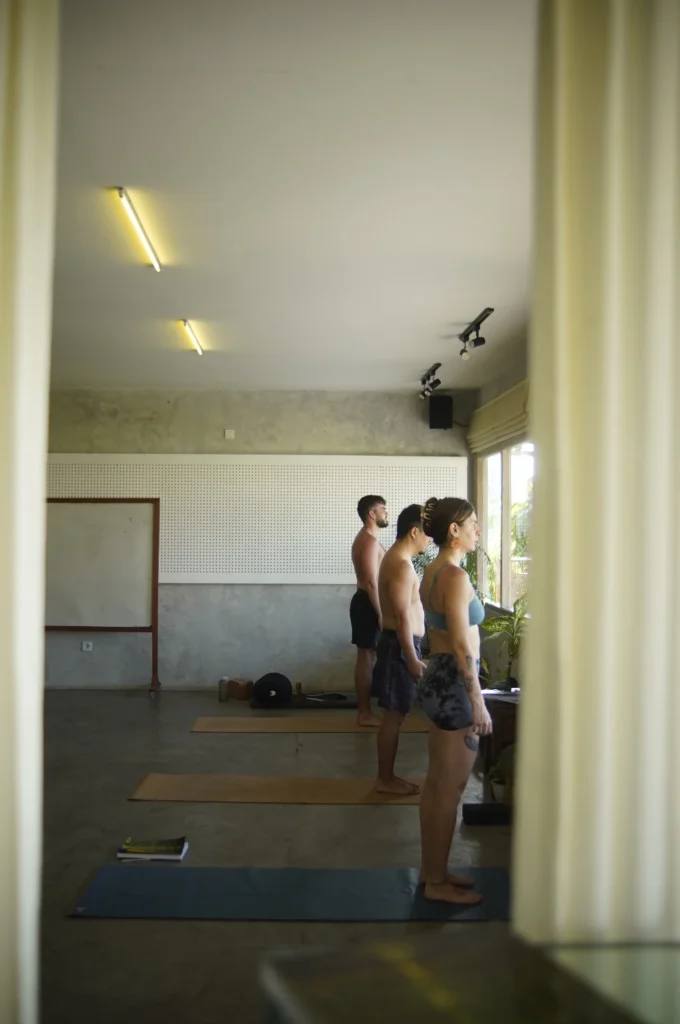
You practice daily, teach your classmates, and get corrected by someone standing next to you. You also see bodies that aren’t yours: different ranges of motion, injuries, and learning styles. That’s what teaches you to stop repeating one cue to everyone and start reading what each student actually needs.
Can You Get Certified Through Online Training?
Yes, if the school is a Yoga Alliance Registered Yoga School and the program hits the curriculum and hour requirements. An RYT 200 or RYT 500 credential doesn’t say whether you trained online or in person. What matters is the school’s registration status.
“Certified” gets thrown around loosely. Some schools hand you a certificate just for finishing their course, and that certificate is only as good as the school behind it. Studios and employers generally want an RYT credential from a registered school, not a completion badge.
Confirm this before you enroll anywhere:
- The school shows as an active Registered Yoga School on Yoga Alliance’s directory
- The curriculum covers all four required categories: techniques, training and practice; anatomy and physiology; yoga humanities; and professional essentials
- There are live teaching hours with real feedback from a trainer, not just self-assessment
- The program includes a practicum and assessment before certification
- Lead trainers have verifiable teaching and training experience
If you want the full breakdown of what each credential level actually means, the yoga teacher certification guide covers RYT levels and what studios look for when hiring.
Weighing the Trade-offs: Pros and Cons of Each Format
Online YTT
Pros: study from anywhere around a job or family, lower upfront cost with no travel or visa expenses, self-paced review of dense material like anatomy, and access to schools regardless of where you live.
Cons: a trainer on a screen can’t physically correct your alignment, dropout and passive watching are real risks in fully recorded formats, teaching confidence takes longer to build without live reps, and quality varies wildly between schools.
A well-built online program includes live teaching sessions, a structured practicum, real feedback from a qualified trainer, and a cohort small enough that you’re not invisible. If you’re weighing the full cost against what you’ll actually walk away with, is yoga teacher training worth it goes deeper on timing and value.
In-Person YTT
Pros: immediate feedback from a trainer who can see and correct you in real time, teaching practice with real students at different levels, built-in community and accountability, and an environment that removes you from normal life long enough to force real growth.
Cons: higher total cost once you add tuition, travel, accommodation, and visas, a fixed schedule that means real time away from work and family, and an intensity that’s hard on your body and your emotions, plan for that.
Is Hybrid Training the Better Middle Ground?
Hybrid is the right call when you need flexibility for theory but still want to build real teaching presence in a room. Philosophy, anatomy, history, and sequencing transfer fine to online delivery, especially since you can rewatch them. Cueing, hands-on adjustment, and live class management don’t.
A good hybrid program isn’t two courses stitched together. The online phase should prepare you for the in-person block, and the in-person block should let you apply what you studied instead of spending the first few days catching up on it.
If part of the appeal of in-person training is simply the experience of being somewhere beautiful with other people doing the same thing, that’s worth separating from the training itself. The yoga retreat vs yoga teacher training guide breaks down when a retreat gets you what you actually want, and when it doesn’t replace the teaching reps a certification requires.
How to Choose, Based on Where You’re Starting From
If you’ve never taught before, choose in-person when you can afford the time and cost. Live feedback and real teaching reps build a safer foundation than learning to teach and learning to practice at the same time with nobody watching.
Online can still work for a beginner, but the program has to be built right: live sessions, a small cohort, regular access to a trainer, real feedback on your practice teaching, and a clear assessment before graduation. Not a stack of videos with a certificate at the end.
Ask yourself before deciding:
- Can I hold a consistent practice without someone checking in on me?
- Do I understand alignment and breath well enough to learn it from video?
- Have I practiced with more than one teacher?
- Do I want to teach soon, or mainly deepen my own practice?
- Would real-time correction on how I move and cue actually change how I learn?
Most beginners underestimate what teaching involves. It’s not just recalling poses. It’s watching students, managing pace, speaking clearly, offering modifications, and staying grounded while a room full of people move and breathe in front of you. That takes practice under conditions that feel real, not simulated. If you’re still deciding whether YTT is right at all, not just which format, the benefits of yoga teacher training article lays out what the training changes beyond the certificate.
What to Check Before You Enroll in Any Program
Check accreditation, curriculum depth, trainer experience, live feedback structure, class size, cost, and what support looks like after graduation. A polished website tells you nothing about whether the training will actually prepare you to teach.
- The school is an active Registered Yoga School with Yoga Alliance, or clearly explains its certification status
- Lead trainers have verifiable teaching experience and years in practice, not just a certificate
- The curriculum covers asana, anatomy, philosophy, methodology, ethics, and a teaching practicum
- There are live teaching hours with trainer feedback before graduation
- The schedule is realistic, programs crammed into too short a window usually cut depth first
- Class size is small enough that a trainer can actually watch and correct you individually
- Reviews mention the quality of the teaching and feedback, not just the food or the location
- The school tells you what happens after you graduate, not just what happens during the course
If you’re comparing locations for an in-person training in Bali, the Canggu vs Ubud yoga teacher training guide breaks down the environment, cost, and what each area suits.
Which Format Should You Choose?
Choose in-person if you want to walk out able to teach a class with confidence. Choose online if flexibility is what’s actually stopping you. Choose hybrid if you want structured theory at home but know you need a room to build real teaching presence.
For most first-time teachers, in-person or hybrid pays off longer term. Teaching yoga is a physical, relational skill, and at some point you need to practice it in front of real people with someone watching who can tell you what to fix. The sooner that happens in your training, the faster your confidence catches up.
Joga runs its 200-hour Yoga Alliance certified training in Canggu, Bali, with groups small enough that trainers actually see you teach: Nitish on anatomy and alignment, Dr. Ningrum on Ashtanga and philosophy, Dada on meditation, and Dr. Sharma on Ayurveda. Training runs just over three weeks (22 nights), with new dates most months through 2027. Current pricing starts at €1,650 for non-accommodation and runs to €2,599 for a private room with the full stay included, against a €260 deposit to hold your spot. Graduates who want more reps before they teach on their own can keep practicing at Joga’s own studio after the course ends.
What that looks like in practice: Dakota Mays, now a working yoga instructor in the US, said the training left her “more than prepared to teach and start my full-time job as a yoga instructor” straight after finishing.
Ready to Become a Certified Yoga Teacher?
Join our 200-Hour Yoga Alliance certified training in Canggu, Bali.
Reserve Your Spot →Frequently Asked Questions
Can I become a certified yoga teacher online?
Yes. You can earn an RYT 200 or RYT 500 credential through an online program if the school is a Yoga Alliance Registered Yoga School and the program meets curriculum standards, including a minimum of live synchronous hours. The credential itself doesn’t say whether you trained online or in person.
Is online yoga teacher training recognized by studios?
Most studios that require Yoga Alliance certification accept an RYT credential regardless of delivery format, as long as the issuing school is registered. Some studios still prefer in-person graduates, so ask directly if that matters to your plans.
How much does online yoga teacher training cost compared to in-person?
Online programs typically run from a few hundred dollars to around $2,000 USD. In-person programs vary by location. Joga’s current 200-hour pricing in Bali runs from €1,650 for non-accommodation up to €2,599 for a private room, which includes vegan meals, materials, and Yoga Alliance certification, making the gap with online smaller than the headline numbers suggest.
Is Yoga Alliance certification required to teach yoga?
Not legally. Yoga Alliance is a private membership organization, not a government body. Many studios and gyms prefer or require RYT credentials, but independent teachers and retreat facilitators often teach without registration.
What is hybrid yoga teacher training?
A hybrid YTT combines online study with an in-person residential block. You typically complete theory, anatomy, and philosophy online over several weeks, then join the school in person for teaching practice and practicum. The in-person portion is usually one to two weeks.
How long does online yoga teacher training take?
Most 200-hour online programs run 10 weeks to 6 months depending on whether the format is self-paced or cohort-based. Joga’s in-person intensive in Bali runs just over three weeks (22 nights).