

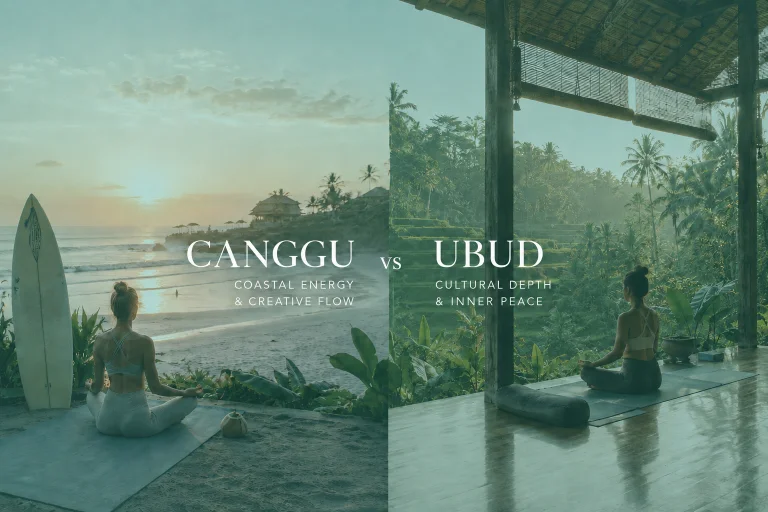
Choosing between Canggu and Ubud for yoga teacher training is really about choosing your learning environment. Canggu suits students who want beach life, social energy, and modern wellness. Ubud suits students who want a quieter, greener, more inward experience.
Both places can be excellent for a 200-hour yoga teacher training. Both have strong yoga communities. Both can help you grow as a teacher and as a person. The better option depends on how you learn, how much stimulation you enjoy, and what you want your weeks in Bali to feel like outside class.
If you are still comparing the bigger Bali picture, our Yoga Teacher Training in Bali Complete Guide gives the full overview of locations, costs, certification, and what to expect.
Which is better for yoga teacher training, Canggu or Ubud?
Canggu is better for students who want a lively, beachside, community-driven training. Ubud is better for students who want a calmer, more reflective setting with a stronger retreat feeling. Neither is universally better. The right choice depends on your personality and goals.
Here is the simplest way to compare them:
| Factor | Canggu | Ubud |
|---|---|---|
| Overall vibe | Social, active, modern | Calm, spiritual, reflective |
| Setting | Beach town | Inland jungle and rice field area |
| Best for | Community, surf, lifestyle balance | Inner work, meditation, slower rhythm |
| Daily life outside class | Cafes, beach, coworking, movement culture | Temples, healing spaces, quieter evenings |
| Typical downside | Traffic, noise, more distractions | Fewer beach options, can feel less social |
| Strong fit for | Outgoing students, surfers, digital nomads, students who like variety | Students seeking focus, ritual, nature, and a retreat atmosphere |
Many comparison pages stop at saying Canggu is beachy and Ubud is spiritual. That is true, but it is not enough to help someone book well. The more useful question is how each place changes your focus, budget, daily rhythm, and learning experience during training.
Who should choose Canggu for yoga teacher training?
Canggu is the better choice if you want your training to happen inside a full Bali lifestyle that includes yoga, beach time, healthy food, social connection, and a modern wellness scene after class.
Choose Canggu if you want your training weeks to feel alive. You might practice in the morning, study anatomy or teaching methodology midday, grab lunch with classmates, then head to the beach for sunset. If you love having options around you, Canggu works well.
Canggu tends to suit students who:
- Like meeting people easily
- Enjoy cafes, movement culture, and a younger international crowd
- Want yoga and surf in the same trip
- Prefer a more modern and practical atmosphere
- Feel motivated by community rather than silence
This is also why Canggu makes sense for students interested in combining teacher training with a broader lifestyle reset. Our Yoga and Surf in Bali guide is useful if that mix is part of the appeal.
The tradeoff is attention. Canggu gives you a lot, but it also asks you to manage yourself. Traffic, social plans, busy streets, and the general pace can pull you outward. If you focus well with energy around you, that is fine. If you get overstimulated easily, it can feel like too much.
Who should choose Ubud for yoga teacher training?
Ubud is the better choice if you want your training to feel more immersive, inward, and retreat-like, with less pull toward beach culture, nightlife, and constant social activity outside the classroom.
Ubud has long been one of Bali’s strongest yoga and wellness centers. Local reporting from ANTARA Bali notes that the area’s yoga growth has been closely tied to Ubud’s cultural and spiritual identity, while established venues such as The Yoga Barn continue to reinforce Ubud’s reputation as a major hub for classes, trainings, retreats, and wellness events.
Choose Ubud if you want:
- More quiet around your practice
- Easier access to meditation, ritual, and healing spaces
- Rice fields, temples, and greener scenery
- A slower evening rhythm
- A setting that supports introspection
Ubud often works best for students who are doing teacher training not only to teach, but to reset, process a life transition, or deepen their personal practice in a more protected environment.
That said, Ubud is not automatically peaceful just because it is Ubud. Central Ubud can still be crowded and traffic can still be frustrating. The calmer version usually comes from choosing the right school and staying slightly outside the busiest center.
How does daily life feel different in Canggu and Ubud?
Canggu feels broader, busier, and more lifestyle-driven day to day. Ubud feels more contained, reflective, and retreat-oriented, which can make your training experience feel either more focused or more isolated depending on your personality.
This difference matters more than many people expect. Yoga teacher training is intense. You are not just dropping into a few classes. You are practicing daily, studying philosophy and anatomy, learning to teach, managing emotions, and often moving through a big personal shift.
In Canggu, your off-hours can include:
- Beach walks and sunsets
- Surf lessons
- Cafes and coworking spots
- A bigger social scene
- More choice, and more temptation to keep moving
In Ubud, your off-hours are more likely to include:
- Quiet meals
- Rice field walks
- Temple visits
- Massage, healing, or meditation sessions
- Earlier nights and more space to integrate
If you want help choosing your Bali base more broadly, our best area to stay in Bali guide breaks down how Canggu and Ubud differ by energy, yoga goals, traffic, and travel style.
Is Canggu or Ubud better for beginners?
Canggu is often better for beginners who want support, community, and a less intimidating entry point. Ubud is often better for beginners who want quiet focus and emotional space, especially if they are taking training for personal growth as much as certification.
Beginners do not all need the same environment. Some beginners thrive when they are surrounded by people, conversation, and a bit of fun outside class. Others need calm and space to absorb everything.
Canggu may be the better beginner choice if you:
- Worry about feeling lonely
- Like a more relaxed social atmosphere
- Want training to feel grounded in modern daily life
- Enjoy mixing serious study with beach and movement culture
Ubud may be the better beginner choice if you:
- Want fewer distractions
- Feel emotionally tender or burned out
- Want more silence, nature, and reflection
- Are drawn to meditation and philosophy, not just asana
The best beginner decision is not about choosing the easier town. It is about choosing the place where you are most likely to stay regulated, rested, and open to learning.
How do cost and logistics compare in Canggu and Ubud?
Costs can overlap, but Canggu often gets more expensive once daily life is added in. Ubud can offer slightly lower day-to-day spending, while both areas still show a wide range of training prices depending on room type, school reputation, and inclusions.
Recent Bali training roundups from One Yoga Thailand and Best Yoga Training Bali still place both Ubud and Canggu among the island’s main yoga teacher training hubs, with published 200-hour and multi-style program prices ranging from the low $1,500s to well above $4,000 depending on the school, location, and accommodation package.
The training fee is only part of the decision. You should also think about:
- Meals not included in your package
- Coffee and cafe spending
- Transport and airport transfers
- Scooter rental or taxi use
- Laundry
- Extra classes, surf sessions, massage, and outings
In practice, many students spend more in Canggu because the social and lifestyle options are everywhere. That is not a flaw. It is just something to budget for honestly.
Logistics also matter:
- Canggu is great if beach access and a social yoga scene matter to you
- Ubud is great if you want greener surroundings and less beach-based distraction
- Both can involve traffic, especially in busier central areas
- Your exact school location matters more than the town name alone
For a fuller pricing breakdown, read our Yoga Teacher Training Bali cost guide.
What should you check before booking any training in Canggu or Ubud?
Before booking in either location, check accreditation, teaching team quality, curriculum, inclusions, class size, and whether the school’s atmosphere actually matches the kind of training experience you want.
Do not let the town make the decision for you on its own. A strong school in the right-fit environment beats a famous location with weak teaching or unclear structure.
Check these points carefully:
- Is the school listed in the Yoga Alliance directory if Yoga Alliance registration matters to you?
- What styles are taught, and do they match your goals?
- How much teaching practice is included?
- What is the class size?
- Are accommodation and meals included?
- Is the atmosphere more retreat-style, fitness-style, or teacher-development focused?
- What do reviews say about support, clarity, and safety, not just transformation?
If you are leaning toward Canggu specifically, our guide to yoga in Canggu and our best yoga teacher training in Canggu article can help narrow the options.
So should you choose Canggu or Ubud for yoga teacher training?
Choose Canggu if you want energy, beach life, and a social training environment. Choose Ubud if you want quiet, depth, and a stronger retreat atmosphere. The best result comes from matching the place to your nervous system, not to someone else’s ideal Bali fantasy.
If your best version of Bali includes surf, community, healthy cafes, movement culture, and a practical lifestyle rhythm, Canggu will probably feel more natural.
If your best version of Bali includes jungle mornings, meditation, slower evenings, cultural texture, and deeper inward focus, Ubud will probably feel closer to what you are looking for.
A simple rule helps:
- Choose Canggu if you want your training to happen inside life
- Choose Ubud if you want life to quiet down around your training
For students who want Yoga Alliance-certified training in a beachside setting with strong community and practical support, Joga’s Canggu-based approach may be the better fit. If you want the jungle-retreat version of Bali instead, Ubud will likely feel closer to what you are looking for.