

Most yoga teacher training programs in Bali aren’t really in Bali. They’re in an air-conditioned studio that happens to be located in Bali. The schedule is the same one you’d find in London or Los Angeles. The teachers are Western. The ceremonies aren’t there.
At Joga Yoga, the Balinese cultural context is part of the training structure itself. That includes a sacred purifying water temple excursion, a traditional Balinese opening ceremony at the start of the program, daily chanting and mantra practice sourced from Indian and Balinese traditions, and meditation instruction from Dada, a monk who has practiced for over 20 years. None of this is optional. It’s the curriculum.
Why Balinese ceremonies belong inside a yoga training
Yoga didn’t originate in Bali. But the Balinese approach to daily ritual, to the relationship between the physical body and the unseen world, and to the idea of spiritual obligation sits close enough to the foundations of classical yoga that being immersed in it accelerates something most Western students take years to understand in theory alone.
The Balinese concept of Tri Hita Karana describes three relationships essential to human wellbeing: harmony with the divine, with other people, and with the natural environment. This isn’t a decorative philosophy. It shapes how Balinese people wake up, what they place at the entrance of their homes each morning, how they approach a new day, and how they understand the purpose of ceremony. Spend four weeks surrounded by this and the yoga philosophy content in your training starts to feel less like a text to memorize and more like a system you’ve already been living.
That’s the difference between a training that happens to be in Bali and one that uses Bali intentionally.
The Sacred Water Temple excursion
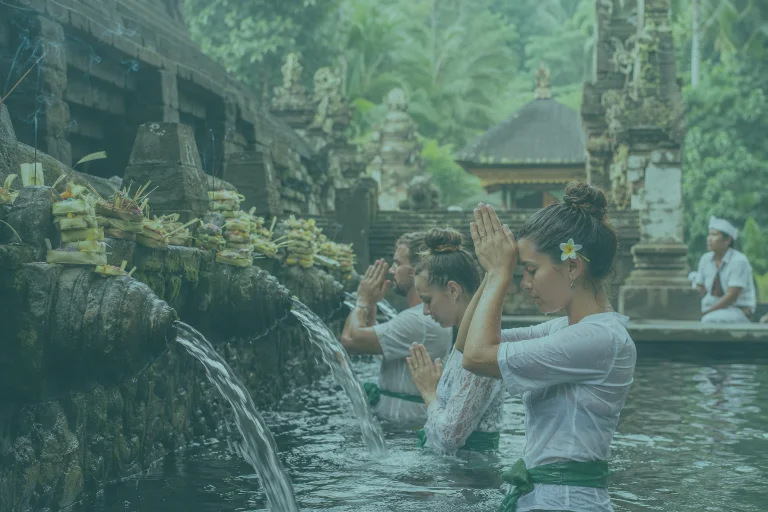
Once per training, the Joga Yoga cohort visits one of Bali’s sacred water temples for a traditional purification ceremony. The Balinese call this melukat, a ritual cleansing practice that uses holy spring water channelled through carved stone spouts. It’s not a tourist experience. The ceremony is conducted in the traditional format, with guidance on the spiritual significance of each stage.
After the temple, students return to the shala for a sauna and cold plunge session. That sequence, intense ceremonial immersion followed by physiological reset, is deliberate. It mirrors the pranayama logic of contraction and release that students are working with in their daily practice.
The melukat tradition is documented by the UNESCO recognition of Balinese cultural practices, which notes that Balinese water rituals carry cosmological significance beyond their physical form. Understanding that context changes what you experience when you’re standing under those spouts.
The opening ceremony
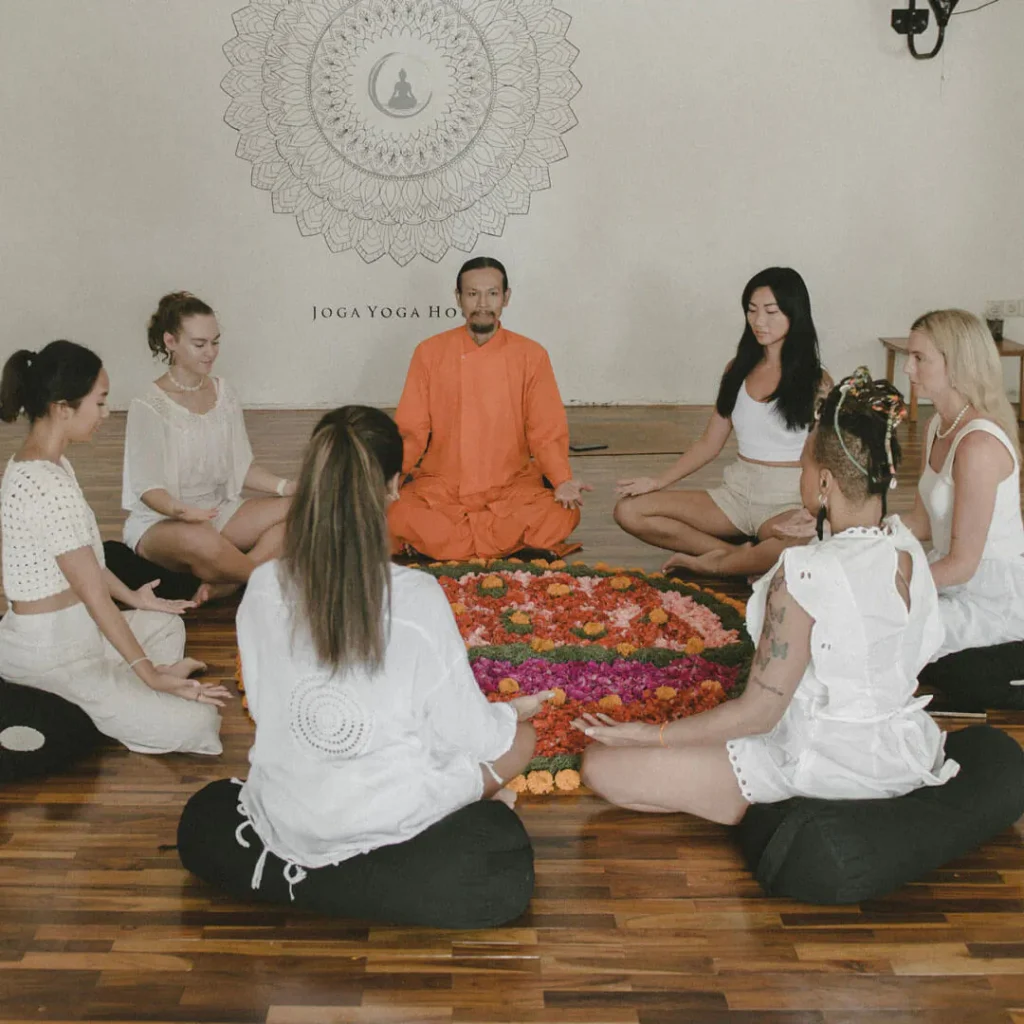
Every Joga Yoga training begins with a Balinese ceremony. Not a welcome speech. Not a group introduction. A ceremony.
This matters for several reasons. In Balinese culture, significant undertakings require formal acknowledgment. A new building gets a ceremony. A harvest gets a ceremony. Beginning something that will change your life gets a ceremony. The opening ceremony at Joga Yoga sets the intention for the training in a way that no whiteboard exercise or group meditation can replicate. Students consistently report that it changed how seriously they took the first week.
It also signals something to the students who came looking for depth: this training knows where it is.
Meditation instruction from a practicing monk
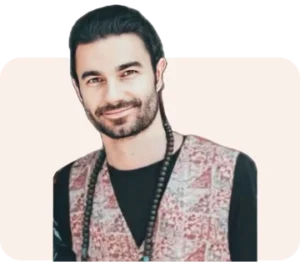
Dada has practiced as a monk for over 20 years. He was introduced to yoga, meditation, and Tantra in 1993, left his corporate career in 1999 to train in India as a sannyasin, and has been based in Bali since. He teaches meditation within the Joga Yoga training.
This matters because most YTT meditation sessions are taught by yoga teachers who also meditate. Learning from someone who has devoted his adult life to the practice is structurally different. Dada’s instruction draws on the Tantric tradition, which understands the body, energy, and consciousness as inseparable, and which has direct roots in both Indian and Balinese spiritual practice. That lineage gives the philosophy content of the training a living anchor rather than a historical footnote.
The yoga philosophy curriculum at Joga Yoga covers the Yoga Sutras, Hatha Yoga Pradipika, Bhagavad Gita, dharma, karma, and ahimsa. Dada’s presence means students encounter a practitioner who has lived by these texts, not just someone who has read them.
Chanting, mantras, and the sonic dimension of the training
The daily schedule at Joga Yoga includes a 30-minute chanting and meditation session at 10:00 AM. The curriculum covers Sutras and mantras from the Indian tradition alongside music practice led by Joe Berridge, the founder, who has spent ten years studying yoga, music, and Chinese medicine.
Chanting is one of the most underestimated tools in yoga training. The Sanskrit mantras used in classical Hatha and Tantric practice carry specific vibrational patterns. Whether or not you hold a metaphysical view of that claim, the physiological effects of sustained mantra repetition, on breath regulation, nervous system state, and concentration, are documented in the research literature. For students who want to teach meditation or sound-based practices, learning these chants in a cultural context that takes them seriously produces better outcomes than learning them off a printed sheet.
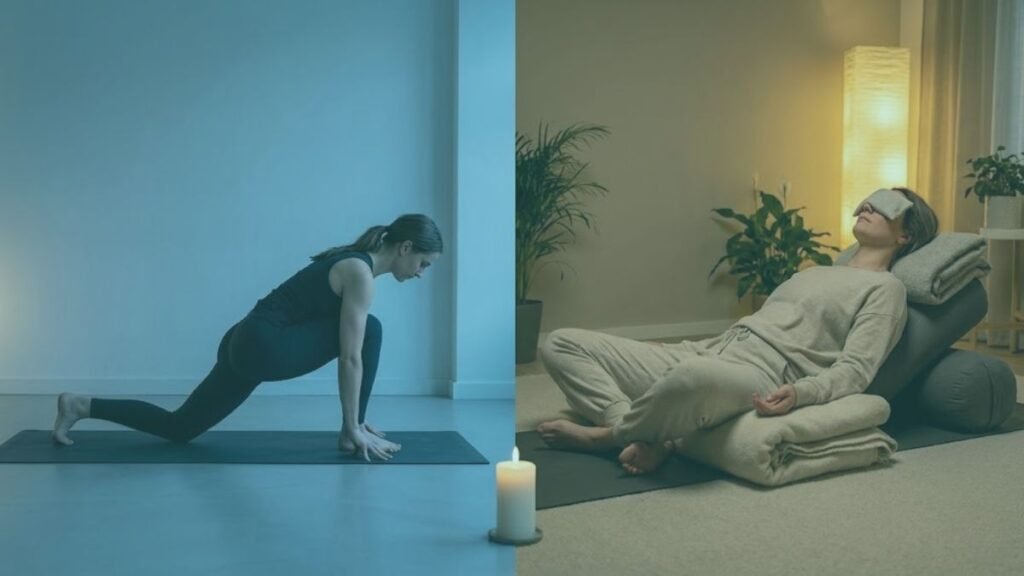
The full daily schedule runs from 6:30 AM with Pranayama and Kriya through to 5:30 PM with candlelight Yin Yoga at sunset. The chanting session sits between the morning practice and the philosophy and anatomy block, which is exactly where it should be: between the physical and the intellectual.
What this means for your teaching after you graduate
Two graduates from the same 200-hour program can produce very different teachers. One spent a month in Bali doing yoga. The other spent a month living inside a culture that has practised ritual, ceremony, and sacred space-holding continuously for centuries.
The second graduate has something specific to offer students: they’ve seen how ceremony functions in real life, not as performance, but as a technology for marking threshold moments. They’ve been led in meditation by a monk. They’ve stood in a water temple and understood, at a body level rather than a conceptual one, what purification actually means. These experiences change what they bring into the room when they teach.
Dakota Mays, a US-based yoga instructor who completed the Joga Yoga training, put it plainly: the program isn’t cookie-cutter, and you’ll push yourself in ways you didn’t expect. Beth James, a paediatric nurse from the UK, described the training as creating “growth on a mental, physical and spiritual level.” Both are describing the same thing: a training that treats the cultural and ceremonial layer as load-bearing, not decorative.
If this is the angle you’re looking for in a training, the full breakdown of what to expect at Joga Yoga and the complete program guide cover the curriculum in detail. The karma and dharma philosophy content taught in the training is also worth reading before you arrive, since that framework underpins how the ceremonies are understood.
Joga Yoga’s Balinese ceremony program at a glance
For reference, here’s what the ceremonial and cultural content includes within the standard 200-hour training:
Sacred Water Temple Excursion: melukat purification ceremony at a traditional Balinese water temple, followed by sauna and cold plunge recovery.
Opening Ceremony: traditional Balinese ceremony at the start of each training cohort.
Daily Chanting and Meditation: 30 minutes each morning, covering Sanskrit mantras, Sutras from the Indian tradition, and meditation instruction from Dada.
Monk-led Meditation: Dada (20+ years monastic practice) teaches meditation as part of the core curriculum.
Cultural Immersion: the shala is located in Canggu, surrounded by active Balinese cultural life, with beach access 5 minutes away and daily proximity to temple offerings, ceremony, and the rhythms of Balinese daily practice.
No other program currently running in Canggu offers this combination as a structured part of their curriculum. You can compare what other Canggu programs include, or go directly to the Joga Yoga 200-hour program page to see the next available dates.
Frequently asked questions
Do I need any prior knowledge of Balinese culture to take part in the ceremonies?
No preparation is needed. The ceremonies are explained and guided before they happen. The intention is experience first, context second, which is how Balinese culture itself transmits these practices. You’ll be told what you’re doing and why at each stage.
Is the water temple ceremony included in the program fee or is it an add-on?
It’s included as part of the weekend activity program, which is part of the training. There’s no separate cost. The same applies to the sauna and cold plunge access at the shala.
What if I don’t have a spiritual practice? Will the ceremonies feel out of place?
Most students who come to Joga Yoga don’t describe themselves as particularly religious. The ceremonies aren’t asking you to adopt a belief system. They’re structured experiences that work at a sensory and somatic level regardless of what you believe. Students with secular backgrounds consistently describe the temple excursion as one of the most significant parts of the training.
Can yoga teacher training in Bali really teach you about Balinese Hinduism?
A four-week training won’t give you a deep understanding of Balinese Hindu practice. What it gives you is direct experience of how ceremonial culture shapes everyday life, and how that connects to the yoga philosophy you’re studying. That experiential link is what most Western yoga trainings are missing entirely.
Is this the only yoga school in Canggu that includes Balinese ceremonies in the YTT curriculum?
Based on what’s publicly documented in school curricula and itineraries, Joga Yoga is the only school in Canggu that includes a melukat temple excursion, a formal Balinese opening ceremony, and monk-led meditation as structural parts of the 200-hour training, not optional extras.