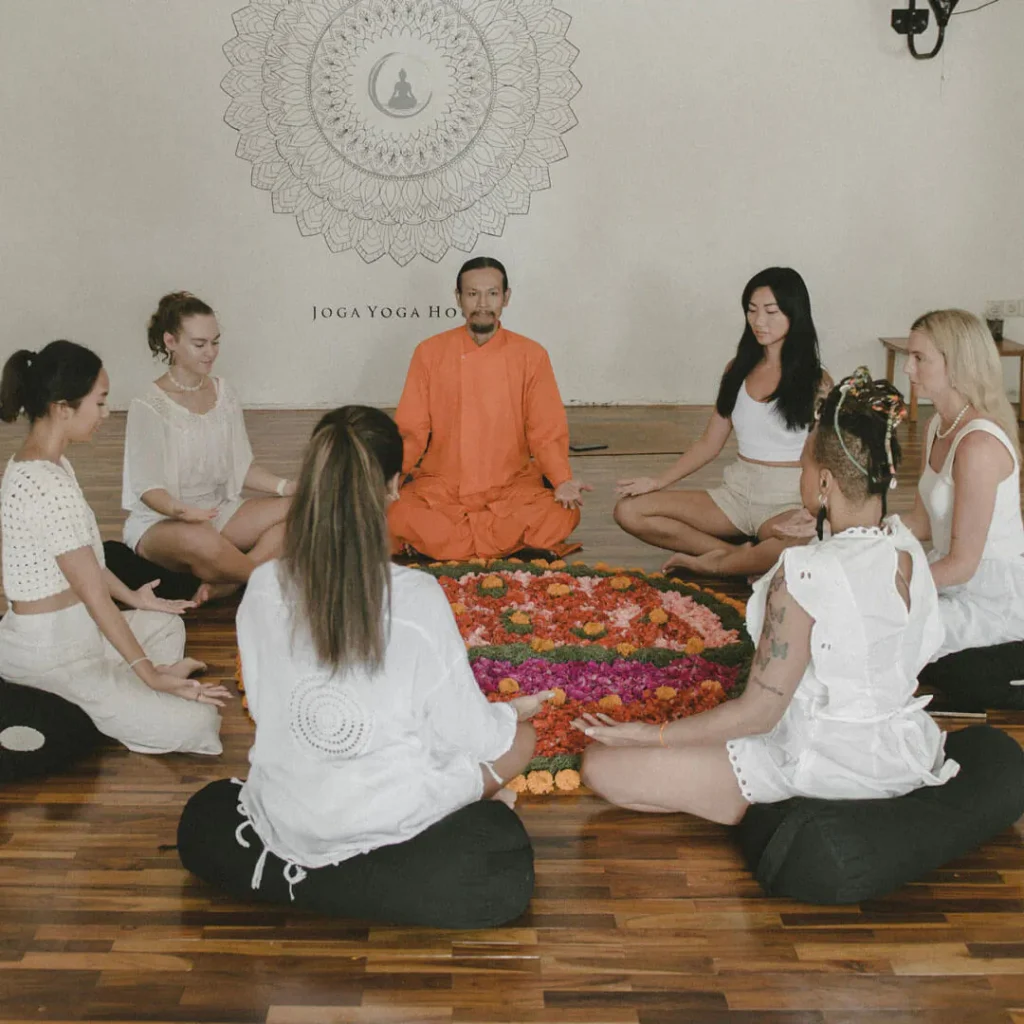




Karma and dharma are two of the most important ideas in yoga philosophy. They help explain why actions matter, how intention shapes experience, and what it means to live in a way that feels honest, steady, and aligned.
In simple terms, karma is action and its consequences. Dharma is the right path, duty, or way of living that fits your nature and values. When these two work together, yoga stops being something you only practice on the mat and starts becoming a way to live with more clarity.
If you are new to yoga philosophy, these words can sound abstract at first. They are not. They become practical the moment you ask simple questions like: What is the right thing to do here? Why am I doing this? What kind of result am I creating through my choices?

What do karma and dharma mean in yoga philosophy?
In yoga philosophy, karma means action and consequence, while dharma means the right path, duty, or way of living. Karma explains what your actions set in motion. Dharma helps you choose actions that are truthful, responsible, and aligned.
The word karma comes from Sanskrit and originally means action. Over time, it became closely tied to the idea that actions carry consequences. Encyclopaedia Britannica explains karma as a principle connecting action with later results across Indian religious traditions.
The word dharma has a wider meaning. Depending on context, it can refer to law, duty, order, truth, ethics, or the teaching itself. In yoga philosophy, dharma is often used to describe the right way to live and the role or responsibility that fits your nature. Britannica’s overview of dharma shows just how broad and important the concept is.
For practical reading, think of it like this: karma is what you do, and dharma is what tells you whether that action is in the right direction.
How are karma and dharma different?
Karma and dharma are connected, but they are not the same thing. Karma is the action you take and the effect it creates. Dharma is the principle, duty, or purpose that should guide that action.
This difference matters because people often use karma as a loose way to mean fate. In yoga philosophy, karma is not random luck and it is not cosmic revenge. It is closer to cause and effect shaped by intention, choice, and behavior.
Dharma is also often oversimplified as “life purpose.” That is partly true, but too narrow. Dharma can also mean doing what is right in a given role, relationship, or stage of life. Sometimes your dharma is not dramatic. It may be telling the truth, caring for your family, teaching responsibly, or doing honest work without ego.
Here is a simple way to separate them:
| Concept | Simple meaning | Main question |
|---|---|---|
| Karma | Action and consequence | What am I creating through this action? |
| Dharma | Right path, duty, or truth | What is the right action here? |
That distinction helps this topic stay grounded. Dharma shapes the quality of karma. Karma reveals the results of how you live.
Why are karma and dharma closely linked in the Bhagavad Gita?
The Bhagavad Gita links karma and dharma by teaching that action is unavoidable, but right action matters deeply. You are meant to act, yet you are also meant to act according to duty, truth, and a steadier inner orientation.
This is one reason the Gita is so central to yoga philosophy. Arjuna is confused about what he should do, and Krishna does not tell him to escape life. He teaches him how to act with understanding.
A key teaching appears in Bhagavad Gita 2.47, which explains that you have a right to action, but not to clinging to the fruits of action. Another important verse, Bhagavad Gita 3.35, says it is better to live your own dharma imperfectly than to perform another person’s path well.
That combination is the heart of the topic. You still have to act. You still have responsibilities. The deeper practice is learning to act from clarity instead of fear, comparison, or attachment.
How does dharma guide karma in daily life?
Dharma guides karma by giving your actions a moral and practical direction. It helps you pause, choose more consciously, and act in a way that matches your values instead of reacting from habit, pressure, or ego.
This is where the philosophy becomes useful in ordinary life. If someone upsets you, karma is the response you choose. Dharma is what helps you decide whether that response should be patient, honest, firm, compassionate, or silent.
You can see this in simple examples:
- A teacher’s dharma is not just to deliver information. It is to guide students responsibly.
- A parent’s dharma is not just to manage tasks. It is to care, protect, and model steadiness.
- A student’s dharma is not just to collect knowledge. It is to learn sincerely and apply it with humility.
When dharma is clear, action becomes cleaner. That does not mean life becomes easy. It means your choices become more coherent.
This idea also sits close to core yogic ethics like the yamas and niyamas, which offer practical guidance on truthfulness, discipline, non-harming, and self-study.
How can you recognize your own dharma?
You recognize your dharma by noticing where responsibility, ability, and inner honesty meet. It is less about chasing a perfect calling and more about seeing what kind of action feels true, useful, and sustainable over time.
A lot of people expect dharma to arrive like a lightning bolt. Usually it does not. It becomes clearer through self-study, repetition, and honest reflection.
Helpful questions include:
- What responsibilities keep showing up in my life?
- What kind of service feels natural to me?
- Where do I feel both challenged and steady?
- What work feels honest, even when it is not glamorous?
- What values do I keep returning to?
Yoga gives you tools for this process. Meditation helps quiet noise. Journaling helps you name patterns. A clear intention practice, or sankalpa, can help you connect values with action.
Dharma can also evolve. What is right for you in one stage of life may not be right in the next. That does not make it unstable. It makes it lived.
What is karma yoga and how does it relate to karma and dharma?
Karma yoga is the practice of acting wholeheartedly without clinging to rewards, praise, or control over outcomes. It connects karma and dharma by turning right action into a conscious practice of service, steadiness, and inner discipline.
This is one of the cleanest ways yoga philosophy brings action into everyday life. Karma yoga does not require a temple, retreat, or dramatic lifestyle shift. It asks you to do the work in front of you with care, then loosen your grip on the result.
That might look like:
- teaching with patience instead of performing for approval
- helping someone without keeping score
- doing necessary work well, even when no one notices
- making a difficult but honest choice because it is right
Karma yoga does not mean becoming passive. It means acting fully while being less ruled by ego and outcome. If you want a deeper foundation for this side of philosophy, Joga’s guide to types of karma in yoga philosophy is a useful companion read.
How can you apply karma and dharma without becoming rigid?
You can apply karma and dharma well by staying honest, flexible, and attentive to context. These ideas are meant to sharpen awareness, not turn life into a performance of being “spiritual” or morally perfect.
This matters because philosophy can become another ego project if you are not careful. People sometimes use “dharma” to justify stubbornness, or “karma” to oversimplify suffering. Neither move is especially wise.
A healthier approach is to use these ideas as reflection tools:
- Before action, ask: Is this honest? Is it necessary? Is it kind?
- During action, ask: Am I acting from service or from image?
- After action, ask: What did this create in me and around me?
That kind of reflection keeps the philosophy alive. It also keeps you from turning every choice into a grand spiritual identity test.
How does Joga Yoga Bali teach karma and dharma in teacher training?
At Joga Yoga Bali, karma and dharma are taught as lived parts of yoga philosophy, not just abstract terms. Students explore how action, intention, ethics, and service shape both personal practice and responsible teaching.
In a strong teacher training, philosophy should connect to real behavior. That means not only learning concepts, but also examining how they show up in teaching, communication, discipline, and care for students.
Joga’s broader yoga philosophy guide supports that foundation, and the training itself is designed to help students connect practice with self-inquiry. The goal is not to sound wise in discussion. The goal is to teach and live with more awareness.
For students considering a deeper immersion, Joga’s Yoga Teacher Training in Bali complete guide gives a fuller picture of the experience, structure, and philosophy-focused learning environment.
What is the real takeaway from karma and dharma in yoga?
The real takeaway is simple: your actions matter, and so does the inner truth guiding them. Karma shows that every choice has weight. Dharma reminds you to choose with awareness, responsibility, and alignment.
That is why this topic still matters. It is not only about ancient philosophy. It is about how you speak, teach, work, love, respond, and serve.
When you act with more awareness, karma becomes less reactive. When you live with more honesty, dharma becomes easier to recognize. That does not make life perfect. It does make your path clearer.
If yoga is meant to be lived, this is one of the places where that living starts.