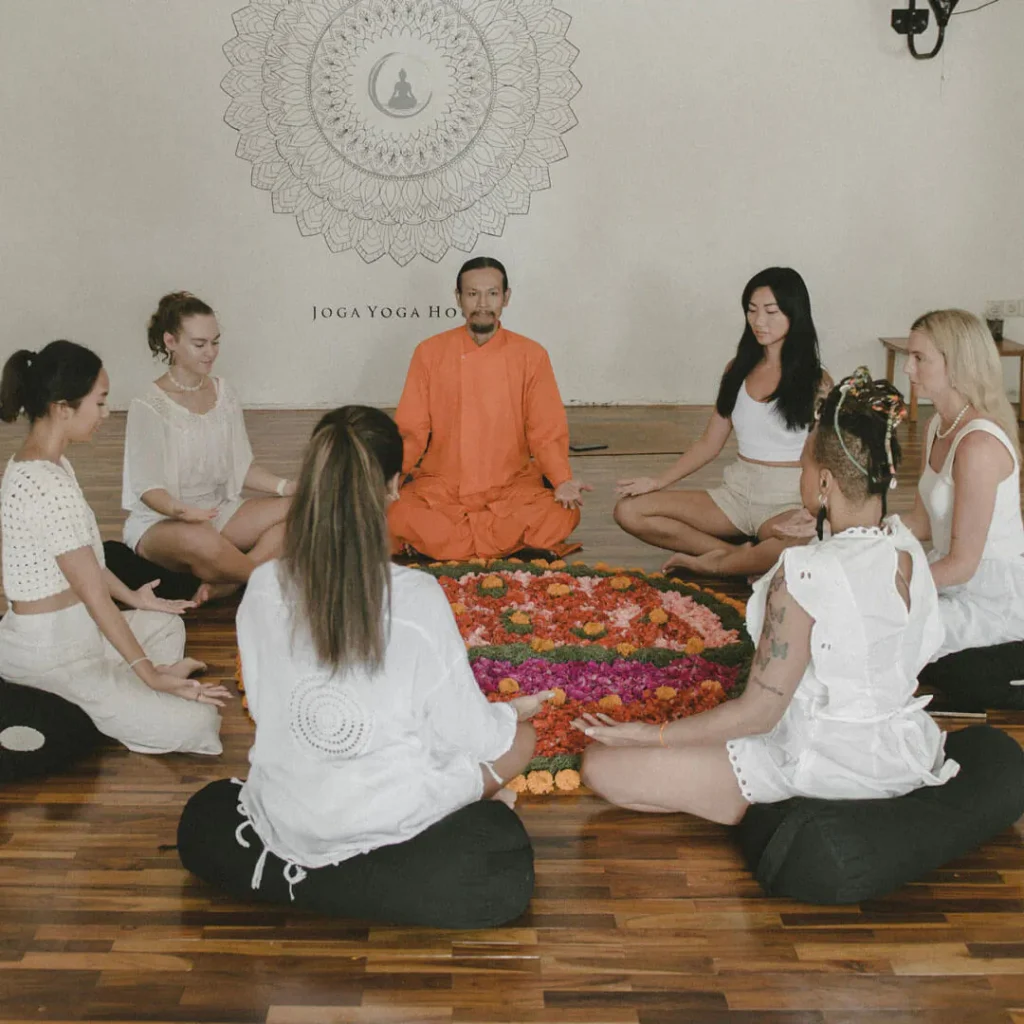



If you are wondering what yoga teacher training in Bali actually feels like, expect a full and immersive experience. Your days are structured, your body gets used, your mind gets challenged, and the personal side of the journey is usually just as important as the certification.
At Joga Yoga Training’s Bali teacher training programs, that experience is shaped by a live-in community setting in Canggu, a Yoga Alliance-registered training path, and a curriculum that combines asana, breathwork, anatomy, teaching practice, meditation, and philosophy. As of May 23, 2026, Joga’s live site shows active 100-hour, 200-hour, and 300-hour trainings scheduled across 2026.
What is yoga teacher training in Bali really like?
Yoga teacher training in Bali is part education, part routine reset, and part personal deep dive. You are not just taking classes. You are living inside a structured learning environment where practice, study, food, rest, and community all shape the outcome.
The first surprise for many students is how different teacher training feels from a normal yoga holiday or retreat. A retreat is designed to help you unwind. Training asks more from you. You practice daily, study concepts you may never have touched before, speak in front of a room, and learn how to teach with clarity instead of just moving well yourself.
That is also why Bali works so well for this kind of experience. The island gives many people enough distance from normal routines that they can focus properly. At Joga, the environment is clearly part of the pitch: the school positions itself as a health-conscious yoga and meditation community in Canggu, with nature around the shala and a more connected lifestyle than most people have at home.
What does a typical day at yoga teacher training look like?
A typical day in Bali teacher training includes morning practice, theory classes, meals, breaks, and teaching work. You should expect your whole day to revolve around yoga, even when you are not on the mat.
The exact timetable changes by school, but the rhythm is usually consistent. Mornings often begin with movement, breathwork, or meditation. Later blocks tend to cover anatomy, alignment, philosophy, methodology, sequencing, or practicum. Evenings may include restorative practice, reflection, chanting, or group discussion.
What matters most is not the exact hour-by-hour schedule but the fact that your energy is spoken for. You are learning through repetition. That means practicing when you feel strong, listening when you feel tired, and showing up even when your comfort zone would rather stay quiet.
Joga’s current training pages make that intensity clear in a practical way. The live site shows:
- 100-hour training as a 12-night format
- 200-hour training as a 22-night format
- 300-hour training as a 29-night format
That structure gives you a good reality check. This is not a loose wellness week. It is a focused block of time where yoga becomes your main job.
What will you actually learn during yoga teacher training?
You should expect to learn much more than poses. A solid Bali YTT covers physical practice, teaching skills, anatomy, breathwork, meditation, philosophy, and the ability to guide other people safely and clearly.
According to Yoga Alliance’s RYS 200 overview and credentialing guidance, foundational 200-hour trainings are built around techniques, anatomy and physiology, yoga humanities, and professional essentials. That matters because it sets the baseline for what a real teacher training should cover.
Joga’s current 200-hour page mirrors that broad structure closely. The live page lists:
- asana fundamentals
- pranayama
- kriyas
- chanting and music
- meditation with a monk
- teaching methodology
- anatomy and physiology
- yoga philosophy, lifestyle, and ethics
- practicum
That last part, practicum, is one of the biggest shifts for students. You stop being only the receiver of instruction and become the one who has to observe, cue, sequence, adjust, and speak clearly. That is usually where confidence gets built.
Joga also frames its training around a mixed teaching team rather than one single lead voice. The current 200-hour page names Joseph, Nitish, Dr Ningrum, Dada, Dr Sharma, Lena, Gus Wira, Marion, and Vita, which suggests students are exposed to different styles and specialties during the course.
Do you need to be advanced before you arrive?
No, you do not need to be the strongest person in class before you start. What you need most is consistency, openness to feedback, and enough physical and mental readiness to handle an intensive learning environment.
This is where many people talk themselves out of training too early. They assume everyone else will be more flexible, more spiritual, more experienced, or more confident. Usually that is not true. Most groups include a mix of future teachers and students who are also there for self-development.
Joga’s live site supports that beginner-friendly angle. Its 100-hour training page describes the course as ideal for beginners or people who want a more flexible time commitment. The school also states that about 50 percent of its students do YTT for self-development, not only to teach.
A better question than “am I advanced enough?” is “am I ready to learn in public?” Training asks you to be corrected, seen, and stretched. That matters more than touching your head to your shin.
What is it like to live in Bali during your training?
Living in Bali during YTT usually feels simple, social, and focused. Your world gets smaller in a good way: practice, meals, rest, classmates, nearby cafes, and enough free time to catch your breath without losing your momentum.
At Joga, the setting is Canggu, which gives the experience a more beach-and-community feel than a remote retreat center. On the live homepage, the school describes its location as just five minutes from the beach, with a spacious studio, lush gardens, Wi-Fi, purified water, and a vegan cafe nearby in the overall campus feel.
That day-to-day environment matters more than people expect. The right room setup, food rhythm, and amount of quiet can affect how well you recover. If you already know that sleep, privacy, or nervous-system regulation matters a lot to you, Joga’s current accommodation page lays out the room options clearly, from non-accommodation to dorm, twin share, standard private, and private villa room.
The same page also makes a useful point that many people learn the hard way: private rooms are often the better fit for light sleepers, older students, or anyone doing deeper personal work during the training.
What is included, and what should you still budget for?
You should expect tuition and core training materials to be included, but the real value often sits in the extras. Food, airport pickup, accommodation length, recovery options, and cultural activities can change the feel of the whole experience.
As of the current live Joga pages, the 200-hour pricing shown on the site runs from:
- IDR 33 million or €1,650 for non-accommodation
- IDR 36 million or €1,799 for a dorm room
- IDR 40 million or €1,999 for twin share
- IDR 52 million or €2,599 for a standard private room
- IDR 56 million or €2,799 for a private villa room
The same live accommodation page says the 200-hour package includes:
- 22 nights accommodation when selected
- vegetarian or vegan breakfast and lunch
- Yoga Alliance certification
- books and resources
- airport pickup
- online student portal access
- traditional massage or spa
- Bali excursion to the sacred water temple
- sauna and cold plunge for recovery
- community extras such as bonfire and kirtan music
That is a solid inclusion list, but you should still budget for dinners, flights, insurance, personal spending, scooter or transport costs, and any visa-related costs if they apply to your stay. If you are traveling internationally, the official Indonesia eVisa site says travelers must submit an arrival card within three days before arrival, and Bali’s official Love Bali portal states foreign visitors are subject to the Bali tourist levy.
How intense is yoga teacher training emotionally and physically?
Yoga teacher training is usually more intense than people expect, not because it is harsh, but because it keeps asking for your attention. You are training your body, your voice, your habits, and your self-awareness all at once.
Physically, the challenge is not only the number of classes. It is the repetition. You practice, then observe, then practice again with more detail. Hips, shoulders, energy, sleep, and digestion all tend to become more noticeable because your body has less room to hide from your routine.
Emotionally, the intensity often comes from being in a group while learning something personal. You may feel inspired one day and doubtful the next. You may bond quickly with classmates, then suddenly want more quiet. All of that is normal.
This is also why preparing properly matters. Joga already has a useful related guide on how to prepare for your upcoming yoga teacher training in Bali, and it is worth reading before you book or fly.
What happens after you graduate?
After graduation, you should expect more clarity, more practical skill, and usually a more honest sense of what teaching involves. You may leave ready to teach right away, or you may leave knowing you want more practice first.
Both outcomes are valid. A good training does not only hand you a certificate. It shows you where your strengths are and where you still need repetition. For some people, that means teaching classes within weeks. For others, it means deepening their own practice before stepping into a teaching role.
Joga’s current site says graduates receive an internationally recognized Yoga Alliance certification, and the school also notes that it offers students teaching practice at the studio after graduation to help them gain experience. That kind of bridge between course completion and real teaching is worth paying attention to.
If you are choosing between tracks, the simplest version is this:
- 100-hour training is the lighter entry point
- 200-hour training is the foundational teaching qualification most people start with
- 300-hour training is for teachers who want a more advanced step after that
Is yoga teacher training in Bali worth it?
Yoga teacher training in Bali is worth it when you want more than a beautiful setting. The best outcomes come when you are ready for structure, honest feedback, daily practice, and a course that changes how you understand yoga from the inside.
If you want the version with fewer surprises, look at the practical details first. Read the schedule. Read the room options. Check what meals are included. Ask how much practicum is built in. Ask who is teaching anatomy and philosophy. Ask yourself whether you want a soft retreat feeling or a real learning container.