Related Articles
Yoga in Canggu

Yoga in Canggu: Daily Life, Classes & Teacher Trainings

Canggu blends surf, spirituality, and serious yoga. This guide explores the local yoga scene, the best places to train or....
Types of Yoga Explained

14 Types of Yoga Explained: Find the Right Style for Your Mind and Body

Not all yoga is the same. Whether you're looking for strength, flexibility, stress relief, or spiritual growth, this guide helps....
what to expect at yoga teacher training in bali

What to Expect at Yoga Teacher Training in Bali

Thinking about yoga teacher training in Bali? This guide breaks down what the experience is actually like, from daily routine....
tcm vs ayurveda

TCM vs. Ayurveda: Why Chinese Yogis Master Yoga Philosophy Faster

Table of Contents

Many students from China arrive at our Yoga Teacher Training in Bali with a hidden fear: they worry that learning Ayurveda (Ancient Indian Medicine) and Yoga Philosophy will be too difficult because the culture feels “foreign.”

They worry about memorizing Sanskrit terms or understanding complex Indian concepts.

But here is the secret: If you grew up with Traditional Chinese Medicine (TCM) concepts, like Qi, Yin-Yang, or Meridians, you aren’t starting from zero. You are actually starting with a massive head start.

You already possess the map; you just need to learn the new names for the territories. This guide explains why Chinese yoga practitioners often become some of the most intuitive and skilled yoga teachers in our program.

Two Paths, One Mountain: The Shared Roots of Healing

TCM and Ayurveda are often called “Sister Sciences.” Though they developed on different sides of the Himalayas, they share the exact same goal: Harmony.

Unlike Western medicine, which often treats symptoms in isolation (like a mechanic fixing a broken part), both TCM and Ayurveda view the human body as a microcosm of nature.

  • TCM seeks balance between Yin and Yang.
  • Ayurveda seeks balance between the Doshas (Vata, Pitta, Kapha).
  • Both rely on the flow of vital energy to maintain health.

When you study our Yoga Philosophy curriculum, you will find that you aren’t learning “new” ideas. You are simply seeing your own cultural wisdom reflected in a new mirror.

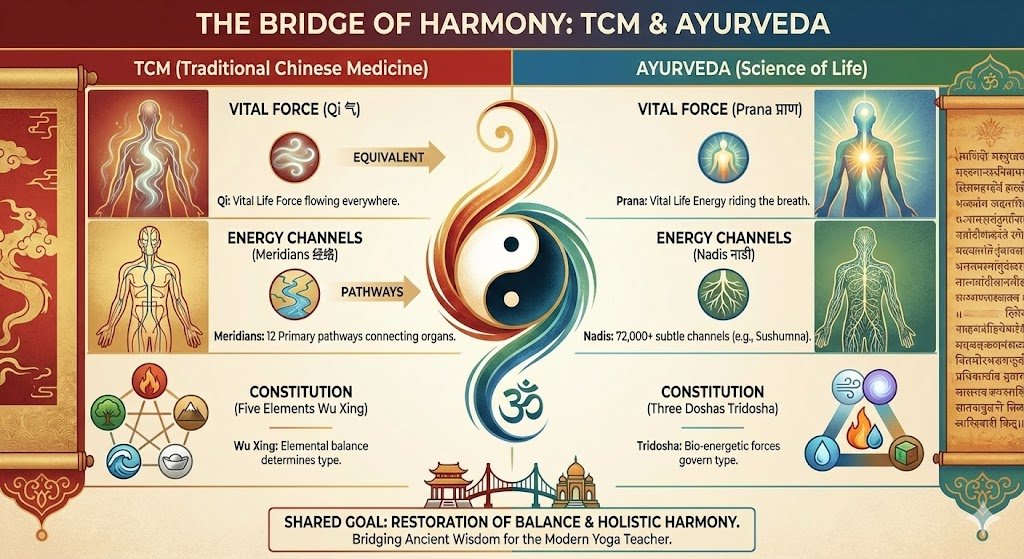
Prana is Just Qi: Decoding the Energy

The most fundamental concept in Yoga is Prana. In the West, students often struggle to grasp this because there is no English word for it. They translate it simply as “breath,” which is incomplete.

For you, however, the translation is instant. Prana is Qi (气).

Just as TCM teaches that Qi flows through the body to animate our organs and tissues, Yoga teaches that Prana rides on the breath to nourish our physical and subtle bodies.

  • In TCM: If Qi is blocked, pain (stagnation) occurs.
  • In Yoga: If Prana is blocked by “Granthis” (knots), disease arises.

During our training, when we teach the Five Vayus (Winds of Prana), you will intuitively understand how energy moves upward (Udana) or downward (Apana), because it mirrors the movement of Qi you may already know from Qigong or Tai Chi practice.

The Map of the Body: Meridians vs. Nadis

If Prana (Qi) is the electricity, it needs wires to travel through.

  • TCM Map: You have 12 Primary Meridians that connect the organs.
  • Ayurveda Map: You have 72,000 Nadis (energy rivers).

While the numbers differ, the logic is identical. In Yoga, the most important channel is the Sushumna Nadi, which runs straight up the spine. This is almost identical to the Chong Mai (Penetrating Vessel) in TCM, which connects the “Sea of Blood” and governs deep vitality.

When we practice Pranayama techniques like Nadi Shodhana (Alternate Nostril Breathing), we are literally doing “acupuncture without needles.” We are using breath to purify these channels, ensuring the smooth flow of energy just as an acupuncturist would.

Because you already respect the existence of these invisible channels, you will master the energetic effects of yoga poses much faster than students who only see the physical muscles and bones.

Five Elements vs. Three Doshas: Understanding Body Types

Both systems recognize that no two bodies are the same. A diet that heals one person might harm another. This is where your knowledge of the Five Elements (Wu Xing) becomes a superpower for understanding the Ayurvedic Doshas.

In TCM, you categorize people by their dominant element (Wood, Fire, Earth, Metal, Water). In Ayurveda, we categorize them by their “Dosha” (Vata, Pitta, Kapha).

The Translation Key:

  • If you know “Yang/Fire”: You will instantly understand Pitta Dosha.
    • Characteristics: Hot, sharp, ambitious, prone to inflammation (or “excess heat”).
    • Advice: Just as you wouldn’t give spicy food to a “Fire” type in TCM, you avoid hot foods for a Pitta student in Ayurveda.
  • If you know “Yin/Dampness”: You will instantly understand Kapha Dosha.
    • Characteristics: Heavy, stable, slow, prone to lethargy (or “stagnation”).
    • Advice: They need stimulation and movement to break the stagnation.
  • If you know “Wind”: You will instantly understand Vata Dosha.
    • Characteristics: Dry, mobile, cold, anxious (or “internal wind”).
    • Advice: They need grounding and warmth.

During our training, we don’t just teach you the theory; we teach you how to apply it. You will learn to look at a student and see their constitution immediately. You can even take our Free Dosha Quiz now to see which archetype fits you best.

We also explore how these body types react to food. For example, our Ayurvedic Weight Loss Guide uses principles that will feel very familiar to anyone who understands TCM dietary therapy, eating with the seasons and balancing flavors.
traditional Chinese medicine and ayurveda

Why This Makes You a Better Yoga Teacher

The world is full of yoga teachers who simply repeat Sanskrit words they memorized from a textbook. You have the opportunity to be different.

Because you possess a “dual map” of the body (East Asian and South Asian), you can explain abstract concepts in ways that others cannot.

  • When a student asks about “Nadis,” you can explain them using the logic of Meridians.
  • When a student struggles with “Agni” (digestive fire), you can explain it through the lens of “Qi” and organ function.

At Joga Yoga, we encourage this integration. We believe that your background in Chinese culture is not an obstacle to learning Yoga, it is your greatest asset. You are uniquely positioned to bridge the gap between these two ancient wisdom traditions.

Learn Ayurveda in Our Bali YTT

joga yoga teacher training bali

Are you ready to translate your TCM knowledge into a global yoga certification?

Our 200-Hour Yoga Teacher Training includes a comprehensive Ayurveda module designed specifically for modern teachers. We strip away the confusion and focus on the practical connections that help you heal yourself and your future students.

Don’t leave your culture at the door. Bring it with you to the mat.
View the Syllabus & Upcoming Dates for 200-Hour YTT

About Author

Picture of Joseph Berridge<br><span style="font-size:16px">Founder of Joga Yoga / Lead Yoga Teacher</span>

Joseph Berridge
Founder of Joga Yoga / Lead Yoga Teacher

Joe has devoted the last ten years studying yoga, Chinese medicine and music, discovering that yoga can help to realize true happiness, patience, inner peace and harmony, and strength in day-to-day life. Joe then traveled to India and Bali to study yoga in more depth and has now made Bali his home. Exploring the art and science of yoga has given him enthusiasm for sharing the knowledge and physical practice. He founded Joga Yoga, a health conscious yoga and wellness studio in Bali and Children’s Garden Kindercare. He also works with local schools to support children’s and teachers in need.

Explore Our Yoga Teacher Training

Our training focuses on deepening one’s understanding of yoga philosophy, asanas (postures), pranayama (breathing techniques), meditation, and teaching methodologies. It aims to empower aspiring yoga teachers to guide others on their journey towards physical, mental, and spiritual well-being.

Robert
Typically replies in few minutes

09.45

Namaste and welcome to Joga Yoga 🙏
Looking for answers about yoga training or Bali? I’m here to help—just drop me a message!

Or Fill out the form below

Chloe

Chloe is a dedicated personal trainer and certified yoga teacher currently based in Bali, Indonesia. With a BSc in Medical Sciences and a Level 3 Personal Training certification, Chloe brings a strong foundation in both science and movement to her practice. As a 200hrs certified yoga teacher, she blends structured fitness training with the mindful discipline of yoga, guiding clients toward better strength, flexibility, and overall wellness. Passionate about all things fitness, wellness, and yoga, Chloe creates personalized approaches that help her clients build sustainable, healthy habits for life.

Joga Yoga Training

30% OFF

Limited Spots Available

IDR 47 Mio

IDR 33 Mio

€2,350

€1,650

Apply now to be eligible:

Fi

Fi is an Indonesian who currently call Bali as a home. She sees yoga as much more than movement. It’s a pathway home to oneself. In her classes, she guides students to reconnect with their breath, body, and spirit while gently helping them find proper alignment and a graceful flow. She embraces the grounding stillness of Yin and the invigorating fire of Yang, believing that both are essential for true harmony. Through this balance, she aims to support others in cultivating a centered mind and a deeply nourished body.

Marion

After years of working on superyachts, Marion found her grounding in Bali, where her journey into yoga deepened. She has studied yoga both in Bali and India, with a focus on strengthening the connection between mind, body, and spirit. Yoga became her anchor in a fast-paced world, and now she’s passionate about creating a space for others to slow down, tune inwards, and reconnect. Marion’s classes are gentle, grounding, and guided by a deep sense of calm and connection.

Briggita

Brigitta is an Indonesian creative and mindfulness enthusiast who believes in the power of writing as a tool for self-reflection and personal growth. Through her journaling sessions, she creates a gentle and safe space for participants to slow down, connect with themselves, and explore their thoughts and emotions through writing. Her approach encourages curiosity, honesty, and self-discovery, allowing each person to explore their own journey through the simple practice of putting thoughts into words.

Ricky Gunawan

Ricky Gunawan (RYT-200), Indonesian, has practiced yoga since 2014 and completed his teacher training at Joga Yoga (Bali). His teaching focuses on understanding the mechanics of movement through strength, mobility, and anatomy-informed cueing to help students move with greater clarity, control, and confidence.

Nitish

My name is Nitish, and I am a dedicated yoga teacher from the Himalayas in India. With a primary focus on Yoga Anatomy, Hatha, Vinyasa, and precise alignments, I have been passionately teaching for the past seven years. I hold a Bachelor’s degree in Yoga Therapy from S-VYASA University in Bangalore and a Master’s degree in Yoga Therapy from JRRSU University in Rajasthan. Additionally, I am a certified yoga instructor with over 1000 hours of training. My experience encompasses teaching practitioners of all levels, helping them navigate their unique yoga journeys with expertise and care.

Lena

Lena is an incredible and dynamic yoga and advanced stretching teacher. Her background is in competition gymnastics and yoga so she has a profound understanding of the human body. In present – stretching, yoga and fitness instructor, preferring to combine styles and make functional healthy trainings aimed to improve flexibility, mobility, body control, healthy breathing and awareness, as well as recovery after activities.

Dr Sharma

Dr. Sharma is an experienced Ayurveda Practitioner, Naturopath, and Yoga Teacher based in Bali, Indonesia, dedicated to helping individuals achieve holistic well-being through ancient healing practices. With a background in Ayurveda, naturopathy, yoga, and Traditional Chinese Medicine, Dr. Sharma offers personalized wellness plans, therapeutic yoga, natural detox programs, and Ayurvedic spa therapies. With over a decade of experience, including leadership roles in wellness centers and international workshops, he combines modern therapeutic approaches with timeless healing traditions to guide clients on their journey to better health, balance, and inner peace.

Dada

Dada has been a practising monk for over 20 years. He was searching for spiritual answers since childhood and finally introduced to holistic practices of yoga pose, meditation, and Tantra and Rajadhiraja Yoga in 1993. In 1999, after several years working in the corporate world, Dada’s strong vision for spirituality led him to a major turning point in his life when he decided to leave his job and immerse himself fully in a devoted path of yoga. He went on to pursue training in India as a sannyasin, senior yoga monk.

Gus Wira

Gus Wira got to know Yoga from his father who was practicing Yoga everyday at home to get well. Gus got interested in Yoga only when he grew older, especially as he found out for himself that Yoga can address various sicknesses and helps to control mind and emotions.

Besides having completed his Yoga teacher training, Gus Wira is also trained in acupuncture and acupressure. His unique way of teaching includes physical postures, body movement and breathing techniques (pranayama) with a strong focus on energy work. Gus sees Yoga as form of therapy and healing for body, heart and mind.

Joseph

Joe has devoted the last ten years studying yoga and music, discovering that yoga can help to realize true happiness, inner peace, and strength in day-to-day life. He studied music and Chinese medicine while balancing this with yoga practice to maintain a clear mind and reduce stress. He then traveled to India and Bali to study yoga and has now made Bali his home. Exploring the art and science of yoga has given him enthusiasm for sharing the knowledge and physical practice to benefit all of us.

Mirah

Mirah is a Balinese local who grew up surrounded by the island’s beauty and traditions. Her love for yoga deepened when she completed her 200-hour Teacher Training, inspiring her to share the practice with her community. For Mirah, yoga is more than poses—it’s about awareness, connection, and joy, both on and off the mat. With a balance of strength and softness, she guides her students to find harmony within themselves and with the world around them.