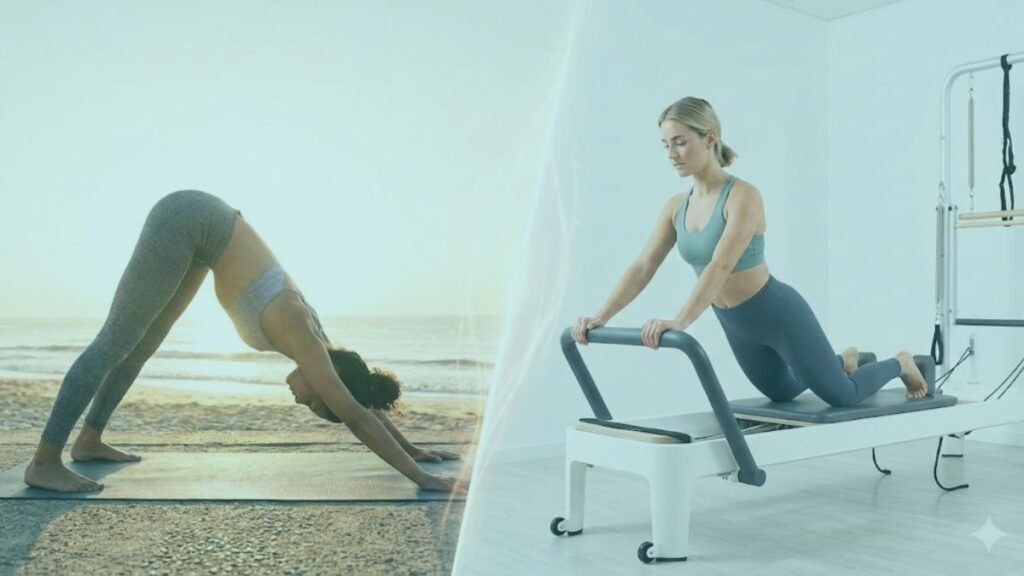

Scroll through TikTok or Instagram right now and you will see the “Pilates Body” aesthetic everywhere. It promises sculpted abs, a snatched waist, and long, lean muscles. It is trendy, it is popular, and it looks effective.
But does pulsing on a reformer actually change your body faster than holding a Warrior II?
The answer depends entirely on what you mean by “change.”
If you are looking for a quick core fix, Pilates is powerful. But if you are looking for a complete body transformation that builds functional strength, creates deep flexibility, and lowers the stress hormones that cause belly fat, Yoga offers a different path.
This guide breaks down the battle between the mat and the machine so you can stop guessing and start moving.
The Physical Results: “Sculpting” vs. “Lengthening”
The biggest confusion comes from the fact that both practices happen on a mat and involve slow movement. However, they change your anatomy in very different ways.
Pilates: The Specialist (Isolation)
Pilates is often described as working from the “inside out.” It focuses heavily on the “Powerhouse”…your core, glutes, and lower back.
- The Look: Pilates tends to create a “corset” effect. By doing high repetitions of small, isolated movements (micro-movements), you fatigue specific muscle groups until they tone up.
- The Limitation: It is often linear. You mostly move forward and backward. It creates great stability, but it often lacks the dynamic, full-range motion needed for total athleticism.
Yoga: The Generalist (Integration)
Yoga is functional movement. It doesn’t just isolate one muscle; it forces your entire body to work as a single unit.
- The Look: Yoga builds long, lean density. When you hold a Plank or Chaturanga, you are lifting your own body weight. This builds upper body and arm strength that mat Pilates often misses.
- The Cardio Factor: While Pilates is usually low-impact, styles like Vinyasa Flow keep your heart rate up. You are moving through a continuous sequence, which burns calories and improves cardiovascular health while you build muscle.
- The Range: Yoga moves the spine and joints in every direction..twisting, inverting, and backbending. This is why yogis often maintain their mobility much later in life than those who only do linear exercises.
The “Burn” Factor: Which Burns More Calories?
If your main goal is weight loss, you are likely looking for the most efficient way to create a calorie deficit. This is where the intensity of the class matters more than the name on the schedule.
The Pilates Burn
Standard mat Pilates is a low-impact strength workout. While it burns deeply in the muscles (that famous “Pilates shake”), it doesn’t always spike the heart rate for long periods.
- Average Burn: Expect to burn between 175 and 250 calories per hour.
- The Focus: It builds muscle mass, which eventually increases your resting metabolic rate, but the immediate caloric expenditure is moderate.
The Yoga Burn
Many people mistakenly think yoga is just sitting and breathing. If you step into a Power Vinyasa or Ashtanga class, you will quickly realize this is a myth.
- Average Burn: A dynamic Vinyasa class typically burns 300 to 500 calories per hour.
- The Heat Factor: If you practice in a heated room, your body works harder to regulate its temperature. Our data shows that Hot Yoga sessions can burn significantly more calories than traditional workouts because the heat increases your heart rate even during rest.
The Verdict: If you want to sweat and burn maximum calories in 60 minutes, dynamic Yoga wins.
The Mental Shift: Nervous System vs. Muscle Control
The most profound difference between the two practices isn’t what happens to your abs. It is what happens to your brain.
Pilates: The Practice of Control
Pilates was originally called “Contrology.” It requires intense mental focus to isolate specific muscles. You are constantly thinking about your ribs, your pelvis, and your breathing. It is a form of mental “work.” You are training your mind to dominate your body.
Yoga: The Practice of Surrender
Yoga is designed to do the opposite. While it requires focus, the ultimate goal is Chitta Vritti Nirodha…quieting the fluctuations of the mind.
- Nervous System Reset: Yoga focuses on shifting you from the Sympathetic state (Fight or Flight) to the Parasympathetic state (Rest and Digest). This is crucial for reducing cortisol, the stress hormone that causes the body to hold onto belly fat.
- Emotional Release: Because yoga targets the fascia and deep hips where trauma is often stored, it offers a mental release that Pilates does not. It is not just exercise; it is a tool for managing anxiety and depression.
What Is Asian Pilates?
Asian Pilates is a modern fitness trend that combines classical Pilates exercises with slow, mindful movement inspired by practices like Tai Chi and Qigong. It is popular on social media because it looks calm, controlled, and graceful while still focusing on core strength and posture.
Asian Pilates is not an ancient system and not an official Pilates method. It is a contemporary fusion style created by modern instructors.
Why Asian Pilates Is Trending?
Asian Pilates is gaining attention for several clear reasons:
-
People want gentler workouts that reduce stress
-
Social media favors slow, elegant movement styles
-
Many are drawn to Eastern-inspired breathing and flow
-
Pilates studios are offering softer, less intense formats
Because of this, Asian Pilates is often described as a calmer alternative to high-intensity fitness classes.
What Makes Asian Pilates Different From Traditional Pilates
Asian Pilates still uses Pilates-based movements, especially for the core, alignment, and posture. The difference is how the movements are performed.
Asian Pilates usually includes:
-
Slower movement speed
-
Smooth transitions between exercises
-
More focus on breathing rhythm
-
Standing or flowing sequences instead of only floor work
Traditional Pilates is more structured and technical. Asian Pilates feels more fluid and relaxed, even though the foundation remains Pilates.
The Influence of Tai Chi and Mindful Movement
Asian Pilates often borrows ideas from Tai Chi, such as balance, controlled weight shifts, and continuous motion. Tai Chi itself is a traditional Chinese practice focused on slow movement, stability, and body awareness.
Asian Pilates does not include Tai Chi philosophy, martial training, or energy systems. It only adopts the movement quality, not the full practice.
For a deeper understanding of how Tai Chi and Yoga differ in purpose and structure, see a full comparison of yoga vs tai chi.
Asian Pilates vs Yoga: Key Differences
Asian Pilates and Yoga may look similar in videos, but they serve different goals.
Asian Pilates focuses on:
-
Muscle control and toning
-
Core strength and posture
-
Slow, controlled movement
Yoga focuses on:
-
Full-body strength and flexibility
-
Breath regulation
-
Nervous system balance and stress reduction
Yoga also moves the body in more directions, including twists, backbends, and inversions, while Pilates styles tend to be more linear.
Is Asian Pilates Better Than Yoga or Pilates
Asian Pilates is not better or worse. It is simply a style preference.
Asian Pilates may suit people who want:
-
Gentle toning
-
Calm studio classes
-
Pilates with a softer feel
Yoga may suit people who want:
-
Long-term mobility and joint health
-
Stress reduction and mental clarity
-
A complete mind-body practice
Cost & Accessibility: The Reformer Barrier
One of the biggest differences between the two disciplines is the barrier to entry. This matters not just for your wallet, but for your ability to maintain the habit for a lifetime.
The Pilates Price Tag
Mat Pilates is accessible, but the “Pilates Body” results people chase often come from the Reformer machines. These machines are expensive and large, meaning you are almost always tied to a studio.
- The Cost: Reformer classes are among the most expensive fitness classes on the market, often costing $30 to $50 per session.
- The Dependency: If you travel or cannot get to the studio, your practice stops. You become dependent on the equipment to feel good.
The Yoga Freedom
Yoga is democratic. It requires nothing but two meters of floor space.
- The Accessibility: Once you learn the sequences, whether through a class or a teacher training, you own that knowledge forever. You can practice in a hotel room in Paris, on a beach in Bali, or in your living room.
- The Career Advantage: This is why many fitness enthusiasts choose to teach yoga. You do not need to buy $50,000 worth of equipment to start your business. You just need your knowledge and your voice.
The Longevity Test: Who Is Moving Better at 80?
When we are young, we exercise for aesthetics. As we age, we exercise for function. We want to be able to tie our shoes, reach the top shelf, and play with our grandchildren without pain.
Pilates for Rehabilitation
Pilates is exceptional for rehabilitation. If you are recovering from an injury or need to stabilize a weak spine, the linear, controlled movements are safe and effective. It builds a strong protective structure around the injury.
Yoga for Mobility
Yoga focuses on maintaining your full range of motion. Unlike Pilates, which often moves the body in straight lines (forward and backward), yoga moves the spine and joints in every possible direction. You twist, you side-bend, you invert, and you extend.
- Joint Health: This 360-degree movement pumps synovial fluid into the joints, keeping them lubricated.
- The Result: Look at a lifelong yoga practitioner in their 70s or 80s. They often move with a fluidity and grace that weightlifters or strict pilates practitioners lose over time. Yoga keeps the body “soft” enough to be resilient.
Don’t Just Practice. Master the Movement.
The debate between Yoga and Pilates ultimately comes down to your personal goals. If you want specific muscle isolation and rehabilitation, Pilates is a powerful tool. But if you want a practice that builds functional strength, creates deep flexibility, and heals your nervous system simultaneously, Yoga offers a complete transformation.
Why choose one when you can understand the science behind both?
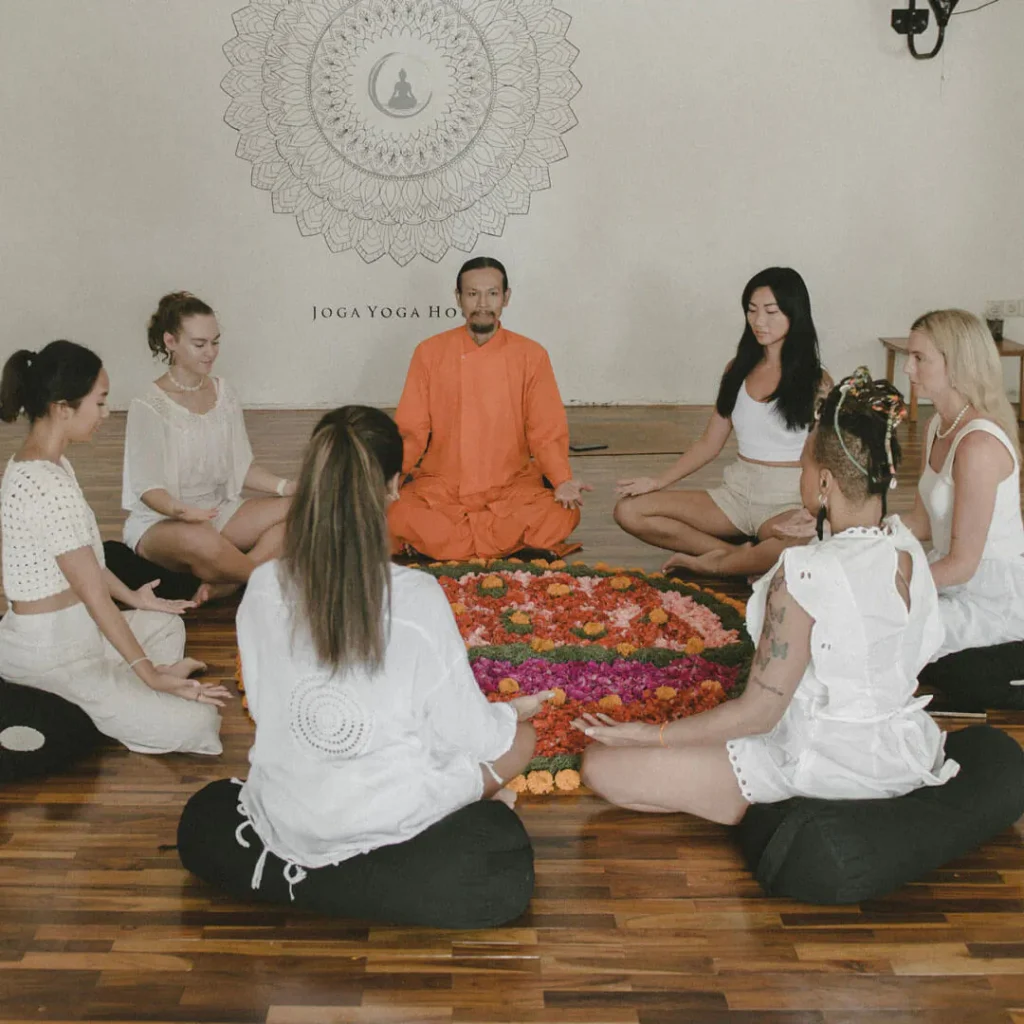
At Joga Yoga, we don’t just teach you how to perform a pose; we teach you the functional anatomy that explains why it works. We train you to see the body as a connected system, giving you the skills to sculpt not just bodies, but lives.
Transform your body—and your career—in paradise.
View 200-Hour Yoga Teacher Training Bali