

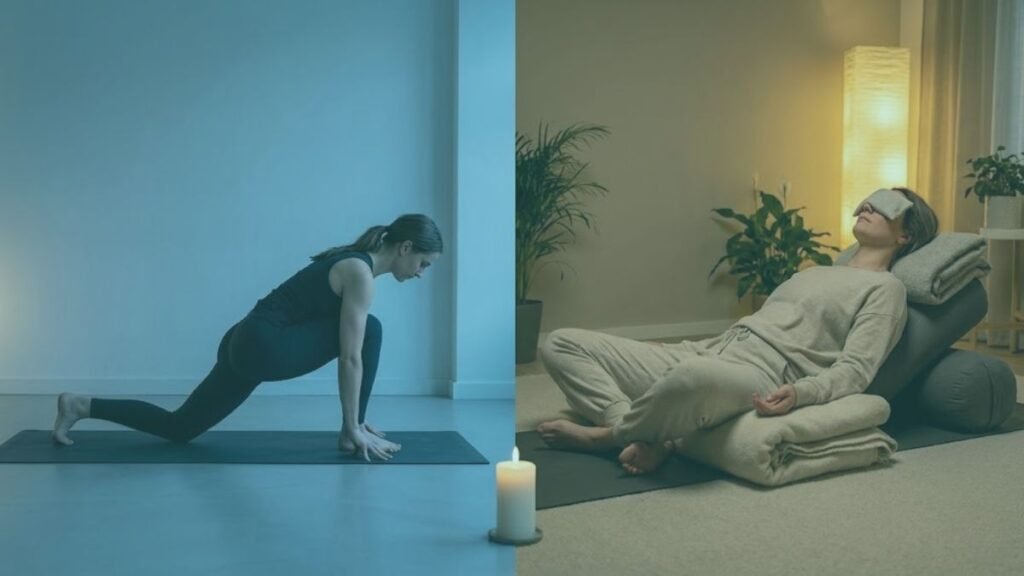
You walk into a dimly lit studio filled with bolsters and blankets. The pace is slow, the music is soft, and the teacher asks you to get comfortable on the floor. Is it Yin Yoga? Is it Restorative Yoga? Does it even matter?
The answer is yes. While both styles look similar on the surface, they have completely different biological goals.
Many students confuse these two “slow” practices. They often engage in Yin Yoga when they are actually seeking deep rest, or they choose Restorative Yoga when they really need to improve mobility.
One practice is about stressing the tissues to create change. The other is about supporting the body to create safety. Understanding this distinction is the key to giving your body exactly what it needs today.
The Core Difference: “Healthy Stress” vs. “Deep Rest”
To choose the right class, you need to understand the intent behind the stillness.
Yin Yoga: The Art of Healthy Stress Yin Yoga is not about relaxation. It is about applying “Eustress” (positive stress) to the plastic tissues of the body.
- Target: The connective tissues. This includes fascia, ligaments, and joints.
- Action: We hold poses for 3 to 5 minutes to gently stretch these dense tissues.
- Sensation: You feel it. The practice challenges you to find a “comfortable edge” where the sensation is intense but manageable. It requires mental endurance to stay with the discomfort.
Restorative Yoga: The Science of Safety Restorative Yoga is the practice of “active rest.” It is designed to switch off the “Fight or Flight” response.
- Target: The Parasympathetic Nervous System (Rest and Digest).
- Action: We use props like bolsters, blocks, and blankets to fully support the body so there is zero muscular effort.
- Sensation: You should feel nothing but comfort. If you feel a deep stretch, you are doing it wrong. The goal is to make the body feel so safe that it drops into a state of deep healing.
The TCM Connection: Yin Yoga and Your Meridians
Yin Yoga is unique because it was not developed solely from the Indian Hatha tradition. It is deeply rooted in Daoist philosophy and Traditional Chinese Medicine (TCM).
In TCM, your health depends on the smooth flow of Qi (energy) through specific channels called Meridians. These channels run through the connective tissues that Yin Yoga targets.
When you hold a pose like “Dragonfly” (Straddle Fold) for five minutes, you are not just opening your inner hips. You are stimulating the Liver and Kidney Meridians that run along the inner leg. In this way, Yin Yoga functions almost like acupuncture without the needles. It uses compression and tension to remove blockages in the energy body.
For Chinese students or those familiar with TCM concepts, this practice often feels intuitive. It bridges the gap between the physical asana and the energetic theories of the East.
(If you are interested in how Chinese Medicine connects to Yoga philosophy, read our detailed guide on TCM vs. Ayurveda.)
The “Recovery” Factor: Why Athletes Need Restorative
If you are a runner, CrossFitter, or high-intensity athlete, your instinct might be to choose Yin Yoga. You feel tight, so you want to stretch.
However, sometimes the body needs repair more than it needs flexibility.
High-intensity training keeps your body in a “Yang” state of high alert and muscular engagement. While Yin Yoga is excellent for joint mobility, it is still a form of physical stress. If your nervous system is already fried from overtraining, adding 60 minutes of deep tissue stress might not be the answer.
This is where Restorative Yoga becomes a performance tool. By completely shutting down the nervous system, you shift the body into a state where it can repair muscle tissue and reduce inflammation efficiently.
At Joga Yoga teacher training in Bali, we pair these practices with our recovery protocols like ice baths and saunas. We teach our students that true strength requires the ability to fully soften.
Which Style Should I Practice Today?
Still unsure which class to take? Use this simple checklist to listen to what your body is asking for right now.
Choose Yin Yoga If:
- You feel stiff physically but have mental energy.
- You want to increase your range of motion or flexibility.
- You are ready for a meditative challenge that requires focus.
- You have “stuck” energy and want to feel lighter after class.
Choose Restorative Yoga If:
- You feel exhausted, burned out, or depleted.
- You are recovering from an illness or a physical injury.
- You are experiencing high levels of anxiety or depression.
- You just want to disconnect and be held.
Learning the “Art of Slow” in Our YTT
A complete Yoga Teacher knows when to push (Yang) and when to yield (Yin).
In the modern world, most students are already over-stimulated. They don’t always need another sweaty Vinyasa flow. Often, they need permission to stop.
Our 200-Hour Yoga Teacher Training in Bali includes comprehensive modules on both Yin and Restorative modalities. We teach you the anatomy of fascia, the science of the nervous system, and the art of using props. This ensures you graduate with the skills to guide your students toward the precise type of balance they need.
Are you ready to master the quieter side of yoga?