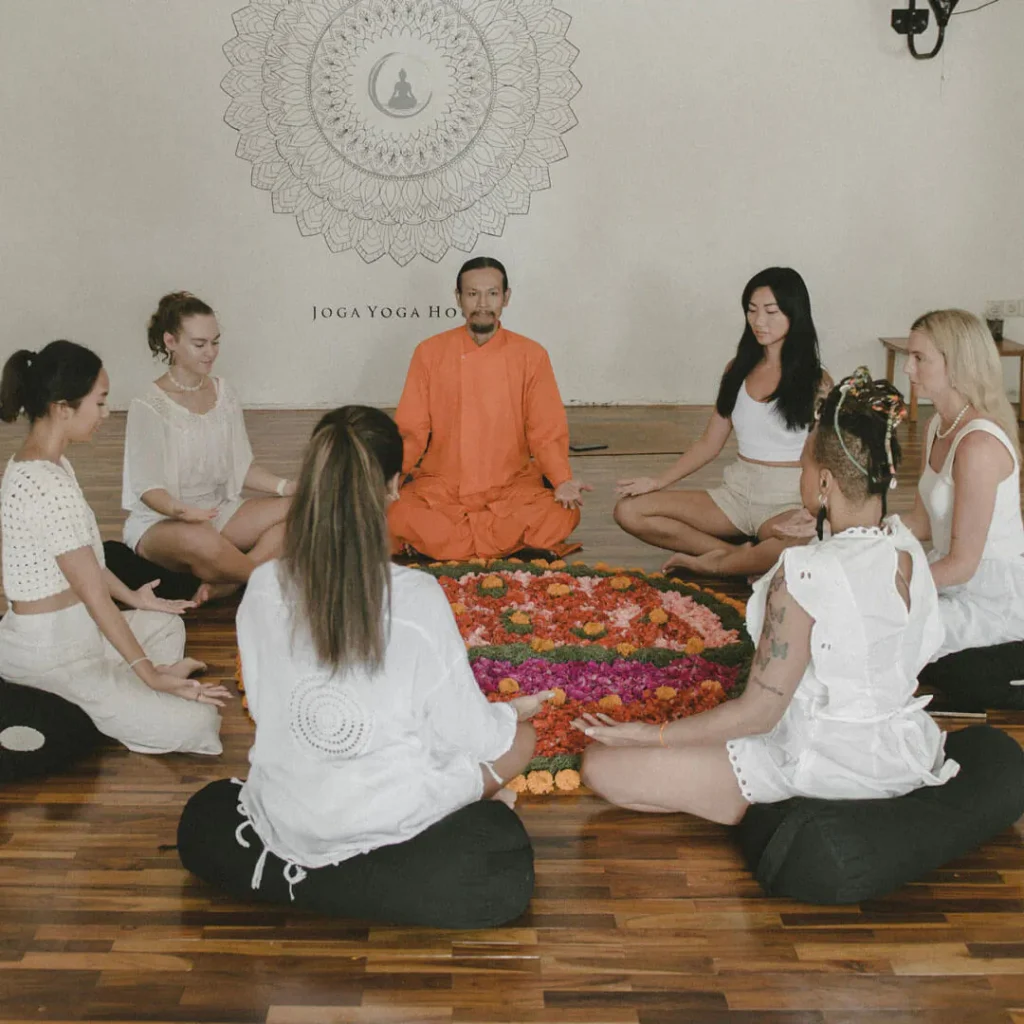




If you are wondering what to expect on the first day of yoga teacher training in Bali, expect arrival admin, orientation, a first group practice, simple teaching introductions, and time to settle into the rhythm of training.
The first day is not usually the hardest day physically. It is the day your body, mind, luggage, sleep schedule, and nervous system all realize: this is actually happening.
At Joga Yoga Training in Canggu, the first day sits inside a bigger experience: a Yoga Alliance-certified training path, a small-group setting, plant-based meals, Bali cultural touches, and a structured daily rhythm. If you want the wider overview, Joga’s guide to what to expect at yoga teacher training in Bali explains the full training journey. This article focuses on day one.
What should you expect on the first day of yoga teacher training in Bali?
Your first day is usually about settling in, meeting the group, understanding the schedule, and gently entering the practice. Expect orientation, introductions, a first class, basic logistics, and a clear sense of how training life will work.
Most Bali YTT schools use the first day to create structure. You will likely learn where classes happen, when meals are served, what to bring to the shala, how attendance works, and who to speak to if you need help.
You may also feel a little awkward. That is normal. People arrive from different countries, time zones, practice backgrounds, and levels of confidence. Some students are excited and chatty. Others are tired from the flight and quietly wondering if they packed the wrong clothes.
A good first day should answer these questions:
- Where do I need to be and when?
- What is expected from me as a student?
- How intense will the practice be?
- Who are my teachers and classmates?
- What should I prepare for tomorrow?
- How do meals, rooms, laundry, water, and local transport work?
The real goal is not to prove anything. It is to land.
What happens before the first official class?
Before your first official class, you will usually check in, unpack, confirm your course details, meet staff, and attend an orientation or opening ceremony. Arriving one day early makes this much calmer.
Joga asks students to arrive in Bali at least the day before training begins because students are invited to attend a traditional Balinese opening ceremony on the Sunday before the Monday course start. That matters more than it sounds. The first day feels very different when you are not rushing straight from airport immigration into yoga whites.
As of June 6, 2026, Indonesia’s official eVisa page says eligible visitors need a passport valid for at least six months from arrival, and immigration officers may ask for a return ticket at entry. Check the latest rules before flying through the official Indonesian eVisa portal, since visa rules can change.
Before training starts, use your arrival window to do the practical basics:
- unpack your yoga clothes where you can find them easily
- refill your water bottle
- charge your phone and adapter
- check where breakfast or morning tea is served
- ask about laundry timing if you packed light
- avoid scheduling big sightseeing plans the night before day one
Canggu is convenient, but traffic and heat can still surprise first-time visitors. Give yourself margin.
What is the first yoga practice usually like?
The first practice is usually grounding rather than performance-based. Expect breathwork, foundational movement, alignment cues, and a chance for teachers to observe the group’s energy, experience level, injuries, and confidence.
This is where many students relax. You do not have to arrive able to do advanced postures. You do need to listen, modify, breathe, and be honest about your body.
Yoga Alliance’s RYS 200 standards place foundational teacher training across four core areas: techniques and practice, anatomy and physiology, yoga humanities, and professional essentials. That means your first practice is not just exercise. It begins the process of learning how practice, teaching, philosophy, and safety connect.
At Joga, the curriculum includes Hatha, Vinyasa, Yin, basic Ashtanga, pranayama, kriyas, chanting, meditation, anatomy, teaching methodology, philosophy, and practicum. Founder and lead teacher Joseph brings years of study in India and Bali, with a focus on yoga as a practical path for steadiness, strength, and inner clarity. On day one, that shows up as a simple message: practice fully, but do not force.
Expect sweat too. Canggu is tropical, with warm temperatures year-round and high humidity, so your first class may feel more intense than the same class at home. Bali.com describes Canggu as warm throughout the year, with wet and dry seasons and average temperatures commonly around 26 to 32 C.
Will you start learning to teach on day one?
You may begin teaching skills on day one, but usually in small, low-pressure ways. This might mean introductions, voice work, observing alignment, naming poses, or practicing short cues with classmates.
Competitor coverage often talks about full daily schedules, but the missing detail is how teaching actually begins. It rarely starts with leading a polished class. It starts with becoming comfortable being seen.
You may be asked to say your name, share why you came, observe a partner in a pose, or notice how different bodies respond to the same instruction. These simple moments are part of the shift from student to teacher.
At Joga, practicum includes practice teaching, receiving and giving feedback, observing others teach, assisting students, and a small written exam. The first day is the doorway into that process. It is not an audition.
If you are nervous about teaching, remember this: everyone is learning the same skill in public. Clear, kind, simple instruction matters more than sounding like a perfect yoga teacher.
What should you bring to the shala on your first day?
Bring only what helps you practice, learn, and stay comfortable. A water bottle, notebook, pen, light layers, hair tie, towel, and any personal supports are usually enough for the first training day.
Bali packing gets overcomplicated fast. You do not need your whole suitcase beside your mat. You need a small daily setup that works in heat, humidity, and long training blocks.
A practical first-day shala bag can include:
- refillable water bottle
- notebook and pen
- small towel
- light cover-up for seated study or meditation
- simple snacks if allowed
- any medication you need during the day
- hair tie or headband
- phone on silent
- clean change of top if you sweat heavily
Do not bring valuables you do not need. Do not bring a heavy laptop unless the school asks for it. If you are staying in Canggu for several weeks, pack with laundry in mind rather than stuffing your bag with 21 perfect outfits.
For broader prep, use Joga’s guide on how to prepare for yoga teacher training in Bali before you fly.
How does the first day feel emotionally and socially?
The first day often feels exciting, tender, and slightly disorienting. You are meeting strangers, adjusting to Bali, entering a new routine, and realizing the training may be more personal than expected.
This is one of the biggest gaps in the SERP. Many pages explain the schedule. Fewer explain the social reality.
You may compare yourself to someone who looks more flexible. You may wonder if everyone else knows more Sanskrit. You may feel shy at lunch. You may feel surprisingly emotional during the opening circle or first meditation.
None of that means you are in the wrong place.
Joga’s small-group approach helps here. The school notes that its trainings focus on student-teacher time, with a maximum group size of 16 students. Smaller groups make it easier to ask questions, receive individual feedback, and form real friendships rather than disappearing into a large crowd.
A useful first-day rule: talk to one person before dinner. You do not need to become instantly social. Just make one honest connection.
What does Joga include that makes day one easier?
Joga includes several practical supports that reduce first-day stress, including airport pick-up, accommodation options, vegetarian and vegan meals, training materials, purified drinking water, and access to teachers in a small-group setting.
Joga’s 200-hour yoga teacher training in Bali is designed as an all-inclusive training experience, not just a course schedule. That matters on the first day because fewer logistics are left for you to solve alone.
Joga first-day support block
- Location: Canggu, Bali, near Batu Bolong Beach
- Arrival support: airport pick-up included
- Training format: Yoga Alliance-certified program
- Group size: maximum 16 students
- Meals: vegetarian and vegan breakfasts and lunches
- Materials: books, resources, yoga journal, and t-shirt
- Daily comfort: purified drinking water, Wi-Fi, accommodation options
- Bali experience: traditional Balinese opening ceremony and later cultural excursion
- Recovery support: traditional Balinese massage, sauna and cold plunge access
- Community: lifetime access to the online student portal after completion
If accommodation is part of your booking, Joga’s yoga teacher training accommodation in Bali page is the best internal page to support room-related questions.
How should you spend your first evening in Canggu?
Spend your first evening quietly: eat well, hydrate, organize tomorrow’s clothes, check the schedule, and sleep early. Canggu has plenty going on, but day one is not the night to test your limits.
This is especially true if you have jet lag. Bali’s energy can make you want to do everything at once: beach sunset, cafe dinner, scooter ride, shopping, and “just one quick look around.” Save most of that for your day off.
A better first evening looks like this:
- take a short walk if you need to move
- drink more water than you think you need
- keep dinner simple
- lay out clothes for morning practice
- put your notebook and water bottle near your bag
- message family once, then let yourself unplug
- avoid late-night scrolling if you are already overstimulated
Joga’s Canggu location gives you access to cafes, shops, surf culture, and beach sunsets, but training works best when you pace yourself. If you are deciding whether Canggu is the right base, Joga’s guide to yoga teacher training in Canggu, Bali gives more local context.
What is the best mindset for your first day?
The best first-day mindset is curious, humble, and steady. You are not there to perform yoga. You are there to learn, be teachable, join the group, and begin building trust.
Come in with fewer expectations and more attention. Your first day may not feel magical every minute. You might be tired. You might forget someone’s name. You might sweat through your clothes before breakfast. Very normal.
What matters is how you meet the experience.
Let the first day be simple:
- arrive
- listen
- practice honestly
- ask clear questions
- meet the group
- rest before tomorrow
By the end of the day, you should understand the training rhythm, know where to be in the morning, and feel less like a visitor and more like a student. That is enough.