
Vipassana meditation means “to see things as they are.” It is one of the oldest forms of Buddhist meditation and it trains you to observe body sensations without reacting to them. This guide covers what Vipassana is, how the technique works, what a 10-day retreat actually involves, the real benefits, and how it differs from mindfulness meditation.
What Is Vipassana Meditation?
Vipassana meditation is an insight practice from Theravāda Buddhism that trains a person to observe body sensations, thoughts, and emotions without reacting to them. The word comes from Pali: “vi” means clearly or deeply, “passana” means seeing. Together, Vipassana means clear seeing, or insight into reality as it actually is, not as the mind assumes it to be.
Vipassana meditation was taught by the Buddha as a path out of suffering and is described in the Satipatthana Sutta, the early Buddhist text that explains how to observe the body, feelings, mind, and mental patterns. Vipassana is not relaxation. It is a systematic method for watching how the mind and body change from moment to moment.
Vipassana meditation connects to three core Buddhist teachings, known as the Three Marks of Existence. Anicca means impermanence: every sensation rises and passes away. Dukkha means suffering: clinging to things that change causes stress. Anatta means non-self: there is no fixed, permanent self controlling experience. Vipassana meditation trains a practitioner to see Anicca directly through the body, which deepens understanding of Dukkha and Anatta.
How Does Vipassana Meditation Work?
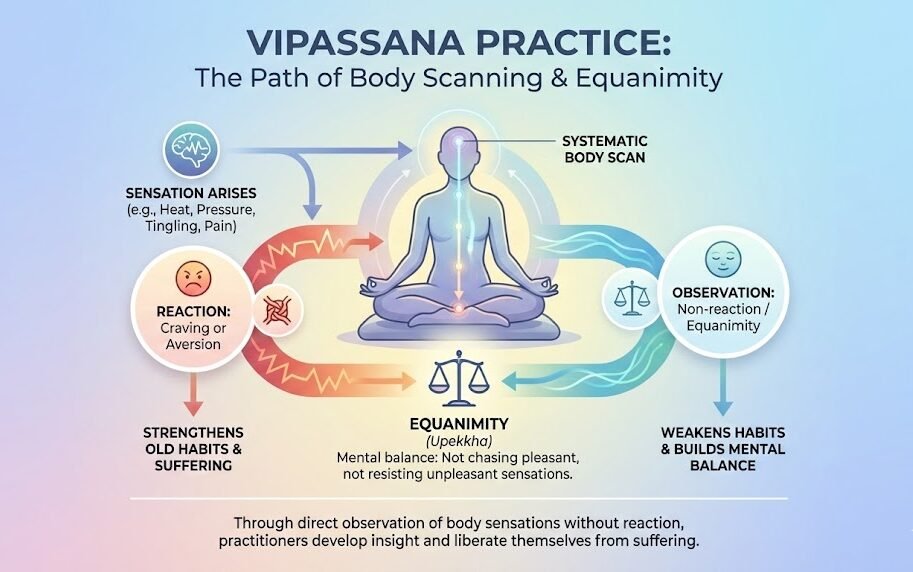
Vipassana meditation works by training a practitioner to observe body sensations and mental reactions instead of reacting to them with craving or aversion. The core technique is body scanning: attention moves slowly from head to feet, noticing sensations such as heat, pressure, tingling, or pain, without labeling them good or bad. The goal is non-reaction.
When a practitioner observes a sensation without reacting to it, equanimity develops, called Upekkha in Pali. Equanimity means the practitioner does not chase pleasant sensations and does not push away unpleasant ones. Over time, this breaks the automatic cycle of craving and aversion that Buddhist psychology treats as the root of suffering.
Most 10-day Vipassana courses teach the technique in three stages. Anapana meditation comes first and builds concentration by focusing on the natural breath. Vipassana meditation is the second stage and uses body scanning to develop insight into impermanence. Metta meditation, loving-kindness practice, closes the course and directs the calm built by the first two stages toward compassion for oneself and others.
Vipassana vs Mindfulness Meditation: What’s the Real Difference?
Vipassana meditation and mindfulness meditation are not the same practice, even though many mindfulness apps borrow Vipassana’s language of observation and non-judgment. Mindfulness meditation, the kind taught in most apps and secular courses, trains present-moment awareness of breath, sound, or general experience, with the aim of calm and reduced reactivity.
Vipassana meditation goes further. It uses a specific, structured technique, body scanning through the whole body in sequence, aimed at direct insight into Anicca, Dukkha, and Anatta, not just calm. A mindfulness app can teach a person to notice their breath. Vipassana meditation trains a person to notice a sensation, recognize that it is already changing, and let it pass without adding a reaction on top of it. That last step, watching the reaction itself dissolve, is the part secular mindfulness training generally leaves out.
Vipassana meditation also differs from Zen meditation (Zazen), which comes from Mahayana Buddhism and emphasizes posture and direct awareness of mind rather than systematic body scanning, and from Transcendental Meditation, which uses silent mantra repetition for relaxation rather than sensation-based insight. Vipassana meditation does not use a mantra.
The confusion is not accidental. Headspace’s own guide to Vipassana meditation states plainly that its app teaches Vipassana technique without requiring any background in Vipassana or Buddhist meditation, and Calm’s help center lists Vipassana as one of several practices folded into its general mindfulness sessions. Both apps borrow the name and the basic instruction, observe a sensation, do not react, while dropping the doctrinal container: the Three Marks of Existence, the Noble Eightfold Path, and the specific goal of insight into impermanence rather than general calm. That is a legitimate simplification for a five-minute app session. It is also the reason someone who has only used a meditation app is often surprised by how demanding and doctrinally specific a real Vipassana course turns out to be.
What Happens During a 10-Day Vipassana Retreat?
A 10-day Vipassana retreat is the standard way most people first learn the technique, and it runs on a strict fixed schedule inside a residential center with no outside contact for the full ten days. Most retreats follow the Goenka tradition, though other Theravāda centers run similar formats.
Every retreat observes Noble Silence: no talking, no eye contact, no reading or writing, and no phone or internet use. Noble Silence removes distraction so the mind can settle, and it is a deliberate part of the method, not an incidental rule.
- 4:00 AM wake up
- 10 to 12 hours of meditation across the day, in group and individual sitting
- Simple vegetarian meals: breakfast and lunch as full meals, with only tea and fruit offered in the evening for first-time students
- An evening recorded discourse, usually by S.N. Goenka or the center’s teacher
- Lights out around 9:30 PM
Students also follow five ethical precepts, or Sila, for the retreat’s duration: no killing, no stealing, no sexual activity, no lying, and no intoxicants. Sila is not a moral test. It removes sources of mental agitation so the meditation itself has fewer distractions to work against.
Leaving is allowed. Every 10-day course accepts that some students will find the intensity too much, and a student can ask to leave at any point without penalty. Enrollment forms also ask about mental health history before a course begins, though that screening is self-reported rather than clinical, so it depends on the applicant being honest about their own condition. Assistant teachers can also ask a student to leave or postpone if they judge, once the course has started, that the student is not ready for it. Neither safeguard makes a 10-day retreat risk-free. People with severe untreated depression, active PTSD, psychosis, or early addiction recovery should talk to a mental health professional before relying on either safeguard to catch a problem for them.
Goenka vs Mahasi: Which Vipassana Tradition Should You Choose?
The two most widely available Vipassana traditions today are the Goenka tradition and the Mahasi Sayadaw method, and they differ enough in technique that the choice matters for a first-time student.
| Tradition | Origin | Core Technique | Best For |
|---|---|---|---|
| Goenka | U Ba Khin lineage, Burma, spread globally by S.N. Goenka | Systematic body scanning, fixed 10-day format, donation-based centers via Dhamma.org | First-time students who want a structured, standardized course |
| Mahasi Sayadaw | Burma, 20th-century lay-accessibility reform | Noting technique: mentally labeling experience as “thinking,” “hearing,” or “feeling” as it arises | Students who want a less rigid body-scan sequence and a looser daily practice |
A third branch, the Thai Forest tradition associated with teachers like Ajahn Chah, emphasizes monastic discipline and continuous awareness over a fixed retreat structure. All three traditions share the same goal: direct insight into impermanence, suffering, and non-self. The technique differs, the aim does not.
What Are the Benefits of Vipassana Meditation?
Vipassana meditation has its own dedicated research, rather than results borrowed from general mindfulness studies. The first systematic review of that research, by Chiesa (2010) in the Journal of Alternative and Complementary Medicine, found only seven controlled studies worth including, most of them small or methodologically weak, and called for far more rigorous trials before drawing firm conclusions. Read the abstract on PubMed. A 2025 update to that review, published in Cureus, found moderate evidence that Vipassana meditation reduces stress, anxiety, and migraine frequency, and improves heart rate variability and executive function, with the strongest effects showing up in intensive retreat settings rather than short daily sessions. Read the 2025 review. The same review flagged small sample sizes and a lack of blinding as ongoing limitations across the field.
The strongest evidence base for Vipassana meditation comes from correctional settings. A controlled study published in Psychology of Addictive Behaviors (Bowen et al., 2006) followed incarcerated participants who completed a 10-day Vipassana course and found significantly greater reductions in alcohol, marijuana, and other substance use after release compared with a treatment-as-usual control group, along with improvements in psychiatric symptoms and psychosocial functioning. Read the study.
Vipassana meditation is not a treatment for diagnosed mental health conditions, and it should not replace medical or psychological care. Long periods of silence and sustained self-observation can surface strong emotions, including grief or old trauma, and this can feel intense rather than calming. People with severe untreated depression, active PTSD, psychosis, or early addiction recovery should talk to a mental health professional before booking a 10-day retreat, and should not attend one without that guidance.
Can You Practice Vipassana Without a 10-Day Retreat?
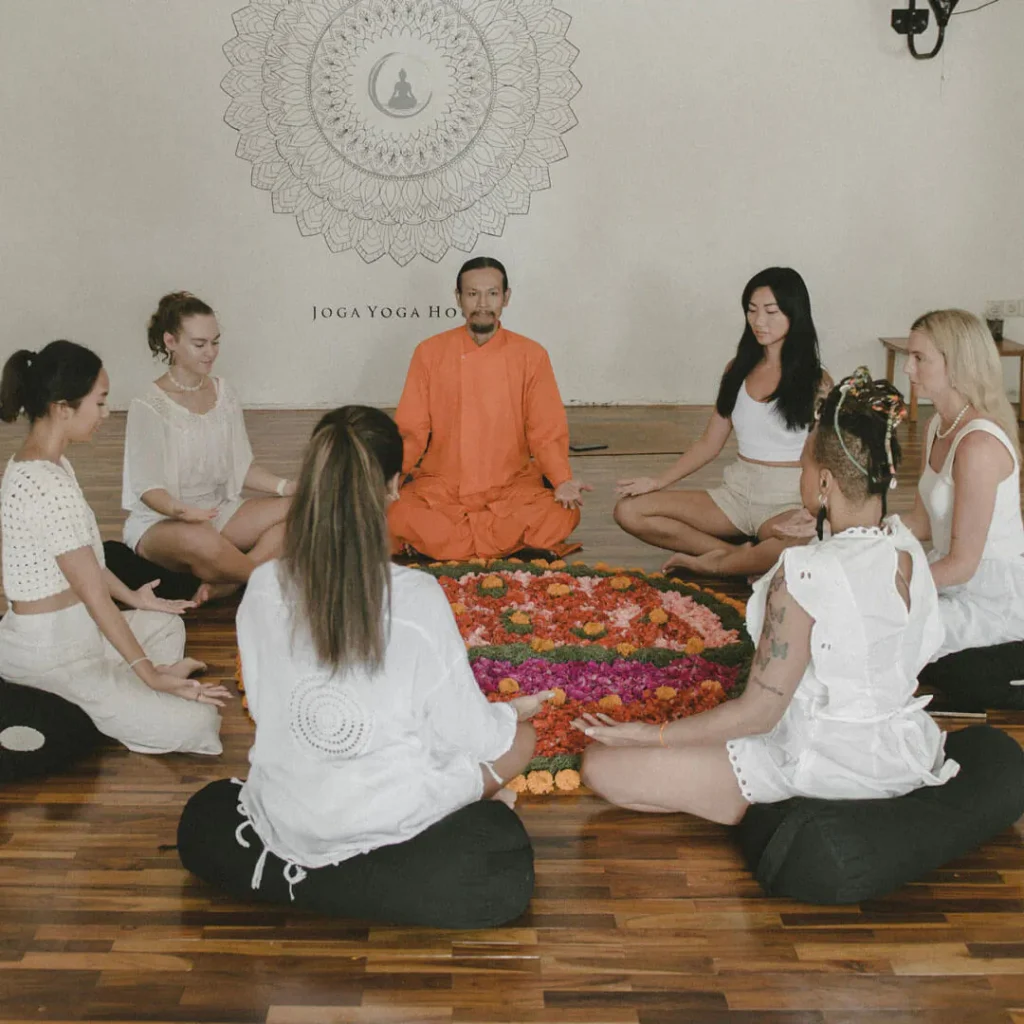
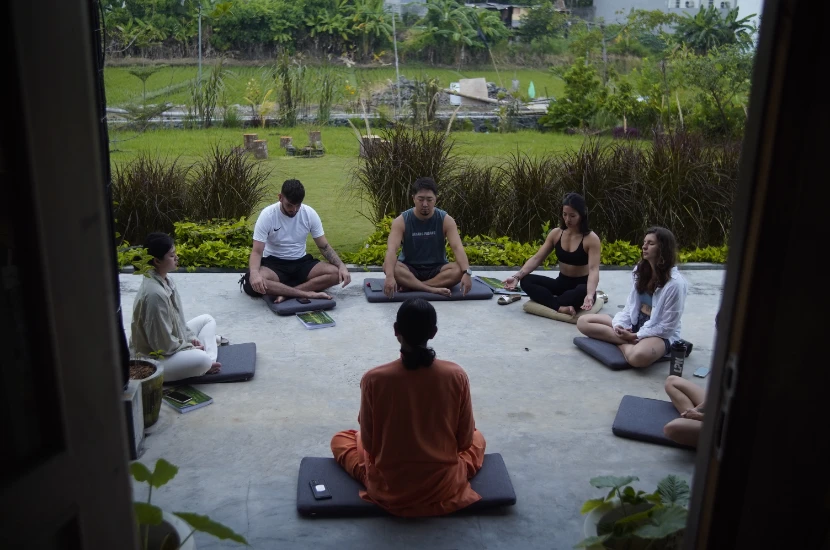
Yes. A full 10-day silent retreat is the traditional way to learn Vipassana meditation, but it is not the only way to encounter the technique with real guidance. Joga Yoga Training, a Yoga Alliance Registered Yoga School in Canggu, Bali, introduces Vipassana meditation as part of the daily meditation sessions inside its 200-Hour Yoga Teacher Training, alongside mantra-based meditation, trataka, and yoga Nidra.
Vipassana at Joga Yoga Training happens in two daily slots rather than one long sitting: a short chanting and meditation block mid-morning, after the opening pranayama and asana practice and before the philosophy and anatomy sessions, and a second meditation slot in the evening paired with Yin yoga, once the day’s heat has dropped. That timing is not incidental to Bali’s climate. Sitting still for a long stretch in the middle of a tropical afternoon is harder than doing it in the cooler morning or evening hours, which is part of why the schedule places meditation around those windows rather than in the heat of the day.
This route suits a different student than a 10-day silent retreat does. A 200-Hour Yoga Teacher Training at Joga Yoga Training runs 22 days and pairs daily Vipassana practice with asana, pranayama, and yoga philosophy study, rather than isolating meditation inside a fully silent, single-purpose retreat. Someone who wants to try the technique inside an active daily structure, with a teacher present to answer questions, gets that here. Someone who specifically wants the strict Noble Silence format should book a dedicated Goenka course instead. Both are legitimate ways to meet Vipassana meditation for the first time. For a broader look at meditation styles taught at Joga Yoga Training beyond Vipassana specifically, see the guide to meditation in Canggu.
Is Vipassana Meditation Right for You?
Vipassana meditation suits someone who wants direct insight rather than light relaxation, who is willing to sit with physical and emotional discomfort without immediately fixing it, and who can commit to daily practice once the initial course ends. It is a demanding technique, and the demand is the point.
Vipassana meditation is less suited to someone in acute mental health crisis, someone who wants a quick stress-relief tool rather than a long-term practice, or someone who is not ready to sit through several hours of body scanning without a phone nearby. None of that makes Vipassana meditation wrong for that person forever. It just means the timing matters, and a gentler entry point, such as guided meditation sessions inside a broader yoga teacher training in Canggu, Bali, or a conversation with a teacher first, is a reasonable way to find out.
Learn Vipassana Meditation Inside a Full Yoga Teacher Training
Practice Vipassana daily alongside asana, pranayama, and philosophy on Joga Yoga Training’s Yoga Alliance-certified 200-Hour YTT in Canggu, Bali.
Apply for the 200-Hour YTT