




Opening and growing a yoga studio takes more than good teaching. You need a clear business model, legal setup, realistic budget, smart location choice, and consistent marketing that brings in new students while keeping regulars engaged.
For most aspiring studio owners, the biggest mistake is starting with the space instead of the plan. Build the business first, then build the room around it.
What should you decide before opening a yoga studio?
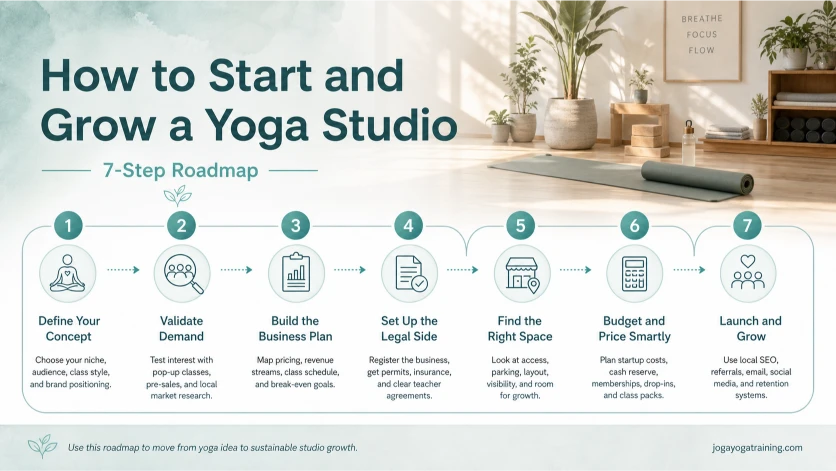
Before you spend money, decide exactly who your studio serves, what style you teach, how you will make money, and why students should choose you over nearby options. Clear positioning makes every later decision easier.
Start by answering four questions:
- Who is your core student: beginners, busy professionals, prenatal clients, older adults, athletes, or a mixed community?
- What experience are you selling: spiritual sanctuary, neighborhood community studio, premium boutique brand, or accessible all-levels practice?
- What will you offer: memberships, drop-ins, workshops, privates, retreats, teacher training, retail, or corporate classes?
- What makes your studio different: schedule convenience, teaching quality, beginner support, heated rooms, recovery services, strong community, or a niche style?
This matters because “yoga studio” is not one business model. A small community studio with two rooms, simple pricing, and strong retention needs a very different budget than a premium hot yoga studio with showers, retail, and a larger team.
If you are still deciding whether the teaching path fits your long-term goals, Joga’s guide on whether teaching yoga is worth it and its article on the role of a yoga instructor certification in your career are useful starting points.
How do you test demand before signing a lease?
The safest way to test demand is to sell the offer before you build the studio. Run pop-up classes, gather pre-sale commitments, and study local competitors so your first lease is backed by evidence, not hope.
Before committing to a long-term space, try a simple validation phase:
- Teach a 4 to 6 week pop-up series in a rented room, wellness center, or shared community space.
- Build a waitlist page with your studio concept, neighborhood, class style, and expected opening date.
- Offer a founding membership or discounted first month to measure real buying intent.
- Track which class times fill first.
- Review nearby studios for pricing, schedule gaps, Google reviews, and student complaints.
The U.S. Small Business Administration’s market research guidance is helpful here. Look for a gap you can actually own, such as early morning classes for professionals, gentle yoga for beginners, or a stronger community feel than larger gyms provide.
A studio that validates demand early has a better chance of launching with momentum instead of scrambling to fill empty classes.
What belongs in a yoga studio business plan?
A strong yoga studio business plan explains your offer, target market, pricing, operations, and numbers clearly enough that you can make decisions fast and spot problems before they become expensive.
The SBA says a business plan is the foundation of your business, and that applies especially well to yoga studios, where rent, payroll, and class utilization can make or break profitability.
Your plan should cover:
- Your concept and positioning
- Your target students and local market
- Your class formats and revenue streams
- Your pricing model
- Your launch plan
- Your staffing plan
- Your monthly operating costs
- Your break-even point
- Your 12-month cash flow forecast
A useful yoga studio business plan is not a motivational document. It should answer practical questions such as:
- How many members do you need to cover rent and payroll?
- How many classes per week can you realistically fill in month one?
- Which services have the best margins?
- How much cash do you need in reserve before opening?
- What happens if enrollment is slower than expected?
If you want the simplest test, your plan should make it obvious whether your studio works at 60 members, 100 members, and 150 members. If it only works in the best-case scenario, the plan is not ready.
How do you set up a yoga studio business legally?
Legal setup usually means choosing a business structure, registering the business, getting tax IDs, checking licenses and permits, arranging insurance, and setting up clean contracts before your first paid class.
For U.S.-based owners, the SBA launch guide covers the main sequence: choose a structure, register the business, get federal and state tax IDs, apply for licenses and permits, open a business bank account, and secure insurance.
At a minimum, review these items:
- Business structure such as sole proprietorship, LLC, or corporation
- EIN and local tax registration
- Local business license requirements
- Zoning approval for group fitness use
- Lease review before signing
- General liability and professional liability insurance
- Waivers, membership terms, and cancellation policies
- Music licensing if you use copyrighted music in class
- Worker classification for teachers and staff
The IRS reminds business owners that you must classify workers correctly as employees or independent contractors. That is a big one for yoga studios, because misclassifying teachers can create tax, payroll, and legal problems later.
This is also where local variation matters most. Permits, occupancy rules, signage rules, and health or safety requirements can vary by city and country, so use local legal and accounting advice before opening.
Do you need yoga certifications or Yoga Alliance approval?
You do not need Yoga Alliance approval to open a basic yoga studio, but training quality and recognized credentials help with trust, hiring, insurance, and long-term brand credibility.
If you are opening a studio that offers regular public classes, the business itself does not need to be a Yoga Alliance school. But if you plan to run teacher training programs, that changes the standard.
According to Yoga Alliance, a Registered Yoga School meets recognized educational and ethical standards, and graduates of an RYS can pursue Registered Yoga Teacher credentials. Their RYT overview explains how teacher credentials connect to training and teaching hours.
For studio owners, the practical takeaway is simple:
- Your personal teaching background affects trust
- Your instructors’ qualifications affect student confidence
- Your insurer may expect minimum training standards
- Teacher training programs need a more formal structure than weekly public classes
If you are building toward that path, Joga’s types of yoga certifications guide and guide to yoga teacher training can help map the education side of the journey.
How do you choose the right location and studio layout?
The right location is one your target students can reach easily, afford repeatedly, and feel comfortable returning to several times a week. Convenience usually beats a beautiful space with weak access or poor visibility.
Look at location through your students’ eyes:
- Is there parking, safe walking access, or public transport nearby?
- Does the neighborhood match your pricing and positioning?
- Can students arrive before work, at lunch, or after work without hassle?
- Is the building quiet enough for classes?
- Is there room for storage, reception, changing, and teacher setup?
- Can the space support accessibility needs?
Do not choose a location only because the rent looks manageable. A cheap room with poor access can cost more in lost retention than a slightly pricier location with better convenience.
Inside the studio, keep the layout practical. Students remember the full experience: entry flow, front-desk welcome, sound, temperature, bathroom cleanliness, changing space, and whether the room feels calm rather than cramped.
If you plan to offer heated yoga, showers, retail, or recovery services later, decide that before signing. Retrofitting a space after launch is usually harder and more expensive than planning for it upfront.
How much should you budget to start a yoga studio?
Your startup budget should include both opening costs and the cash you will need to survive the first slow months. Most new studios underestimate runway more than equipment or decor.
The SBA’s startup cost guide recommends separating one-time expenses from monthly expenses and calculating enough capital to cover early operating gaps.
A simple yoga studio budget usually includes:
- Lease deposit and legal review
- Build-out, paint, flooring, mirrors, lighting, signage
- Mats, props, storage, front-desk equipment, sound system
- Software, website, booking, payment processing
- Licenses, permits, and insurance
- Payroll or teacher pay
- Launch marketing
- Working capital reserve
- Contingency fund
A practical planning framework is:
- 35% to 45% for space and build-out
- 15% to 25% for runway and payroll reserve
- 5% to 10% for equipment and props
- 5% to 10% for software, legal, and admin setup
- 8% to 12% for launch marketing
- 10% to 15% for contingency
Those percentages are a planning framework, not a universal rule. A heated studio, premium neighborhood, or large renovation can push the location side much higher. A shared-space model can lower it dramatically.
The safest budgeting habit is simple: assume opening takes longer and marketing costs more than you first think.
How should you price classes and memberships?
Good pricing covers your costs, matches your market, and makes it easy for students to keep buying. The goal is not the cheapest offer. It is a pricing system that supports retention and margin.
Start with your break-even point, not competitor panic. The SBA break-even calculator is a useful tool for working out how many memberships or class packs you need to cover fixed costs.
A simple pricing stack usually works best:
- Intro offer for first-time students
- Drop-in price for flexibility
- 5-class or 10-class pack
- Auto-renew monthly membership
- Higher-ticket private sessions
- Workshops or short courses for extra revenue
A few pricing rules help:
- Do not make unlimited memberships your only growth plan
- Keep your offers easy to understand
- Reward commitment, not confusion
- Review attendance by time slot before discounting heavily
- Raise prices only when the experience clearly supports it
If your studio serves beginners, make the first purchase feel low-risk. If you serve committed practitioners, build more value into membership through priority booking, members-only workshops, or guest passes.
How do you hire teachers and run daily operations?
Studios grow when classes are consistent, teachers are reliable, and the day-to-day experience feels smooth. Strong operations are quieter than marketing, but they do more to protect retention.
Your first operating system should be simple and repeatable:
- Clear class schedule ownership
- Written substitute policy
- Standard check-in and late-arrival rules
- Cleaning and room-reset checklist
- Teacher expectations for music, cueing, and student care
- Weekly reporting on attendance, revenue, and retention
- Simple student feedback loop
This is also where staffing decisions matter. Some studios start with the founder teaching most classes, then bring in specialists later. Others open with a broader team. Either can work, but only if payroll matches demand.
When you hire, look beyond charisma. You need teachers who are dependable, student-focused, and aligned with the experience your brand promises. Joga’s piece on nurturing souls through yoga teaching is a good reminder that teaching quality and human connection are still the heart of a studio business.
How do you market a new yoga studio?
The best launch marketing combines local visibility, founder credibility, and a simple first offer. You do not need to be everywhere. You need to be easy to find and easy to try.
For most new studios, the strongest early channels are:
- Google Business Profile
- Local SEO pages on your website
- Instagram and short-form video
- Email collection before opening
- Founding-member offers
- Referral incentives
- Partnerships with nearby cafes, wellness businesses, and apartments
- Community events and soft-opening classes
Your website should explain three things immediately: who the studio is for, where it is, and how to book the first class. Do not hide the schedule, pricing, or contact details.
Content marketing can help too, especially if you are building a values-led brand. Articles about beginner yoga, class types, teacher credentials, or common questions can bring in search traffic and build trust over time. Joga’s career guide on whether yoga teachers are in demand shows how helpful, intent-matched content can support business growth around a yoga brand.
How do you grow a yoga studio after launch?
Growth comes from retention first, then acquisition. A studio with solid retention can grow steadily. A studio with poor retention has to keep replacing students, which is exhausting and expensive.
After launch, focus on the numbers that actually matter:
- New students per month
- Intro-offer conversion rate
- Membership retention
- Average class fill rate
- Revenue per student
- Teacher-level attendance patterns
- Churn by pricing plan
Then grow in layers:
- Improve the schedule before adding more classes
- Deepen community before expanding space
- Add workshops, privates, and teacher development once the core offer is stable
- Build referral systems before spending heavily on ads
- Use student feedback to refine class times, not just class styles
The strongest studios usually grow because students feel known, not because the logo looks polished. Community is not a soft extra. It is a retention strategy.
What is the smartest way to start small?
The smartest path is to prove your concept with the smallest version that still feels professional. Starting smaller gives you data, protects cash, and makes growth easier to manage.
That might mean:
- Renting a room before taking a lease
- Launching with 8 to 12 classes per week instead of 30
- Starting with one signature style and one beginner path
- Keeping fit-out clean and calm instead of expensive
- Delaying retail, showers, or extra rooms until demand is real
If your long-term dream is a full studio, that is fine. Just let the business earn its next size.
For aspiring studio owners who are still building their teaching foundation, a stronger training base often makes the business side easier later. Joga’s guide to yoga teacher training and in-person yoga teacher training in Bali page can help if that is your next step.

FAQ
Can you open a yoga studio without being a yoga teacher?
Yes. You can own a yoga studio without teaching classes yourself, but you still need strong yoga knowledge, qualified instructors, and clear quality standards. If you are not the lead teacher, hire someone experienced to guide programming, class structure, and teacher standards.
How many students does a yoga studio need to be profitable?
It depends on rent, payroll, pricing, and class capacity. A small studio with low rent can break even with fewer committed members, while a larger boutique studio needs higher monthly recurring revenue. Start by calculating fixed costs, then work backward from memberships, class packs, and average attendance.
What is the best size for a first yoga studio?
A smaller studio is usually safer for a first launch. One practice room with space for 12 to 25 students can work well if the schedule, pricing, and retention are strong. Bigger spaces create more revenue potential, but they also increase rent, staffing, cleaning, and pressure to fill classes.
Should a yoga studio offer memberships or class packs?
Most studios should offer both. Memberships create predictable monthly income, while class packs help students who cannot commit to a regular schedule. A simple pricing structure usually works best: intro offer, drop-in, class pack, and monthly membership.
What are the biggest reasons yoga studios fail?
Yoga studios usually fail because of weak financial planning, high rent, unclear positioning, poor retention, inconsistent marketing, or schedules that do not match student demand. Passion helps, but it cannot fix low margins or empty classes.
How long does it take to grow a yoga studio?
A yoga studio usually needs several months to build steady attendance and longer to create a loyal community. Growth depends on location, launch audience, pricing, teacher quality, online visibility, and how well you convert first-time students into repeat members.
Is it better to rent a space or buy a yoga studio?
Renting is usually better for first-time owners because it lowers upfront risk and gives you flexibility. Buying a property or an existing studio can work if the numbers are strong, but it also adds more financial pressure and due diligence.
What software does a yoga studio need?
A yoga studio usually needs booking software, payment processing, member management, email marketing, a website, Google Business Profile management, and basic accounting tools. The right setup should make scheduling, payments, attendance tracking, and communication easier for both students and staff.
How do you get your first yoga studio members?
Start before opening. Build a waitlist, run pop-up classes, collect emails, promote a founding-member offer, partner with local businesses, and ask early students for referrals and reviews. Your first members often come from personal trust and local visibility, not ads alone.
Can a yoga studio make money from more than classes?
Yes. A yoga studio can earn from private sessions, workshops, teacher training, retreats, corporate wellness, events, merchandise, online classes, and room rentals. Add extra revenue streams after the core class schedule works, not before.