


Chaturanga is one of the most common poses in modern yoga, but it is also one of the most misunderstood. When done well, it builds strength and control. When done poorly, it can strain the shoulders and wrists. This guide explains what Chaturanga really is, how to do it safely, and why alignment matters more than repetition.
What Is Chaturanga Yoga Pose
Chaturanga Yoga Pose is a strength-based posture used in many flow-style yoga classes. Its full Sanskrit name is Chaturanga Dandasana.
Here is what it means in simple terms:
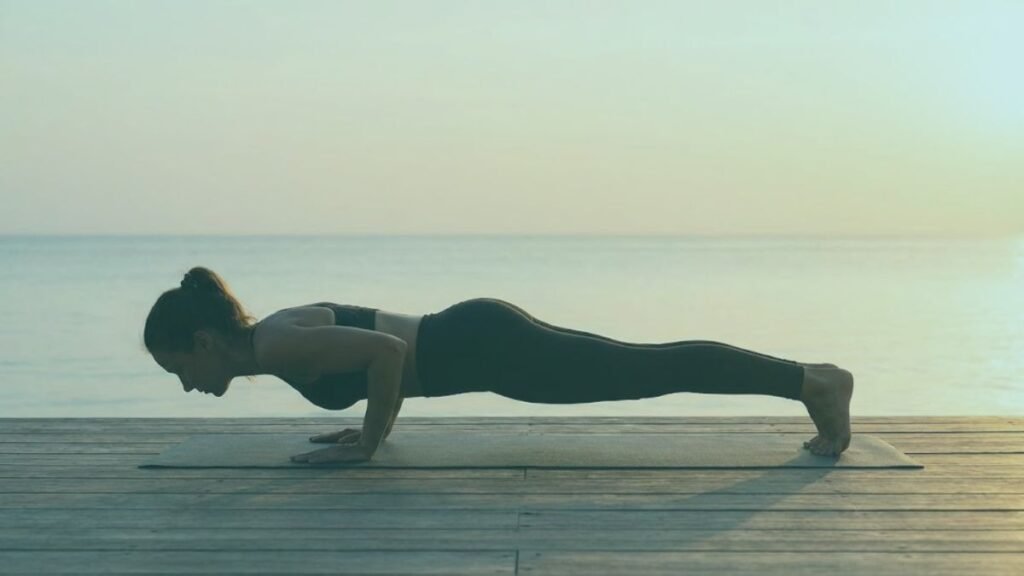
- Chaturanga is a low plank position held with bent arms
- It is part of many Vinyasa, Ashtanga, and Power Yoga classes
- It connects poses like Plank, Upward Facing Dog, and Downward Facing Dog
- It is repeated many times in one class, often without rest
Chaturanga appears so often because it acts as a transition pose. It links one movement to the next and helps create a smooth flow. Because it is repeated frequently, small alignment mistakes can add up quickly.
This is why learning proper Chaturanga form is important, even for experienced students.
What Does “Chaturanga” Mean in Yoga
The word Chaturanga comes from Sanskrit.
- Chatur means four
- Anga means limbs
So Chaturanga means four-limbed staff.
The name describes how the body should look and feel in the pose:
- Two hands on the floor
- Two feet supporting the body
- The body held straight like a staff
This name matters because it reminds us of alignment. Chaturanga is not a push-up and not a drop-down. It is a controlled position where the body stays strong, straight, and supported by all four limbs.
How to Do Chaturanga Yoga Correctly
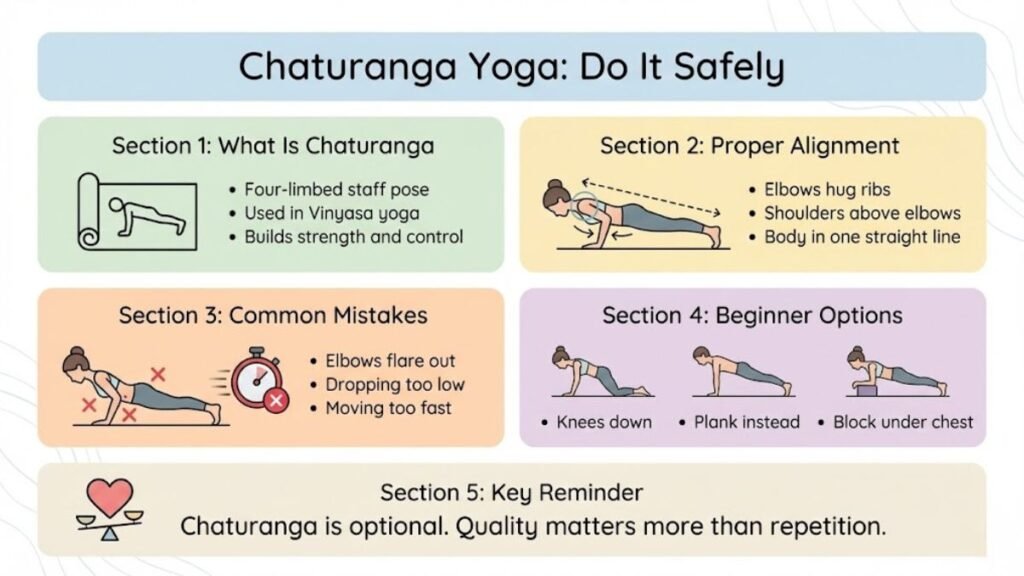
Proper Chaturanga is about control, not depth. Lowering too far is one of the most common causes of shoulder pain in yoga.
Step-by-Step Chaturanga Alignment
- Starting position
- Begin in a strong Plank pose
- Shoulders stacked over wrists
- Body in one straight line from head to heels
- Elbow placement
- Bend the elbows straight back
- Keep elbows close to the ribs
- Do not let elbows flare out to the sides
- Shoulder position
- Keep shoulders level with or slightly above the elbows
- Do not dip the shoulders lower than elbow height
- Chest stays broad, not collapsing
- Core engagement
- Pull the belly gently in
- Engage the legs and press through the heels
- Keep the body firm and steady
- Where to stop lowering
- Stop when elbows reach about a 90-degree angle
- Hover above the floor
- If control is lost, stop earlier or modify
A well-aligned Chaturanga feels strong and stable. If it feels rushed, heavy, or painful, it is a sign to slow down or choose a modification.
Chaturanga vs Plank: What Is the Difference
Chaturanga and Plank may look similar, but they load the body in very different ways. Understanding this difference helps prevent injury.
Arm angle differences
- Plank has straight arms with shoulders stacked over wrists
- Chaturanga has bent elbows held close to the ribs
- In Chaturanga, the arms carry much more body weight
Shoulder load
- Plank spreads the load through the shoulders, core, and legs
- Chaturanga places high demand on the shoulders and elbows
- Poor alignment in Chaturanga increases shoulder strain quickly
Muscle activation
- Plank mainly works the core, shoulders, and legs
- Chaturanga strongly activates the chest, triceps, shoulders, and core
- Chaturanga requires more upper-body strength than Plank
Why Plank is safer for beginners
- Plank allows better control and stability
- It is easier to maintain proper alignment
- Beginners can build strength in Plank before lowering into Chaturanga
For many students, skipping Chaturanga and holding Plank is the safer choice, especially while strength is still developing.
Common Chaturanga Mistakes (And Why They Cause Pain)
Chaturanga mistakes often happen because of speed, fatigue, or poor instruction. Over time, these mistakes can lead to discomfort or injury.
Elbows flaring out
- Elbows move away from the ribs
- This shifts stress into the shoulder joint
- Can lead to shoulder and elbow pain
Dropping too low
- Chest lowers below elbow height
- Shoulders collapse forward
- Increases risk of shoulder strain
Shoulders dipping below elbows
- This puts the shoulder in a weak position
- Often causes sharp or deep shoulder pain
- Especially risky when repeated many times
Moving too fast
- Rushing through the pose removes control
- Muscles cannot support the joints properly
- Pain builds slowly over multiple classes
Using momentum instead of strength
- Body drops instead of lowering with control
- Arms and shoulders absorb sudden force
- Can lead to wrist pain or elbow strain
Pain is not a normal part of Chaturanga. If pain appears, alignment or intensity needs to change.
Is Chaturanga Bad for Your Shoulders
Chaturanga is not bad for your shoulders when it is done correctly and with enough strength. Problems happen when the pose is forced or repeated without proper control.
When Chaturanga is safe
- Elbows stay close to the ribs
- Shoulders do not dip below elbow height
- Core and legs are engaged
- Movements are slow and controlled
When Chaturanga is risky
- Shoulder pain already exists
- Elbows flare out
- The pose is rushed or collapsed into
- Fatigue causes loss of alignment
Who should avoid it
- Beginners without upper-body strength
- Anyone with shoulder, wrist, or elbow injuries
- Students experiencing sharp or lingering pain
Why skipping Chaturanga is okay
- Yoga is about awareness, not forcing poses
- Plank or knees-down options are valid choices
- Many experienced teachers modify or skip it
Listening to your body is part of good yoga practice. Skipping Chaturanga can protect your shoulders and support long-term strength.
Why So Many People Struggle With Chaturanga
Most people struggle with Chaturanga because it requires more strength, control, and shoulder stability than it appears to need.
Chaturanga is often taught as a quick transition, but it is actually a full-body strength pose. When students repeat it many times without enough strength or rest, form breaks down and discomfort starts to appear.
Chaturanga Requires More Strength Than Most People Expect
Chaturanga asks your body to hold itself just above the floor using:
-
Shoulder stability
-
Triceps strength
-
Core engagement
-
Upper back control
For many practitioners, this strength takes months or years to build. Struggling does not mean you are doing yoga wrong. It means your body is still developing the required support.
Fast Yoga Classes Make Chaturanga Harder
In fast-paced Vinyasa or Power Yoga classes, Chaturanga is often repeated many times in a single session.
When the pace is quick:
-
Students lower too fast
-
Elbows flare out
-
Shoulders drop below elbow level
-
Core engagement is lost
Over time, this can irritate the shoulders, elbows, or wrists. This is why many experienced teachers encourage slowing down or modifying the pose.
Modifying Chaturanga Is Not a Failure
Using modifications is not a sign of weakness. It is a sign of body awareness.
Many long-term practitioners:
-
Drop their knees
-
Replace Chaturanga with Plank
-
Lower all the way to the floor
-
Skip Chaturanga entirely on tired days
These choices help protect the shoulders and allow strength to build safely over time.
You Are Allowed to Skip Chaturanga
Chaturanga is optional, not mandatory.
Yoga is not about forcing shapes. It is about choosing movements that support your body on that day. Skipping Chaturanga does not make your practice less effective. In many cases, it makes it safer and more sustainable.
Chaturanga Modifications for Beginners
Chaturanga does not have to be done at full strength. Modifications help protect the shoulders while building control and confidence.
Knees down version
- Lower the knees to the mat from Plank
- Keep elbows close to the ribs
- Maintain a straight line from knees to head
- Stop lowering before the shoulders dip too low
This reduces body weight and makes the pose safer.
Plank to Cobra option
- Hold Plank instead of lowering into Chaturanga
- Lower the body all the way to the mat
- Press into Cobra or Baby Cobra
This option removes shoulder strain while keeping the flow of the practice.
Using blocks
- Place a yoga block under the chest
- Lower until the chest touches the block
- This prevents going too low
Blocks help teach correct depth and protect the shoulders.
Slowing the transition
- Move slowly between Plank and Chaturanga
- Pause halfway to check alignment
- Focus on control instead of speed
Slower movement builds strength and awareness.
Benefits of Chaturanga Yoga Pose
When practiced with good alignment, Chaturanga offers practical benefits without strain.
- Upper body strength
Builds strength in the arms, chest, and shoulders - Core stability
Engages the abdominal muscles to support the spine - Shoulder awareness
Teaches proper shoulder positioning and control - Mindful movement
Encourages slow, intentional transitions
Chaturanga is not about depth or repetition. Its value comes from precision and awareness.
When to Avoid Chaturanga
Chaturanga is not suitable for everyone at all times. It is okay to skip or modify the pose.
Avoid or modify Chaturanga if you have:
- Shoulder injuries or ongoing shoulder pain
- Wrist pain or limited wrist mobility
- Elbow issues or inflammation
- Pregnancy, especially in later stages
In these cases, Plank, knees-down options, or gentle backbends are safer choices.
Learning Chaturanga Safely in Yoga Practice
Chaturanga is best learned slowly and with attention. Doing fewer Chaturangas with good alignment is better than repeating the pose with poor form.
Focus on:
- Control instead of speed
- Shoulder stability instead of depth
- Strength building over time
Chaturanga is always optional. Yoga allows choices, and modifying or skipping the pose supports long-term practice.
With proper instruction and alignment-focused guidance, Chaturanga can become a strong and steady part of yoga practice. Learning in a supportive class environment helps students understand when to lower, when to modify, and when to rest.
The goal is not to force the pose, but to build awareness, strength, and safety over time.
FAQs About Chaturanga Yoga
What muscles does Chaturanga work?
Chaturanga works several muscle groups at the same time, including:
- Arms and triceps
- Shoulders and chest
- Core muscles
- Legs, which help support the body
It is a full-body strength pose when done with control.
Why is Chaturanga so hard?
Chaturanga is difficult because:
- It requires upper body strength
- The body must stay stable while lowering
- Small alignment mistakes increase effort
Many people struggle because they lower too fast or go too low.
How low should you go in Chaturanga?
You should stop lowering when:
- Elbows reach about a 90-degree angle
- Shoulders stay level with or above elbows
- You can still control the movement
Lowering too far increases the risk of shoulder strain.
Can beginners skip Chaturanga?
Yes. Beginners can and should skip Chaturanga if needed.
- Plank is a safe alternative
- Knees-down options are effective
- Skipping the pose helps prevent injury
Skipping Chaturanga does not mean you are doing yoga wrong.
Is Chaturanga the same as a push-up?
No. Chaturanga is not a push-up.
- Push-ups move up and down repeatedly
- Chaturanga is a controlled, single-position hold
- Chaturanga requires more shoulder stability
They look similar, but they load the body differently.