


For anyone feeling the call to become a yoga teacher, the first big decision is almost always the same: The Motherland (India) or The Modern Heart (Bali)?
It is a debate that fills forums and Facebook groups. On one side, you have the raw, ancient roots of yoga in Rishikesh or Mysore. On the other, you have the “Island of the Gods”, Bali, where Hindu tradition blends with modern comfort and vocational excellence.
In 2026, the choice isn’t about which destination is “better.” It is about which environment allows your nervous system to learn best.
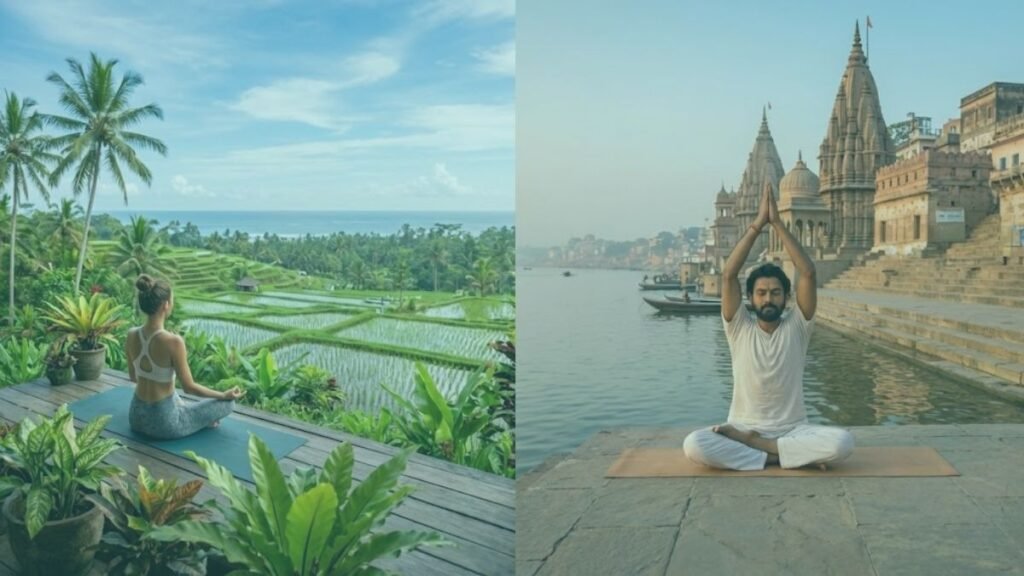
If you are trying to decide between the Ganges and the Rice Fields, this honest comparison will help you choose the path that aligns with your career goals, comfort levels, and learning style.
The “Vibe”: Spiritual Chaos vs. Tropical Zen
India is intense. It is the land of Shakti…raw, creative, and often chaotic energy. A training in India is a lesson in surrender; you will likely deal with noise, crowds, and a sensory overload that can be spiritually awakening but also exhausting.
Bali, specifically areas like Canggu, offers a different energy: Flow.
- The India Experience: You are stepping into a culture that demands you adapt instantly. The “chaos” is part of the guru. It challenges your patience and resilience.
- The Bali Experience: Bali is known for its “Softness.” The infrastructure, from boutique shalas to organized transport, is designed to support you. This creates a container of safety where your nervous system can relax, allowing you to absorb complex philosophy and anatomy without being in “survival mode.”
The Verdict: If you want a “hard reset” and culture shock, choose India. If you want a nervous system reset where you can focus entirely on your studies, choose Bali.
Curriculum & Teaching Style: Lineage vs. Integration
The teaching methodology differs significantly between the two hubs.
In India, training often follows the Gurukula system. It is strictly traditional, often authoritarian, and deeply rooted in a specific lineage (like Ashtanga in Mysore or Hatha in Rishikesh). The focus is often on preservation of the old ways.
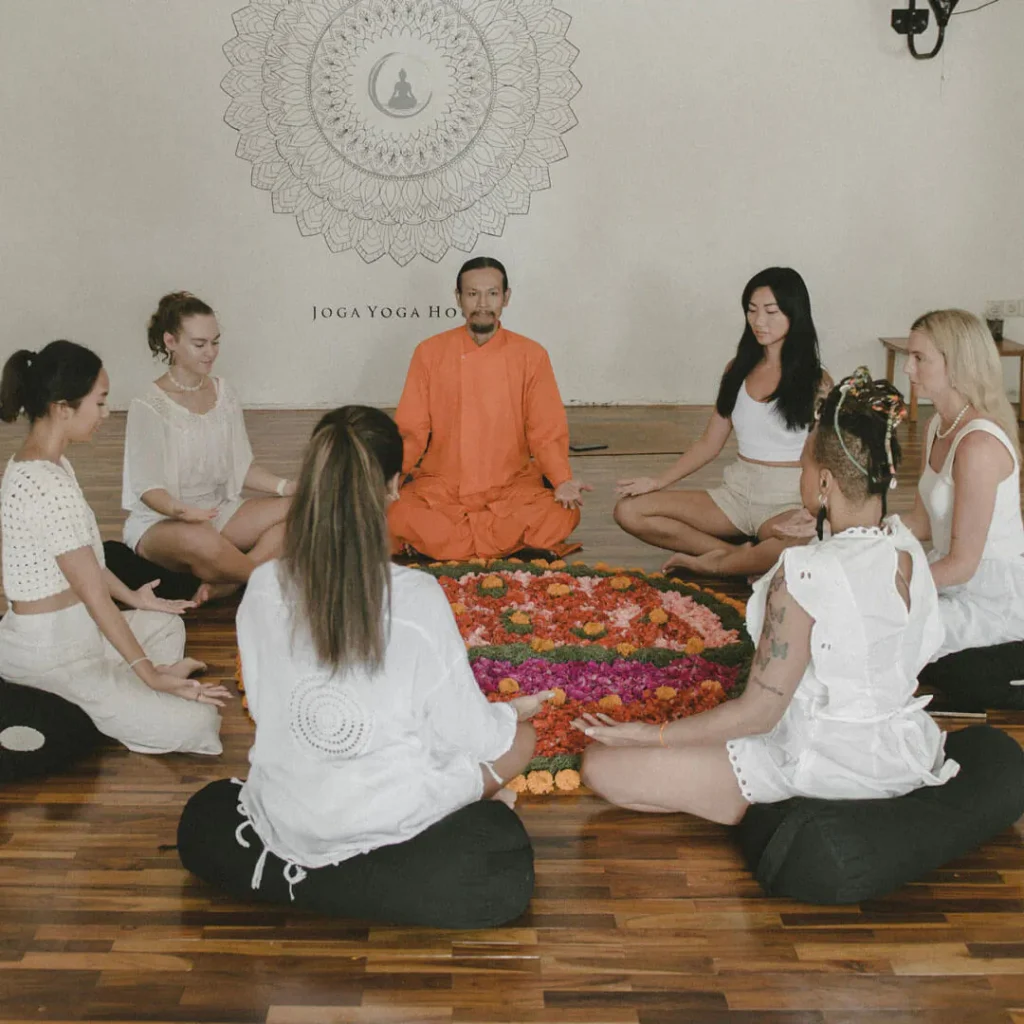
In Bali, and specifically at Joga Yoga, we focus on Integration. We believe a modern yoga teacher needs to bridge the gap between ancient wisdom and modern science.
- Anatomy: While India focuses heavily on the energetic body, Bali trainings often provide superior education in functional anatomy and biomechanics, ensuring you keep your students safe.
- Pedagogy: We teach you how to teach. Our “East meets West” approach combines the spiritual depth of the Yoga Sutras with the practical skills of sequencing, business, and clear communication, essential for a career in 2026.
Cost & Comfort: What Do You Get for Your Money?
On paper, India often looks cheaper. You can find trainings for $1,000 USD. However, the “hidden costs” in comfort and health often balance the scales.
- In India: “Budget” often means shared rooms with no AC, cold showers, and hard mattresses. The lower tuition often reflects a lack of amenities.
- In Bali: The standard of living is significantly higher. For a comparable price, a Bali YTT package typically includes luxury villa accommodation, a swimming pool, air conditioning, and high-speed Wi-Fi.
The Value Equation: When you calculate the cost of flights, visa complications, and the potential need for medical care (see the hygiene section below), Bali often provides a higher Return on Investment (ROI). You are paying for an environment that guarantees you can show up 100% for every single lecture.
Living & Logistics: Austerity vs. Comfort
The philosophy of your daily life differs greatly between these two destinations.
In India, the culture often focuses on Tapas (Austerity). Ashram living is intentionally simple, shared rooms, cold showers, and a disconnect from modern luxuries are features, not bugs. This simplicity is designed to build character and detach you from material needs.
In Bali, the culture focuses on Nurturing. At Joga Yoga, we believe that comfort is a learning tool.
- The Comfort Factor: Sleeping well in an air-conditioned room with a high-quality mattress means you wake up rested. Having high-speed Wi-Fi means you can stay connected with family without stress.
- The Value Equation: While tuition in India can be lower, the “hidden costs” of upgrading your accommodation to Western standards can equalize the price. A Bali YTT package typically includes luxury villa accommodation and amenities that allow you to focus 100% on your studies.
The Verdict: If you want to practice detachment from the material world, India is the place. If you want a supportive environment that maximizes your capacity to absorb information, Bali is the strategic choice.
Health & Hygiene: Managing Your “Agni”
Let’s be honest: whether you choose India or Bali, traveling to the tropics comes with health considerations. You have likely heard of “Delhi Belly,” but “Bali Belly” is also a reality.
In a 200-hour intensive training, your health is your most important asset. Missing 3 to 5 days of lectures due to illness can set you back significantly.
- In India: The bacterial environment is distinct and intense. While many schools maintain good standards, the overall environment in bustling pilgrim cities like Rishikesh requires strict vigilance with water and street food.
- In Bali: You must still be careful (no tap water!), but the tourism infrastructure in areas like Canggu is highly developed for international wellness travelers. At Joga Yoga, we mitigate the risk by controlling the environment: our Sattvic meals are prepared in-house with high hygiene standards, allowing you to focus on learning rather than worrying about your next meal.
The Visa Reality (2026)
When you are planning a month-long vocational course, certainty is key.
- India: Visa policies can be bureaucratic. While the e-Visa system exists, it can sometimes be complex depending on your nationality or political climates.
- Bali (Indonesia): Indonesia has streamlined its entry process to become a top destination for “Edu-Tourism.”
- Simplicity: Most nationalities (including Chinese, Australian, European, and American citizens) can use the Visa on Arrival (VoA).
- Certainty: You can now apply for the e-VoA online 14 days before your trip. It is fast, digital, and reliable.
- Extension: The standard 30-day visa is easily extendable for another 30 days, covering your entire training.
Read our detailed breakdown here: Travel Visa Tips for Yoga Teacher Training in Bali
Conclusion: Which Teacher Do You Need Right Now?
So, India or Bali?
If your soul is calling for a pilgrimage, if you want to touch the soil where the Rishis walked, and you are prepared for the intense “Tapas” that comes with deep spiritual growth…go to India. It is a journey every yogi should take at least once.
But, if your goal for this trip is to become a professional teacher; if you want a learning environment that supports your nervous system, offers modern educational standards, and allows you to graduate feeling rested rather than depleted…choose Bali.
At Joga Yoga, we honor the Indian lineage while embracing the comfort and methodology that modern teachers need to succeed.
Are you ready to find your flow in the tropics?
View Upcoming Dates & Syllabus for 200-Hour YTT in Bali
FAQ
Is yoga teacher training cheaper in Bali or India?
On paper, India is cheaper, with tuition often ranging from €1,200 to €2,000 for a standard course. However, Bali packages (typically €1,500–€3,000) usually include luxury villa accommodation, air conditioning, and high-hygiene meals. When you factor in the “hidden costs” of upgrading your lifestyle in India to match Western comfort standards, the price difference narrows significantly, with Bali often offering a higher Return on Investment (ROI) for comfort and health security.
How much does a 200-hour YTT cost in Bali vs. Rishikesh in 2026?
A standard 200-hour course in Rishikesh typically costs between $800 and $1,500 USD, often with basic shared accommodation. In Bali, reputable schools charge between $2,000 and $3,500 USD. The higher price in Bali reflects the inclusion of resort-style amenities, swimming pools, and “Sattvic” nutritional programs designed to prevent illness, ensuring you don’t lose training days to health issues.
Is it safe for a woman to travel to India for yoga training alone?
India can be safe for solo female travelers, but it often requires a high degree of vigilance and assertiveness to navigate the “spiritual chaos” of cities like Rishikesh. Bali, particularly Canggu and Ubud, is consistently ranked as one of the safest destinations for solo female travelers. The island’s “soft hospitality” and developed tourism infrastructure create a supportive container where students feel secure enough to relax and focus entirely on their studies.
How common is food poisoning during yoga training in India?
Digestive issues, often called “Delhi Belly,” are a frequent challenge for international students in India due to the intense bacterial environment. While “Bali Belly” exists, the risk is significantly lower in established yoga hubs like Canggu. Schools like Joga Yoga mitigate this by providing hygiene-controlled, plant-based meals prepared in-house, ensuring your energy goes into learning rather than recovering.
Is a yoga certificate from India better than one from Bali?
Not necessarily. While India offers the prestige of the “source,” Bali trainings often provide superior education in modern functional anatomy, biomechanics, and business methodology. Both certifications are globally recognized if the school is a Registered Yoga School (RYS) with Yoga Alliance. Joga Yoga’s curriculum specifically bridges the gap, teaching traditional philosophy alongside the practical skills needed to teach in Western studios.
Does Yoga Alliance recognize schools in both India and Bali?
Yes, Yoga Alliance recognizes Registered Yoga Schools (RYS) globally, regardless of location. Whether you train in an ashram in Rishikesh or a shala in Bali, your RYT-200 designation is valid worldwide. The key difference is often the teaching style: India tends to focus on strict lineage preservation, while Bali schools often focus on integration and vocational readiness for the modern market.
Do I need a visa for yoga teacher training in Bali?
Indonesia has a streamlined entry process for “Edu-Tourism.” Citizens from 97 countries (including China, Australia, USA, and UK) are eligible for a Visa on Arrival (VoA). This allows for an initial 30-day stay, which can be easily extended for another 30 days to cover your entire training. This process is often faster and more digital-friendly than the visa application process for India.
Is yoga in Bali “authentic” compared to India?
Yes, but the flavor is different. Bali is the only Hindu-majority island in Indonesia, practicing Agama Hindu Dharma, which is deeply ritualistic and woven into daily life. While India offers the raw historical roots, Bali offers a “living tradition” of devotion. Modern schools in Bali honor these roots while integrating scientific anatomy, offering a blend of ancient wisdom and modern application.
Are yoga teacher trainings in India taught in English?
Yes, most courses catering to foreigners in India are taught in English. However, accents and pedagogical styles can vary greatly. In Bali, schools catering to the international market specialize in “Global English” or “Yoga English”, the standard cueing language used in top studios worldwide. This is a major career advantage for non-native speakers (like Chinese students) who want to teach globally.
Which is better for beginners: India or Bali YTT?
Bali is often the strategic choice for beginners. The supportive environment, defined by comfort, safety, and high hygiene standards, allows you to focus 100% on learning the foundations (Asana, Philosophy, Anatomy) without the distraction of “survival mode” often experienced in the more intense environment of India. This “soft landing” helps beginners build confidence before they eventually make the pilgrimage to India later in their journey.