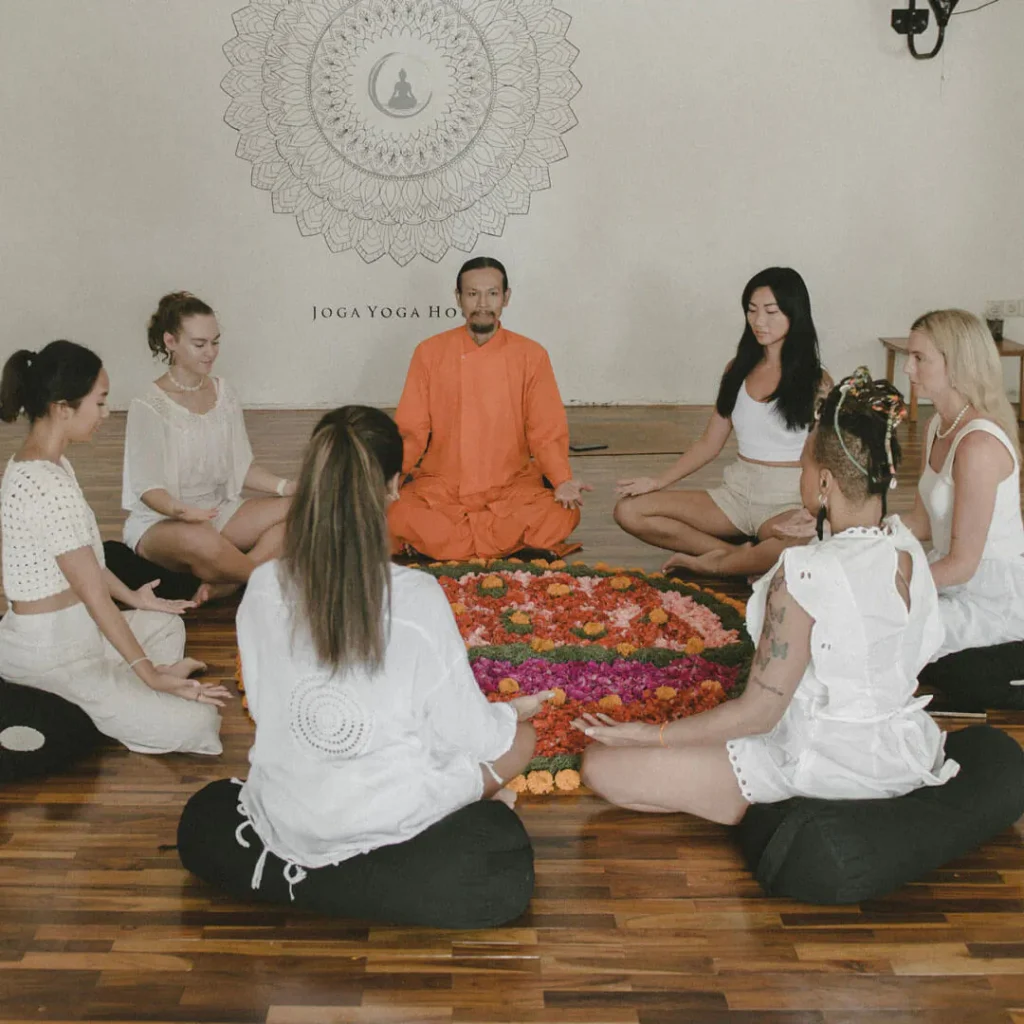




Ayurveda in yoga teacher training Bali is not about memorizing Sanskrit terms or following a perfect detox plan. It is mainly a practical way to manage energy, digestion, sleep, and recovery while training in Bali’s heat, humidity, and high-volume daily schedule.
If you are trying to picture what a YTT day really feels like, this guide focuses on the parts that matter before booking: routine shock, food, fatigue, recovery, and what tends to work better in a real training environment than in idealized marketing descriptions.

How is Ayurveda actually used during yoga teacher training in Bali?
Ayurveda is usually used in yoga teacher training in Bali as a practical framework for managing routine, digestion, and recovery so students can handle long days, heat, and repeated physical practice without burning out too early.
In most programs, Ayurveda shows up less as philosophy and more as structure. Students wake early, eat at set times, practice in a repeated rhythm, and are encouraged to notice how food, sleep, and the Bali climate affect their body. That is the real function of Ayurveda inside a residential training: controlling variables so your system stays stable.
This is why digestion becomes a bigger topic than many students expect. When training runs from early morning into evening, your body is not only processing movement. It is also processing stress, social stimulation, heat exposure, unfamiliar food timing, and inconsistent sleep during the first several days. In Ayurvedic terms, this is often discussed through Agni, but in practical terms it means one thing: if digestion becomes unstable, energy and focus usually drop fast.
Recovery is the third major use. Students often assume yoga teacher training is about flexibility and technique. In reality, recovery capacity becomes one of the biggest performance factors. A person who sleeps well, eats appropriately, hydrates properly, and does not overload the nervous system often handles training better than someone who arrives fit but ignores recovery.
And this is where the Bali context matters. The body behaves differently in humid heat than it does at home. Sweat loss, appetite shifts, bloating, afternoon heaviness, and shallow sleep can all change how a student experiences the same schedule. That is why, if you’ve already seen a typical schedule in a yoga teacher training in Bali guide, you’ll recognize how structured the days are: the structure itself is part of what makes an Ayurvedic approach useful.
What daily routine do yoga students follow during training?
Most yoga students follow a fixed early-to-evening routine during training, with movement, breathwork, lectures, meals, and rest happening at roughly the same times every day so the body can adapt to intensity faster.
The first surprise for many students is not the number of classes. It is how little mental space exists between them. A typical day may feel calm on paper, but in real life it often feels compressed. You move, eat, study, socialize, rest briefly, then repeat.
Morning routine
Mornings usually begin early, often before sunrise or shortly after. Students may start with silence, tea, breathwork, meditation, cleansing habits, or a gentle mobility practice before the main asana session.
This part of the day often feels best physically. The body is cooler, the mind is quieter, and the schedule still feels manageable. Many students assume the entire day will continue like this. That assumption usually breaks by day three or four.
Morning practice can be energizing, but it also sets the tone for the whole system. If a student goes too hard early, skips hydration, or drinks too much coffee on an empty stomach, the rest of the day becomes harder. This is where people begin to notice the difference between training and taking yoga classes on vacation.
Midday structure
Midday usually includes breakfast or brunch, philosophy, anatomy, teaching methodology, alignment work, or group sessions that require sustained attention rather than pure physical output.
This is often when fatigue starts to show up. The combination of heat, sitting after movement, heavy meals, and information load can create a very different kind of exhaustion than students expect. Some feel sleepy. Others feel wired but unfocused. Some notice bloating, low appetite, or an odd mix of hunger and heaviness.
The ideal schedule looks balanced, but the real schedule behavior is messier. Students sometimes crash after lunch, struggle to retain information, or feel emotionally sensitive for no obvious reason. That does not necessarily mean the program is too hard. It often means the nervous system is adapting.
Most schedules follow a structure similar to what you’ll find inside a 200-hour yoga teacher training in Bali, but the lived experience depends on how well the student handles repetition, food timing, and climate stress.
Evening recovery
Evenings usually include a lighter practice, meditation, chanting, self-study, journaling, teaching practice, or an earlier dinner followed by rest.
In theory, evenings are calming. In reality, this is where hidden fatigue becomes obvious. Students may feel socially drained, overstimulated, or too tired to process what they learned. Some sleep deeply. Others find they are exhausted but restless.
This is also when recovery habits matter most. A simple dinner, less phone use, enough water and electrolytes, and reduced social activity often help more than adding more stretching or self-improvement tasks.
How does Bali’s climate affect your body during yoga training?
Bali’s climate affects your body during yoga training by increasing heat stress, fluid loss, digestive irregularity, and sleep disruption, especially during the first week when your routine changes faster than your body can fully adapt.
Students often underestimate how much heat and humidity influence training tolerance. In places like Canggu Bali, the air can feel heavy even before practice starts. That changes sweating, breathing, appetite, and energy distribution across the day.
Heat impact
Heat often creates earlier fatigue than students expect. You may not feel sore, but you feel slower, flatter, and more easily drained.
This matters during YTT because classes are stacked. A level of exertion that feels fine for one session may become difficult when repeated morning and afternoon over many days. Heat can also reduce appetite, which then leads students to under-eat, only to crash later.
Another common issue is mistaking dehydration for emotional instability or poor fitness. Students may think they are not cut out for the program when the real issue is simply fluid and mineral loss.
Humidity impact
Humidity can make the body feel heavy even when practice itself is not extreme. Sweat does not always feel refreshing, and recovery can feel slower because the body never fully cools down.
For some students, humidity creates puffiness, bloating, sluggish digestion, and an odd sense of internal heat combined with physical heaviness. For others, it increases irritability and makes sleep feel less restorative.
This is one reason “light but regular” usually works better than extremes. Skipping meals, overdoing strong practices, or chasing a cleansing routine often backfires faster in Bali than in a drier climate.
Common student problems
The week 1 breakdown is fairly predictable. On days one to two, students often feel motivated and energized. On days three to five, fatigue, digestive changes, headaches, poor sleep, and emotional sensitivity tend to rise. By the end of week one, the body either starts adapting or the student begins accumulating avoidable stress.
Common problems include afternoon crashes, waking up tired, bloating after healthy meals, constipation or loose digestion, lightheadedness during practice, and feeling socially exhausted from constant group contact. None of these are unusual. What matters is responding early rather than pushing harder.
What do you actually eat during an Ayurvedic-based yoga training?
During an Ayurvedic-based yoga training, students usually eat simple, warm, easy-to-digest meals built around rice, vegetables, legumes, soups, fruit, and lighter proteins rather than heavy restaurant food or highly processed snacks.
The meals are often less exciting than what students imagine Bali food will be, but there is a reason for that. YTT food is supposed to support consistency, not entertainment. In most cases, the best meals are the ones that digest cleanly and do not make the next session harder.
Typical meals may include rice, dhal, mung beans, lightly spiced vegetables, soups, congee-style breakfasts, stewed fruit, herbal teas, eggs in some programs, and sattvic food patterns that avoid overly stimulating ingredients. Salads can appear, but many students handle cooked food better during intensive training.
The most common mistake is eating as if you are on holiday in Bali rather than inside a demanding residential course. That often means too much coffee, smoothie bowls that digest poorly for some people, late-night desserts, fried foods on days off, or large meals after long hunger gaps.
What works in practice is usually less theoretical than students expect:
- warm meals over cold ones
- regular meal timing over “intuitive” chaos
- moderate portions over restriction or overeating
- enough salt and hydration in humid weather
- less experimentation during the first week
What does not work well in Bali’s climate for many students is aggressive cleansing behavior. Juice fasts, ultra-light eating, or trying to become perfectly “pure” while training hard often lead to fatigue, unstable digestion, and poor concentration. A body under load usually handles steadiness better than idealism.
Is Ayurvedic astrology actually relevant in yoga teacher training?
Ayurvedic astrology is only somewhat relevant in yoga teacher training, because while it may be interesting as part of the broader philosophical framework, it usually has far less practical value for students than food, sleep, pacing, and recovery.
Some trainings introduce astrology, subtle body concepts, or related systems as part of a wider spiritual or traditional curriculum. That can add cultural and philosophical context, and for some students it deepens the experience.
But most students do not struggle because they lack symbolic understanding. They struggle because they are tired, dehydrated, under-recovered, or trying to do too much too soon.
So what is useful? General frameworks that help students reflect on patterns can be useful. Noticing whether you get overstimulated, overheated, or mentally scattered is useful. Tracking when you feel clear or heavy is useful. Turning that observation into better routine choices is useful.
What is less practical is spending too much time trying to decode yourself through an abstract system while ignoring obvious physical signals. In a yoga teacher training Bali context, the most effective applications of Ayurveda are usually concrete: food timing, sleep protection, pacing, and digestion support.

How do you use Ayurveda to avoid burnout during training?
You use Ayurveda to avoid burnout during training by regulating recovery, meal timing, and sleep so your nervous system stays stable enough to handle repeated practice, study load, and the environmental stress of Bali.
Burnout in YTT rarely arrives as one dramatic moment. It usually builds through small mistakes repeated daily. Too little food. Too much socializing. Not enough sleep. More effort every day with no compensation.
Recovery
Recovery begins with accepting that more effort is not always better. In week one, many students overperform because they want to prove they belong. They attend every optional session, stretch after every class, explore Bali at night, and keep up constant conversation with new friends.
Then the body pushes back. Signs include waking up unrefreshed, losing enthusiasm, feeling emotionally flat, getting irritable over small things, and having trouble concentrating during anatomy or philosophy sessions.
A smarter recovery approach is simple: protect breaks, sit down when you can, reduce unnecessary outings, and do less extra movement than you think you need.
Food timing
Food timing matters because long gaps or erratic eating create unnecessary stress. Most students do better when they eat enough after morning practice, avoid very heavy lunches, and do not wait until late evening to correct an energy deficit.
This is especially important for students who run on caffeine at home. In Bali, that pattern can magnify nervous system swings. Regular meals stabilize the day more effectively than stimulants.
Sleep
Sleep is where the whole training either consolidates or starts unraveling. Even one hour less sleep each night becomes noticeable across a two- or three-week program.
The simplest Ayurvedic advice here is also the most useful: eat early enough, reduce late stimulation, cool the room if possible, lower screen time, and stop treating every evening like a community event. Students who protect sleep generally recover faster, learn better, and enjoy the training more.
What do most students get wrong in the first week?
Most students get the first week wrong by overtraining, eating unpredictably, and underestimating social fatigue, which together create the exact exhaustion they later blame on the program itself.
The first mistake is overtraining. Students arrive excited and often think every practice should be maximal. They push flexibility, add extra workouts, or refuse to modify because they want to be seen as capable. That usually creates soreness, poor energy, and unnecessary strain by midweek.
The second mistake is bad eating habits disguised as healthy choices. Smoothies, fruit-heavy breakfasts, coffee without enough food, big cheat meals on breaks, or not eating enough protein and grounding foods can all make the body less stable.
The third mistake is social fatigue. This is the one many people never expect. Living, eating, studying, and practicing with the same group all day creates mental load. Even if everyone is kind, constant interaction can wear down the nervous system. Students then confuse overstimulation with a problem in the training itself.
Another common error is believing the ideal version of the schedule is the real version. On paper, the day may look balanced. In practice, delays happen, energy changes, emotional reactions surface, and the body has uneven days. The students who handle week one best are usually the ones who adapt early rather than chase perfection.
How should you prepare before joining a yoga teacher training in Bali?
You should prepare for yoga teacher training in Bali by resetting your routine, simplifying your diet, and arriving with realistic energy expectations so the first week feels like adaptation instead of shock.
Many people prepare intellectually but not physically. They read about certification, compare schools, and buy clothes, but they do not prepare their body for earlier mornings, repeated movement, simpler food, and less private space. Once you understand the commitment, including the real yoga teacher training Bali cost, preparation becomes more important because you want the experience to work, not just the booking.
7-day prep plan
Seven days before travel, start waking up earlier. Reduce late nights. Increase hydration. Cut back on alcohol. Keep food simpler than usual. You do not need a full cleanse. You need stability.
Three to five days before departure, reduce junk food, overeating, and high caffeine dependence. Try eating at regular times. If possible, do one practice each day at a moderate level rather than alternating between nothing and intensity.
The final two days should be calm, not ambitious. Prioritize sleep, organize travel details, and avoid arriving already depleted.
Routine reset
The best routine reset is boring: wake, move, eat, rest at consistent times. That is exactly why it works.
You are preparing your nervous system to tolerate predictability. Students who live in a highly irregular pattern before YTT usually experience the sharpest routine shock in Bali.
Diet adjustment
Diet adjustment does not mean becoming perfectly Ayurvedic overnight. It means reducing what is likely to create friction: excessive sugar, heavy takeout, alcohol, erratic meal timing, and digestive overload.
Warm meals, cooked foods, and moderate portions are often easier to carry into training than a sudden attempt to become ultra-clean. You are not trying to impress the program. You are trying to arrive with a body that can adapt.
How do you choose the right yoga teacher training program in Bali?
You choose the right yoga teacher training program in Bali by checking schedule clarity, teacher quality, class size, and location fit, because those factors affect your daily experience more than broad lifestyle branding.
A strong program tells you exactly how the day runs, who teaches, what the certification includes, and how much attention students realistically receive. If you’re comparing options, the difference between 100 vs 200 vs 300 hour yoga teacher training becomes clear quickly once you match the format to your energy, goals, and experience level.
Schedule clarity matters because vague promises usually hide intensity. You want to know when practice happens, how much teaching practice is included, when meals happen, and whether there is actual recovery time.
Teacher quality matters more than branding language. Look for clear teaching backgrounds, practical communication, and whether the lead teachers seem able to work with mixed levels rather than only advanced practitioners.
Class size changes the whole experience. Smaller groups usually allow better feedback, more adjustment, and less anonymity. Larger groups can still work, but students should know what level of support they are getting.
Location also shapes the experience:
- Canggu often suits students who want convenience, cafés, beach access, and a more social environment.
- Ubud often suits students who want a quieter inland setting and less stimulation.
Neither is automatically better. The right choice depends on how much structure versus stimulation you handle well.
Finally, consider the commercial path too. Some students are best suited to a 100 hour yoga teacher training first. Others need a full 200 hour yoga teacher training with Yoga Alliance certification from the start. More advanced teachers may be better served by a 300 hour yoga teacher training only after they already know how they respond to a residential course format.
Final thoughts: experience matters more than the idea of Ayurveda
The value of Ayurveda during YTT is not that it makes the training sound deeper. The value is that it helps you function better inside a demanding environment.
That means better digestion when the schedule is full. Better recovery when your body feels heavy. Better pacing when motivation tricks you into doing too much too early. And better awareness of what actually supports you in Bali, rather than what sounds good online.
If you’re considering doing a yoga teacher training in Bali, understanding how your body adapts will make a huge difference. The students who usually get the most from training are not the ones who arrive the most extreme or the most “spiritual.” They are the ones who arrive prepared, pay attention early, and build a routine their body can actually sustain.
What Students Actually Feel in Week 1 of Yoga Teacher Training in Bali
Most students do not struggle because the training is “too spiritual” or “too advanced.” They struggle because Bali heat, routine shock, digestion changes, and social fatigue all hit at the same time.
Days 1–2
What it feels like
- High motivation
- Adrenaline and curiosity
- Body still feels fresh
Common mistake
Doing too much too early because energy still feels high.
Days 3–5
What it feels like
- Afternoon fatigue
- Digestive changes
- Sleep disruption
- Mental overload
Common mistake
Using coffee, sugar, or restrictive eating instead of better pacing and recovery.
Days 6–7
What it feels like
- Adaptation starts
- Energy becomes more predictable
- Body responds better to routine
Common mistake
Planning too many outings or social activities instead of recovering properly.
What Usually Works in Bali
- Warm simple meals
- Earlier sleep
- Steady hydration
- Moderate effort in practice
- Less stimulation at night
- Regular food timing
What Usually Backfires
- Overtraining in week 1
- Skipping meals
- Cold smoothie-heavy eating
- Late nights in Canggu
- Too much coffee
- Trying to “cleanse” during training
Thinking about joining a yoga teacher training in Bali? The students who usually do best are the ones who prepare for the routine, not just the certificate.
See the 200-hour yoga teacher training in BaliFAQs
Is Ayurveda required in YTT?
No. Many trainings include Ayurvedic concepts, but you do not need prior knowledge. What matters more is whether the program uses those ideas practically through food, routine, and recovery support.
What dosha is most affected in Bali?
There is no universal answer, but many students notice signs often associated with Pitta and Vata imbalance: overheating, irritability, light sleep, fatigue, and digestive inconsistency caused by climate, schedule, and stimulation.
What food is served in YTT?
Most programs serve simple meals such as rice, vegetables, legumes, soups, fruit, and other light-to-moderate dishes designed to digest well during daily practice.
Can beginners follow Ayurvedic routines?
Yes. Beginners usually do fine with Ayurvedic routines because the basics are simple: regular meals, enough rest, moderate pacing, hydration, and easier-to-digest food.
How intense is yoga teacher training?
It is usually more intense than a yoga retreat and less extreme than some people fear. The challenge comes from repetition, early mornings, mental study, climate adaptation, and reduced recovery margin.