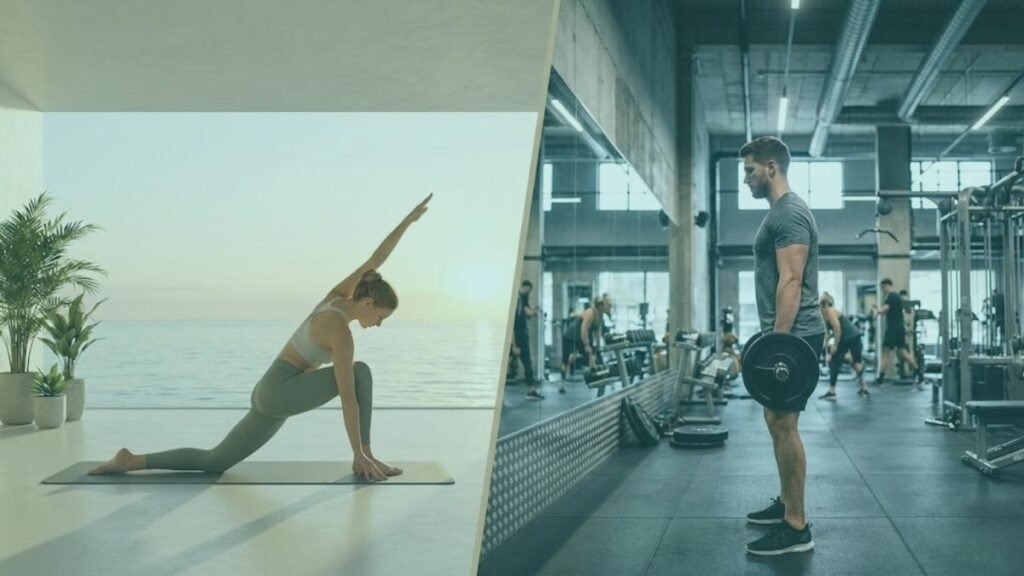
Everyone asks this question eventually. You want to get in shape, but you do not know which path to take. Should you sign up for a gym membership and lift heavy weights? Or should you join a yoga studio and roll out a mat?
It is a big choice. The gym promises big muscles and raw power. Yoga promises flexibility, balance, and peace of mind.
But which one actually builds a better body?
The answer depends on what you want your body to do. Do you want muscles that look big in a mirror? Or do you want a body that is strong, moves easily, and lasts for a long time without pain?
This guide compares weightlifting and yoga so you can decide which method is right for your goals.
The Visual Difference: “Show Muscles” vs. “Go Muscles”
The most obvious difference between the gym and yoga is how your body looks after a year of training.
The Gym Look Weightlifting at the gym often focuses on “isolation.” This means you work on one muscle group at a time, like doing bicep curls or leg presses. This type of training creates hypertrophy, which means the muscle grows larger in size. This is great if you want a bulky, muscular look. We often call these “show muscles” because they look impressive.
The Yoga Look Yoga is different. It relies on “functional movement.” You almost never isolate just one muscle. Instead, you use your whole body to hold a pose. This builds long, lean, and dense muscle. You might not look as bulky as a bodybuilder, but you will be incredibly strong relative to your body weight. We call these “go muscles” because they help you move efficiently in real life.
If you want to see how continuous movement builds this type of lean strength, read our Vinyasa Flow Yoga Guide.
Can You Actually Build Muscle With Yoga?
A common myth is that yoga is just stretching and relaxation. Many people think you cannot build real muscle without heavy dumbbells. This is not true.
Your muscles actually do not know the difference between a metal weight and your own body weight. To a muscle, resistance is just resistance.
In the gym, you create resistance by adding more weight plates. In yoga, you create resistance by using gravity and leverage. When you hold a Plank pose or a Warrior pose for two minutes, your muscles are under constant tension. This burns fat and tears muscle fibers just like lifting weights does.
This is why many professional sports players use yoga to build power without adding extra weight that slows them down. You can learn more about this in our article on Yoga for Athletes.
The “Burnout” Factor: Cortisol and Stress
One major difference between the gym and yoga is how they affect your stress levels. This is very important if you have a busy or stressful job.
The Gym Problem Heavy weightlifting puts a lot of physical stress on the body. When you lift heavy weights, your body releases a hormone called cortisol. This is the “stress hormone.” If you are already stressed from work or life, adding more cortisol can be a problem. It can leave you feeling exhausted or “burned out” instead of energized. High cortisol can also make it harder to lose belly fat.
The Yoga Solution Yoga is different because it focuses on breathing. Even when you are holding a difficult pose, you are trained to breathe slowly and calmly. This sends a signal to your brain to relax. It lowers your cortisol levels. You get the benefit of a hard workout, but you leave the class feeling calm instead of wired.
This balance is why yoga is so good for mental health. You can learn more about how this works in our guide to Nervous System & Yoga.
Longevity: Who Moves Better at 80 Years Old?
When you are young, you might only care about how your body looks. But you should also care about how your body feels when you get older.
The Wear and Tear of Weights Weightlifting creates compression. Gravity and heavy weights push down on your spine and joints. Over many years, this can cause stiffness. It can “squish” the discs in your back. This is why many older weightlifters have trouble bending over or moving freely.
The Length of Yoga Yoga creates decompression. Many poses are designed to lengthen the spine and open up the joints. Instead of compressing your body, you are stretching it out. This keeps your joints lubricated and healthy.
If you want to avoid back problems as you age, yoga is the best medicine. It keeps your posture tall and your movement fluid. Read more about this in our article on Yoga for Posture and Back Pain.
Combining Both: The Hybrid Approach
You do not have to pick just one side. In fact, many of the best athletes in the world do both.
The Balance Strategy Think of the gym and yoga as two different tools in your toolbox.
- Use the gym to build raw power and maximum strength.
- Use yoga to stay flexible, prevent injuries, and speed up your recovery.
If you only lift weights, you might become stiff and prone to injury. If you only do soft yoga, you might miss out on the explosive power that heavy lifting provides.
Many bodybuilders now practice yoga on their rest days. It helps flush out lactic acid from their muscles and improves their blood flow. This helps them get back to the gym faster. You can combine this with other recovery methods like ice baths for the best results. Read more about this in our guide to Yoga Recovery (Sauna & Cold Plunge).
Stop Renting Your Strength. Own It.
There is one final difference that changes everything.
When you use a machine at the gym, the machine stabilizes the weight for you. It dictates the path of movement. In a way, you are “renting” stability from the machine.
In yoga, there is no machine. You have to stabilize your own body. You have to control every muscle, every joint, and every breath. You are not renting stability; you are building it yourself. You own that strength completely.
Are you ready to master your own body?
At Joga Yoga, we teach you the mechanics behind the movement. You will learn how to build a body that is not just strong for a season, but strong for a lifetime.
View Our 200-Hour Yoga Teacher Training in Bali