

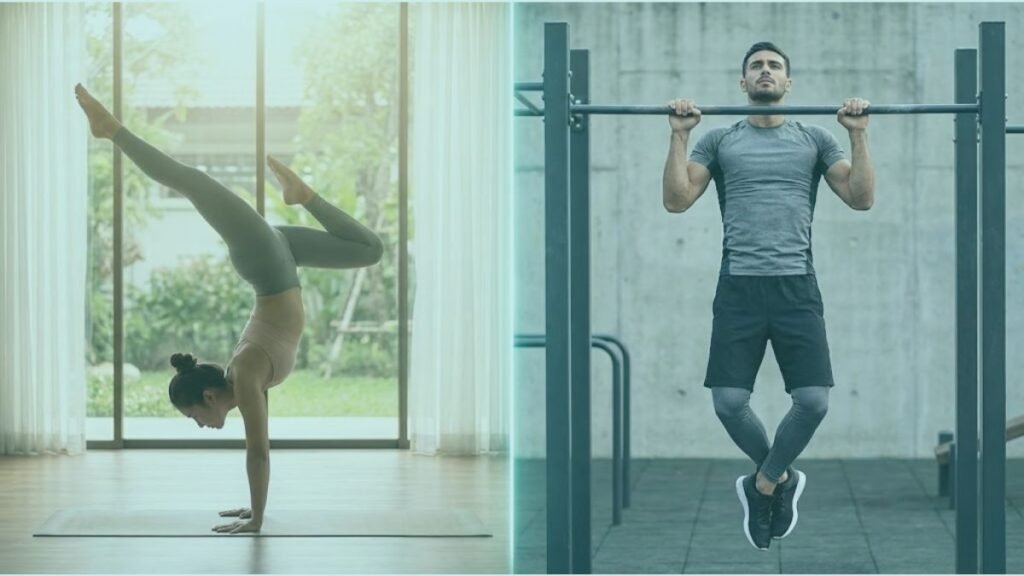
You want to get strong without paying for a gym membership. You go to the park and see guys doing muscle-ups on the bars. Then you look online and see yogis floating into handstands. They both look incredible.
Both styles use your own body weight. Both require a lot of balance. So, is yoga just “spiritual calisthenics”? Or is calisthenics just yoga without the breathing?
It can be confusing. While they look similar on the surface, they train your body and mind in very different ways.
In this guide, we compare strength, muscle growth, and longevity to help you decide which path is right for you.
The Core Difference: “Reps” vs. “Awareness”
If you look at them quickly, yoga and calisthenics seem to be the same thing. Both methods use gravity and your own body weight to build a fit human. However, the goal of each practice is completely different.
Calisthenics: The Street Workout
Calisthenics is often called a “street workout” because you can do it outside using bars or benches. It focuses on dynamic, fast-moving exercises like push-ups, jumping jacks, and pull-ups. The main goal here is physical fitness. You want to increase your muscle endurance and raw power by doing many repetitions. It is often adrenaline-pumping and exciting.
Yoga: The Ancient Practice
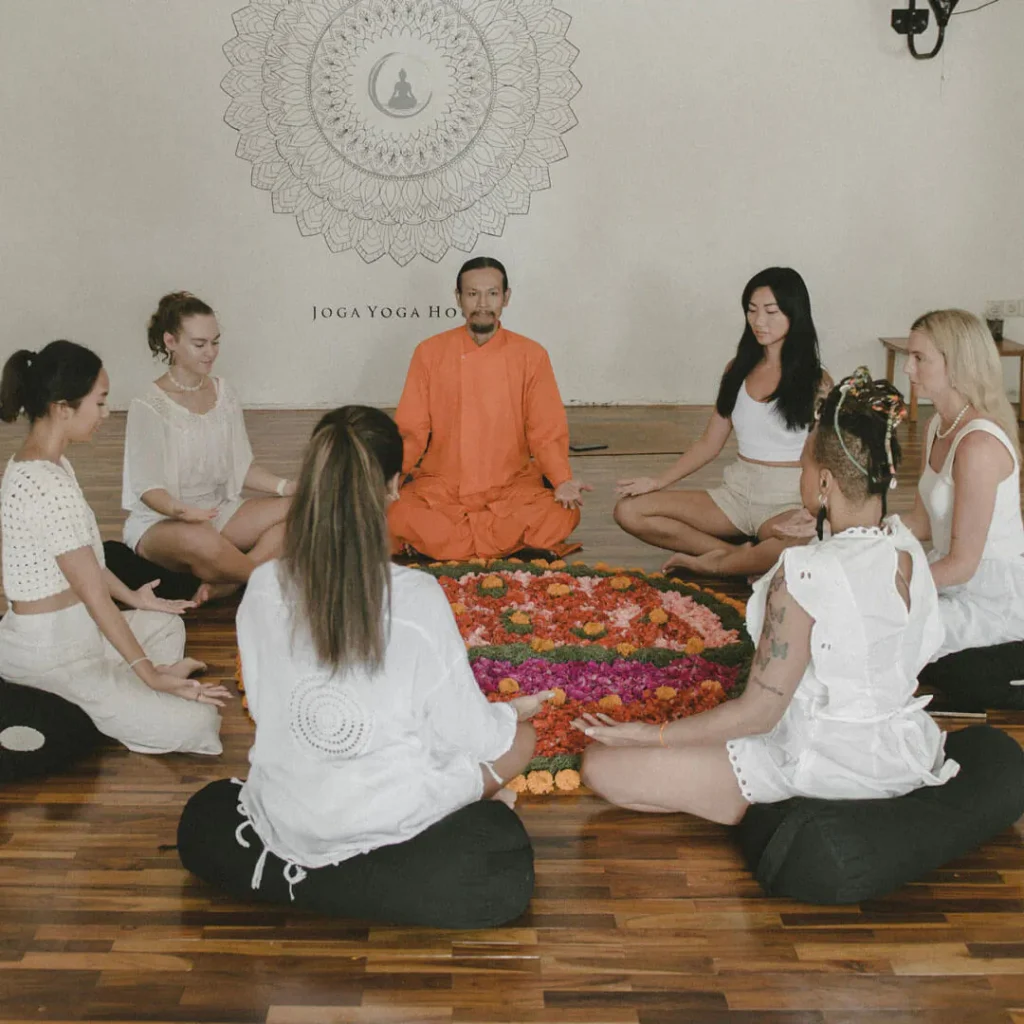
Yoga is over 5,000 years old. While it also uses body weight, it is not just about fitness. It uses static poses to train your mind to focus on your breathing. Unlike calisthenics, which focuses mostly on the physical muscles, yoga also targets the “energetic body”. This leads to a sense of mental awareness that goes beyond just being in shape.
One yoga teacher summed it up perfectly: “Focus on the breath, otherwise it is just calisthenics”.
Calisthenics vs. Yoga for Muscle Growth and Strength
A common question is which one makes you stronger. The answer depends on what kind of strength you want.
The “Six Pack” Factor
If you want chiseled abs and visible muscles very fast, calisthenics is often the winner. It integrates everything into a single function, engaging your core, glutes, and lower back in every movement. Because you do high repetitions of exercises like sit-ups and push-ups, you can build muscle mass and shape your body quickly.
The “Yogi Strength” Factor
Do not be fooled into thinking yoga is just for gentle stretching. Some styles, like Ashtanga, take years to master and build immense strength.
Some people noticed that those who do yoga religiously are slim but incredibly strong. They could carry a 55-pound dumbbell like it was nothing, even though they never lifted weights. This happens because yoga builds “usable strength” or balanced body strength. You are not just pushing weight; you are learning to control your body in difficult positions for long periods.
If you want to know which yoga style builds the most muscle, read our Ashtanga vs. Vinyasa Yoga Guide.
The “Pulling” Problem: Why Yoga Needs Pull-Ups
There is one major gap in yoga training that calisthenics fixes perfectly.
The Yoga Limit
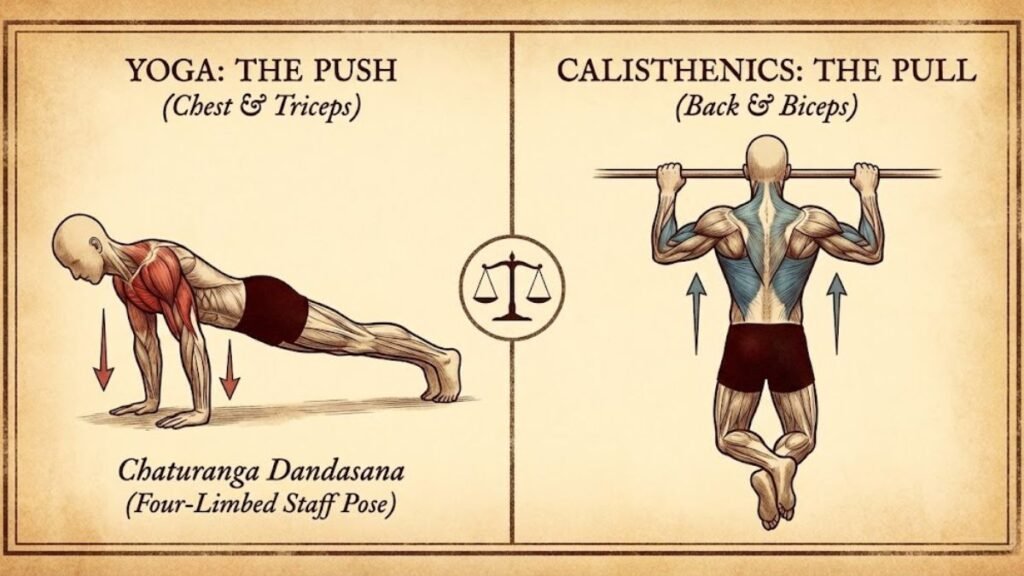
Yoga is almost entirely a “pushing” practice. You push the floor away in Plank, Downward Dog, and Handstand. However, yoga has basically zero pulling work. You rarely pull things towards you in a yoga class.
The Calisthenics Advantage
Calisthenics uses equipment like pull-up bars, rings, and parallettes. This allows you to do pull-ups and chin-ups, which are essential for building your back and biceps.
Even veteran yoga teachers admit this. One yogi with 20 years of experience recommends doing pull-ups or lifting weights outside of the studio to stay well-rounded. If you only do yoga, your back muscles might be neglected compared to your chest and shoulders.
Mental Health: Nervous System Reset vs. Adrenaline Spike
The most profound difference between the two is not how your muscles look. It is how your brain feels.
Calisthenics: The Adrenaline Spike
Calisthenics workouts are often fast-moving and “adrenaline-pumping”. Because you are doing explosive movements like jump squats or burpees, your body needs to produce a lot of force quickly. This challenges your nervous system and wakes you up. It is great if you need to shake off lethargy, but it keeps you in a state of high alert.
Yoga: The Nervous System Reset
Yoga works in the opposite way. It is designed to strengthen the parasympathetic nervous system. This is the “Rest and Digest” mode that helps you recover. By focusing on deep breathing and mindful movement, yoga frees you from negative emotions and reduces anxiety.
The Feeling After Class
The difference is clear when you finish. After a heavy calisthenics session, you might feel pumped and exhausted. After a yoga session, students often report feeling “lively and calm” at the same time.
If you struggle with stress or burnout, read more in our guide to Nervous System & Yoga.
Longevity: Which Practice Ages Better?
When you are young, you might not worry about getting old. But how you train today determines how you will move when you are 70.
The Reality of Calisthenics and Aging
Calisthenics can be very difficult for older adults to start. As we age, we experience “sarcopenia,” which is the natural loss of skeletal muscle mass. If you have never done a muscle-up before, trying to learn it in your 60s is risky. The explosive nature of street workouts can be hard on joints that are already tired.
The Yoga Advantage
Yoga is for everyone at any age. It is never too late to start. Yoga helps counteract the negative effects of aging by maintaining your bone density and keeping your joints flexible. For people with conditions like osteoarthritis, yoga helps by strengthening the muscles around the joints without the heavy impact of jumping.
Because yoga moves the body in all directions. Twisting, bending, and extending. It keeps you functional for everyday life.
Learn more about adapting your practice in our article on Yoga for Seniors.
Combining Yoga and Calisthenics for the Ultimate Hybrid Athlete
You do not have to pick just one side. In fact, combining them might be the best way to train. Calisthenics gives you raw strength, while yoga gives you balance and flexibility.
You can create a “hybrid plan” to get the benefits of both worlds. Here is a simple routine you can try:
- Warm Up with Cardio: Start with explosive calisthenics moves like Jumping Jacks or Burpees. This gets the blood pumping through your veins immediately.
- The Strength Phase: Do your heavy lifting with your own body weight. Focus on push-ups, pull-ups, or sit-ups to build muscle endurance.
- The Flow: Slow down the pace. Move from lunges directly into classic yoga poses like Warrior I or Warrior II. This strengthens your legs while stretching your hips at the same time.
- The Cool Down: Finish your workout with a deep stretch, like a Half-Lotus pose, to relax your mind before you go back to reality.
Don’t Just Exercise. Evolve.

Calisthenics builds a strong body by challenging your nervous system to produce force. Yoga builds a resilient mind by cultivating flexibility and awareness.
When you put them together, you get more than just a workout. You get a training plan that covers everything from stability to mindfulness.
Are you ready to master your body weight?
At Joga Yoga, we teach you the mechanics behind the movement. Whether you want to hold a handstand or sit in meditation, it starts with understanding your own anatomy.