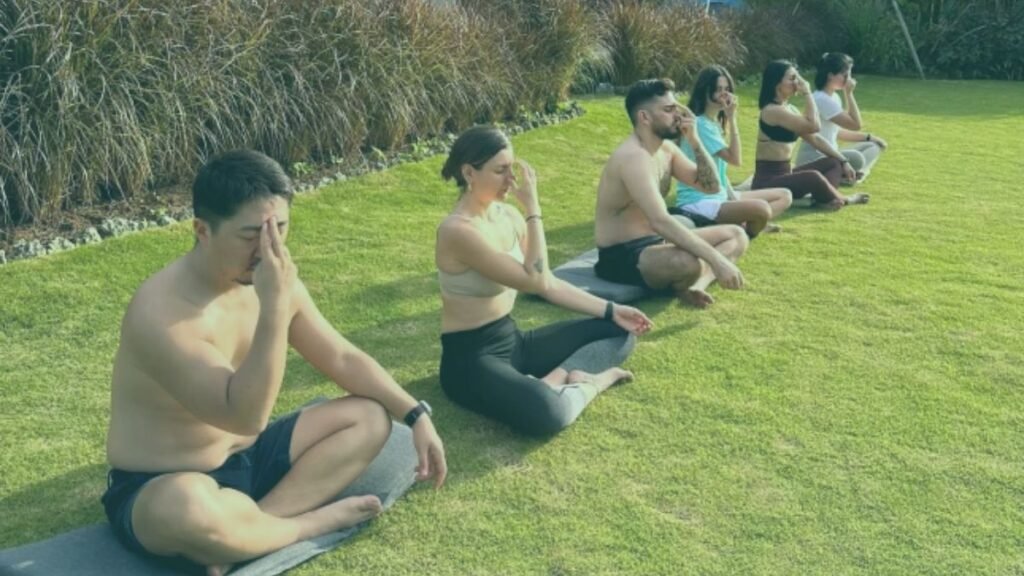

Introduction to Vipassana Meditation
Vipassana meditation means “clear seeing” or “insight” in the ancient Pali language. It is a practice of observing body sensations to understand impermanence, suffering, and non-self. The method comes from Theravāda Buddhism and is based on early teachings of the Buddha over 2,500 years ago.
Today, Vipassana is practiced in silent retreats around the world, especially in the Goenka tradition and the Mahasi Sayadaw lineage. This guide explains what Vipassana is, how it works, its Buddhist foundations, scientific research, retreat structure, risks, and how it applies in modern life.
What Is Vipassana Meditation?
Vipassana meditation is an insight meditation practice that trains you to see reality as it truly is. It focuses on direct experience instead of belief. Practitioners observe sensations, thoughts, and emotions without reacting.
Vipassana is one of the oldest forms of Buddhist meditation and is central to Theravāda Buddhism.
Meaning of Vipassana in Pali and Early Buddhism
The word Vipassana comes from the Pali language.
- “Vi” means clearly or deeply
- “Passana” means seeing
Together, Vipassana means clear seeing or insight into reality.
In early Buddhism, Vipassana was taught by the Buddha as a path to liberation from suffering. It is described in important texts such as the Satipatthana Sutta, which explains how to observe the body, feelings, mind, and mental patterns.
Vipassana is not just relaxation. It is a systematic method to understand how the mind and body change from moment to moment.
Vipassana in Theravāda Buddhism and the Noble Eightfold Path
Vipassana meditation belongs to the Theravāda Buddhist tradition, which preserves the earliest teachings of the Buddha.
It is connected to the Noble Eightfold Path, especially:
- Right Mindfulness
- Right Concentration
- Right Effort
Vipassana also follows the three-part training in Buddhism:
- Sila, which means moral discipline
- Samadhi, which means concentration
- Panna, which means wisdom
Sila creates ethical stability.
Samadhi builds focus.
Panna develops insight.
Vipassana mainly develops Panna, or wisdom, through direct observation.
The Three Marks of Existence in Vipassana Meditation
Vipassana helps practitioners understand the Three Marks of Existence, which are central teachings in Buddhism.
Anicca means impermanence. Everything changes. Every sensation rises and passes away.
Dukkha means unsatisfactoriness or suffering. Because things change, clinging to them causes stress.
Anatta means non-self. There is no fixed, permanent self controlling experience.
By observing body sensations closely, meditators begin to see Anicca directly. This leads to deeper understanding of Dukkha and Anatta.
These concepts are core Buddhist entities and essential to understanding Vipassana.
How Vipassana Meditation Works
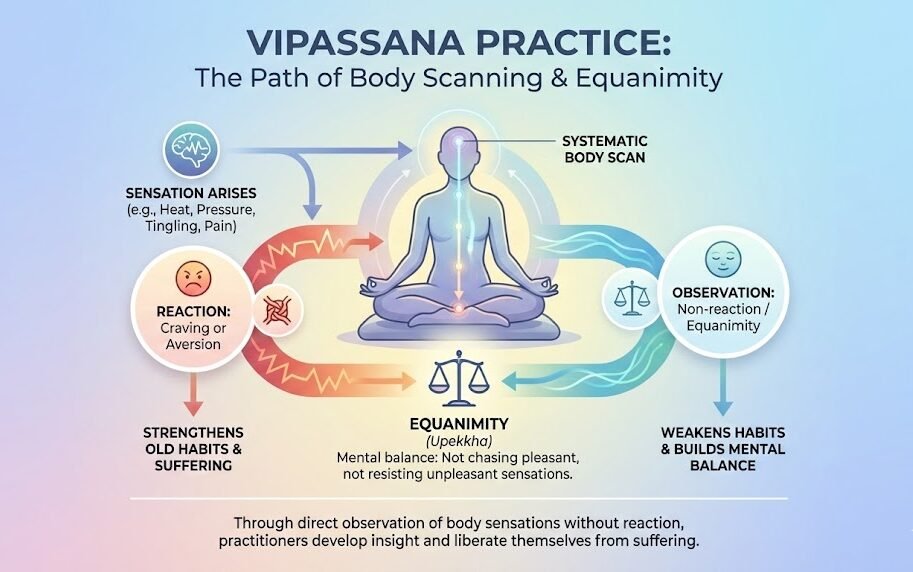
Vipassana meditation works by training awareness of body sensations and mental reactions. Instead of reacting with craving or aversion, the practitioner observes calmly.
Over time, this weakens old habits of reaction and builds equanimity.
Body Scanning Technique in Vipassana Meditation
The main technique in many Vipassana retreats is body scanning.
You slowly move your attention from head to feet. You observe sensations such as heat, pressure, tingling, itching, or pain. You do not label them good or bad.
The key is non-reaction.
When you observe without reacting, you develop equanimity, which in Pali is called Upekkha.
Equanimity means mental balance. You do not chase pleasant sensations and you do not resist unpleasant ones.
This breaks the cycle of craving and aversion.
Why Body Sensations Matter in Buddhism
In Buddhist psychology, every mental reaction creates a physical sensation in the body.
When you feel anger, the body tightens.
When you feel fear, the heart rate changes.
When you feel desire, there is restlessness.
This is the mind-body link.
According to Buddhist teaching, reacting to sensations creates Kamma, which means intentional action that shapes future experience.
Vipassana trains you to observe sensations without creating new reactive Kamma. Over time, old patterns lose strength.
Anapana, Vipassana, and Metta Meditation Explained
Most 10-day Vipassana retreats follow three stages.
Anapana meditation is the first stage. It focuses on breathing. This builds concentration and sharpens awareness.
Vipassana meditation is the second stage. It uses body scanning to develop insight into impermanence.
Metta meditation is the final stage. It develops loving-kindness and goodwill toward yourself and others.
Anapana builds Samadhi.
Vipassana builds Panna.
Metta supports compassion and emotional balance.
Major Vipassana Lineages and Teachers
Vipassana meditation has been preserved through several important Buddhist teachers and traditions. Each lineage keeps the core teaching but may use slightly different techniques.
Understanding these lineages increases clarity and historical accuracy.
The Goenka Tradition of Vipassana Meditation
The Goenka tradition is one of the most well-known modern Vipassana movements.
It traces back to U Ba Khin, a Burmese meditation teacher. His student S.N. Goenka brought Vipassana to India and later to the rest of the world.
Goenka established a standardized 10-day retreat format. These retreats are offered at centers globally through Dhamma.org. They are donation-based and follow strict discipline.
The technique focuses heavily on systematic body scanning and strong equanimity.
This tradition is secular in presentation but rooted in Theravāda Buddhist teaching.
The Mahasi Sayadaw Method of Vipassana
Mahasi Sayadaw was another influential Burmese monk who helped spread Vipassana in the 20th century.
His method is often called the noting technique.
Instead of scanning the body in a fixed order, practitioners mentally note experiences such as “thinking,” “hearing,” or “feeling.”
This approach comes from reform movements in Burma that aimed to make meditation more accessible to lay people.
The Mahasi method places strong emphasis on moment-to-moment awareness.
Thai Forest Tradition and Other Theravāda Vipassana Schools
The Thai Forest tradition is another important branch of Theravāda Buddhism.
Teachers like Ajahn Chah emphasized strict discipline, simple living, and meditation in forest monasteries.
This approach focuses more on monastic life and continuous awareness rather than structured 10-day retreats.
While the method may differ, insight into impermanence, suffering, and non-self remains central.
Different traditions use different training structures, but the goal of liberation from suffering is shared across all Vipassana schools.
What Happens in a 10-Day Vipassana Meditation Retreat?
A 10-day Vipassana retreat is the most common way people learn this meditation method. The structure is strict because the practice is deep and demanding.
Most retreats follow the Goenka tradition, but other Theravāda centers use similar discipline.
Students live at the center for ten full days. They do not leave. They follow a fixed schedule and avoid all outside contact.
Noble Silence in Vipassana Retreats
One of the most important rules is Noble Silence.
Noble Silence means:
- No talking
- No eye contact
- No reading
- No writing
- No phone or internet use
Silence reduces distraction. It allows the mind to settle. Without social interaction, old mental habits begin to surface.
This isolation is intentional. It supports deep observation.
Daily Schedule in a Vipassana Meditation Retreat
A typical retreat schedule looks like this:
- 4:00 AM wake up
- 10 to 12 hours of meditation daily
- Simple vegetarian meals
- Evening recorded discourse by S.N. Goenka or another teacher
- Lights out around 9:30 PM
The long hours of sitting are not meant to cause suffering. They are meant to build Samadhi, which means concentration, and strengthen equanimity.
The Five Precepts in Vipassana Meditation
All students follow five ethical rules called Sila. These rules come directly from early Buddhist teaching.
The five precepts are:
- Do not kill any living being
- Do not steal
- Do not engage in sexual activity
- Do not lie
- Do not use intoxicants
These rules calm the mind. When behavior is clean, meditation becomes easier.
Sila supports Samadhi. Samadhi supports Panna.
This structure comes from the Buddhist training system taught in Theravāda Buddhism.
The Five Hindrances in Vipassana Meditation
During meditation, the mind does not stay calm. It meets obstacles. In Buddhism, these are called the Five Hindrances.
They are described in the Pali Canon and discussed in the Satipatthana Sutta.
1. Sensual Desire
This is craving for comfort, pleasure, or distraction. It may show up as wanting better food, more sleep, or pleasant sensations.
2. Ill Will or Aversion
This includes anger, irritation, fear, or resistance. When pain arises in meditation, aversion often follows.
3. Sloth and Torpor
This is mental dullness or sleepiness. The body feels heavy. The mind feels foggy.
4. Restlessness and Remorse
This includes worry about the future or regret about the past. The mind jumps from thought to thought.
5. Doubt
Doubt questions the practice, the teacher, or yourself. It creates instability and hesitation.
In Vipassana, the instruction is not to fight these hindrances. Instead, you observe them. By observing without reaction, they weaken over time.
Understanding the Five Hindrances is essential for serious practitioners.
Scientific Research on Vipassana Meditation and Brain Changes
Modern science has studied Vipassana meditation and similar insight practices.
Researchers have examined how long-term meditation affects the brain, stress levels, and emotional control.
Vipassana Meditation and Stress Reduction
Studies show that meditation reduces cortisol, which is the stress hormone.
Regular Vipassana practice helps people respond to stress with more balance. Instead of reacting immediately, practitioners pause and observe.
This improves emotional regulation.
Brain Changes and Neuroplasticity in Vipassana
Brain imaging studies using fMRI have shown changes in:
- The prefrontal cortex, which controls decision-making
- The amygdala, which processes fear
- The Default Mode Network, which relates to self-focused thinking
Long-term meditators often show reduced activity in the Default Mode Network. This may relate to the Buddhist teaching of Anatta, or non-self.
Neuroplasticity means the brain can change through practice. Vipassana appears to support these changes.
Vipassana Meditation and Addiction Recovery
Vipassana has been used in prisons and addiction recovery programs.
The practice helps people notice craving as body sensation. Instead of acting on craving, they observe it.
This breaks automatic patterns.
By weakening craving and aversion, Vipassana supports behavioral change.
Psychological Risks and Criticisms of Vipassana Meditation
Vipassana is powerful, but it is not always easy or safe for everyone.
Balanced discussion increases trust and clarity.
Emotional Intensity During Silent Retreats
Long periods of silence can bring up strong emotions. Old trauma or grief may surface.
Crying, anxiety, or emotional release are common experiences.
For some people, this can feel overwhelming.
Is Vipassana Dangerous for Certain Individuals?
Vipassana may not be suitable for people with:
- Severe depression
- Active PTSD
- Psychosis
- Early addiction recovery
Without professional guidance, intense meditation can increase instability.
Some psychologists have raised concerns about meditation-induced distress, especially during long retreats.
Criticism of Modern Vipassana Movements
Some critics argue that large global Vipassana organizations have become institutionalized.
Others question whether the 10-day format is too rigid.
There are also discussions about cultural translation from Buddhist monastic contexts to Western lay life.
These debates are part of the broader conversation around meditation in modern society.
Can You Practice Vipassana Meditation at Home?
Yes, you can practice Vipassana meditation at home, but it will not feel the same as a 10-day retreat.
At a retreat, you have Noble Silence, a strict schedule, and no distractions. At home, daily life continues. Phones, work, and family reduce focus.
Still, home practice is valuable.
How to Start Vipassana Meditation at Home
Beginners can follow a simple structure:
- Sit comfortably with a straight back.
- Practice Anapana by focusing on your natural breath for 5 to 10 minutes.
- Slowly begin scanning body sensations from head to feet.
- Observe sensations without reacting.
Start with 10 to 20 minutes per day.
The goal is not perfection. The goal is awareness.
Consistency matters more than duration.
Common Mistakes in Home Vipassana Practice
Many beginners make these mistakes:
- Trying to force sensations
- Expecting instant calm
- Judging themselves for distraction
- Practicing without understanding Anicca
Vipassana is not about achieving a special state. It is about observing change. Even restlessness is part of the practice.
Vipassana vs Mindfulness Meditation, Zen, and Transcendental Meditation
Many people ask if Vipassana is the same as mindfulness meditation. The answer is no.
They share similarities but have different depth and structure.
Vipassana vs Mindfulness Meditation
Mindfulness meditation focuses on staying present. It often uses the breath or general awareness of thoughts.
Vipassana focuses specifically on body sensations and insight into Anicca, Dukkha, and Anatta.
Mindfulness builds calm.
Vipassana builds insight into the nature of reality.
Vipassana vs Zen Meditation
Zen meditation, also called Zazen, comes from Mahayana Buddhism.
Zen emphasizes posture, simplicity, and direct awareness of mind.
Vipassana follows Theravāda Buddhist structure and uses systematic body scanning.
Both aim at awakening, but the techniques differ.
Vipassana vs Transcendental Meditation
Transcendental Meditation uses silent mantra repetition to create deep relaxation.
Vipassana does not use mantras. It trains awareness of sensations and reactions.
Transcendental Meditation focuses on stress reduction.
Vipassana focuses on insight and liberation from suffering.
Is Vipassana Meditation Right for You?
Vipassana meditation is intense. It requires discipline and patience.
It may be right for you if:
- You want deeper self-awareness
- You are willing to sit with discomfort
- You are interested in Buddhist philosophy
- You can commit to daily practice
It may not be right for you if:
- You have severe untreated mental health conditions
- You are not ready for emotional intensity
- You prefer light relaxation practices
Vipassana is a path of insight, not escape.
Conclusion: Understanding Vipassana Meditation in Modern Life
Vipassana meditation is one of the oldest and most structured forms of insight meditation. Rooted in Theravāda Buddhism, it teaches observation of body sensations to understand impermanence, suffering, and non-self.
Through Sila, Samadhi, and Panna, practitioners develop discipline, concentration, and wisdom.
Scientific research supports its role in stress reduction, emotional regulation, and brain plasticity. At the same time, it requires caution and self-awareness due to its intensity.
For those interested in deepening meditation within a balanced yoga framework, guided training with experienced teachers offers structure and support.
Meditation becomes more sustainable when combined with movement, breathwork, and philosophy.
FAQs ABOUT VIPASSANA MEDITATION
Is Vipassana Meditation Buddhist?
Yes. Vipassana comes from Theravāda Buddhism and early teachings of the Buddha. However, many modern retreats present it in a secular way. People of all religions can practice it.
Is Vipassana the Same as Mindfulness?
No. Mindfulness focuses on present awareness. Vipassana uses structured body scanning to understand impermanence, suffering, and non-self.
Why Is a Vipassana Retreat 10 Days Long?
Ten days allow enough time to develop concentration, observe deep mental patterns, and experience insight. Shorter retreats may not reach the same depth.
Can Vipassana Meditation Cure Anxiety or Depression?
Vipassana can reduce stress and improve emotional regulation. However, it is not a medical treatment. People with serious mental health conditions should consult a professional before attending a retreat.
Is Vipassana Meditation Dangerous?
Vipassana is generally safe for healthy individuals. However, long silent retreats can be overwhelming for people with trauma or psychiatric instability.
How Long Does It Take to See Results from Vipassana?
Some people feel calmer within days. Deep insight often takes months or years of consistent practice.
Vipassana is a long-term training, not a quick fix.
Can Beginners Do Vipassana Meditation?
Yes, beginners can start with short daily sessions. However, a full 10-day retreat requires preparation and commitment.
Can People of Other Religions Attend Vipassana Retreats?
Yes. Vipassana is not a conversion practice. Muslims, Christians, Hindus, and others attend retreats. The practice focuses on observation, not worship.