

 Written by Joseph Berridge, Founder of Joga Yoga / Lead Yoga Teacher
Can You Actually Teach Yoga Online With a Certificate?
Yes. A 200-hour Yoga Alliance RYT qualification covers you to teach anywhere, including online. There is no separate online teaching credential, no extra registration step, and no limit on format. Your certification is valid whether you are standing in a studio in Bali or running a Zoom class from your living room in London.
One thing to check before you charge for your first class is your liability insurance policy. Most reputable providers, including NACAMS, beYogi, and Philadelphia Insurance, now include both live streamed and pre-recorded online teaching in their standard coverage. That was not always true, but it is the norm in 2026. Read your policy wording before you assume you are covered. Confirm that “virtual classes” and “pre-recorded video content” are listed by name. That one read takes five minutes and closes a real legal gap before it matters.
Insurance runs about $60 a year for a student teacher up to roughly $170 to $180 a year once you are teaching full time. It is one of the smallest line items in your setup budget and one of the most important.
Pick Your Niche Before You Pick a Platform
Most guides jump straight to recommending Zoom or Teachable. That is the wrong order. The format you teach in should follow from who you want to teach and what you want to offer, not the other way around.
A teacher who wants to run 6 AM flows for busy parents needs live sessions with predictable scheduling and easy payment collection. A teacher who wants passive income around a hip pain relief sequence is better off with a recorded course on Teachable or Thinkific. A teacher who wants to grow an audience from zero needs to be on YouTube first, not behind a paywall.
Decide these three things before you open a platform account:
- Who is your student? Beginners, prenatal, seniors, athletes, desk workers. The more specific you get, the easier it is to find them, and the less you compete on price.
- What format fits that student? Live classes suit people who need accountability. On-demand libraries suit self-paced practitioners. Short focused courses suit people solving one specific problem, like better sleep or a stiff lower back.
- How do you want to earn? A $15 drop-in class needs 100 students a month to earn $1,500. A $45 monthly membership needs 34. A $197 one-time course needs 8. The income shape changes completely across these three models.
Once you know the answers, the platform choice is obvious. Before that, every platform looks equally appealing and equally confusing.
Which Platform to Use (and When)
You do not need an expensive setup to start. You need a way to take a booking, collect a payment, and run a class. Here is what actually works at each stage.
| Stage | Platform | Cost | Best for |
|---|---|---|---|
| Starting out, private clients | Zoom free plan | $0 | Unlimited 1-to-1 calls, no time limit |
| Starting out, free group classes | Google Meet free plan | $0 | 60-minute group call cap (longer than Zoom’s free 40), no account needed for students to join, no native recording |
| Starting out, group classes with recording | Zoom Pro | $13.33/mo billed annually ($149.90/yr), or $16.99/mo month to month | Removes the 40-minute group cap and includes 10GB of cloud recording |
| Ready to grow | Momoyoga or Sutra | Built for yoga teachers, priced per active student | Live class scheduling, payments, and student management in one place |
| Building courses | Teachable or Thinkific | Tiered monthly plans | Structured programmes with video modules, PDFs, and quizzes |
| Audience building | YouTube | Free | Reaching people who would never find your website on their own |
Zoom is not the only option, and it is not automatically the right one. Google Meet’s free tier gives you 60 minutes for a group class against Zoom’s free 40, and students can join from a plain link with no account. The gap shows up later: Meet does not record on the free tier, and the Google Workspace plan that adds recording starts at $14 a user a month, more than Zoom Pro costs for the same feature. If you plan to record classes and sell the replays, Zoom is the cheaper route. If you only want free live sessions with no recording, Meet does the job just as well.
Momoyoga and Sutra do not support pre-recorded course sales, so they suit live class programmes best. Teachable and Thinkific reward a specific audience and a specific outcome. A course called “Yin Yoga for Better Sleep” outsells “Introduction to Yoga” consistently, because the searcher already knows what problem they need solved. YouTube does not pay well per view, but many established online teachers use it to bring in new students, then convert them to paid memberships or courses. Starting there, rather than behind a paywall, is often the faster path to your first 20 paying students. See Zoom’s current pricing page before you commit to a tier.
The Music Licensing Problem Nobody Warns You About
This catches new teachers every time. If you play copyrighted music during a Zoom class, a YouTube live stream, or a pre-recorded video, you risk DMCA copyright strikes, content removal, or a muted audio track. The platforms do not warn you before it happens. They act after.
The fix is not free, but it is simple. Royalty-free music services built for fitness and wellness teachers include Epidemic Sound, Musicbed, and YogiTunes, which licenses specifically for live streaming on Zoom, YouTube, Facebook, and Instagram. As of 2026, Epidemic Sound’s entry Creator plan runs about $9.99 a month billed annually, or $17.99 month to month, and clears one personal channel per platform for streaming and recording. Some teachers run classes with no background music at all. That works fine for Yin and restorative styles, where ambient silence is part of the experience.
Do not assume a Spotify playlist or an Apple Music track is safe to use in a class you record or stream. It is not. Sort this out before your first class, not after YouTube mutes your first video.
How Your Teaching Technique Changes Online
Getting certified to teach is not the same as knowing how to teach on camera. Online yoga has specific constraints that change what works in the room.
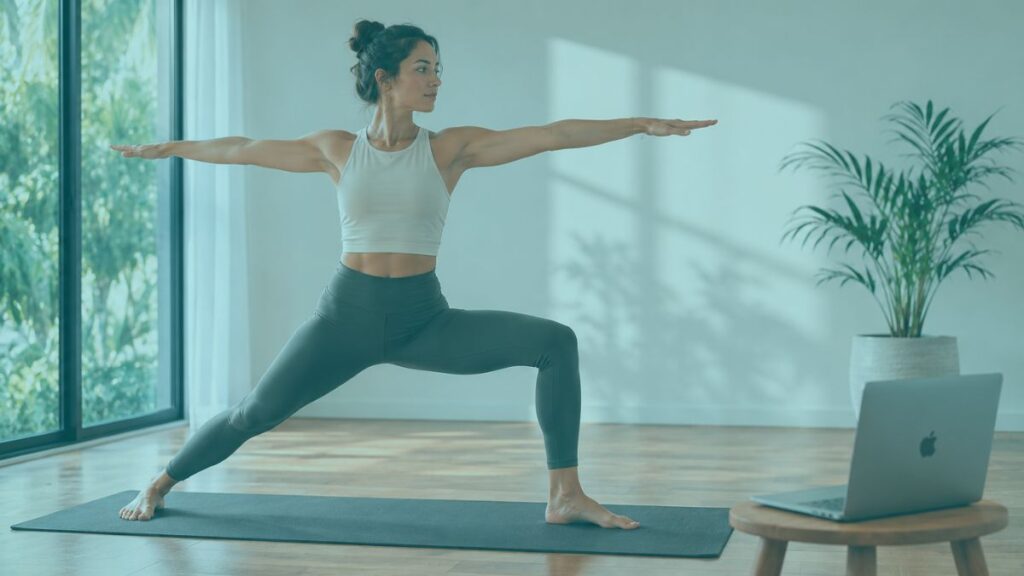
The biggest issue is camera geometry. In most yoga poses, the student cannot look at the instructor without breaking their alignment. Verbal cueing carries almost all the load online because of this. Your ability to describe sensation, breath, and internal experience in real time matters more here than it ever did in person. In a studio, you can walk over and adjust a student’s hip. Online, your words are the only tool you have.
A related problem: you cannot see the student clearly in many poses either. Someone in downward dog is mostly facing the floor. Someone in child’s pose has their face hidden. Build in regular verbal check-ins for this reason. “Let me know in the chat if you need a modification” or “give me a thumbs up if that feels okay on your lower back” keeps you connected to what is actually happening in your students’ bodies.
Some practical adjustments are worth making from day one:
- Place your camera at eye level or slightly below, never above you. A camera angle from above flattens poses and makes alignment much harder to read.
- Face the camera as much as possible and teach in reverse mirror. If you want students to lift their right arm, lift your left. Say this once at the start of class and most students adapt immediately.
- Simplify your flows for the first three months. Sequences with many directional changes are hard to follow on a small screen. Yin, restorative, and floor-based Hatha translate online better than fast vinyasa to start. Save the complex flows until you are comfortable cueing without visual feedback.
- Put a light source in front of you, behind the camera, not behind you. Natural light works well. Teaching as a silhouette is one of the most common beginner mistakes and one of the easiest to fix.
For audio, a clip-on lavalier microphone from a phone accessories shop costs under $20 and sounds noticeably better than any built-in laptop mic. Students forgive imperfect video quality long before they tolerate bad audio.
Feeling disconnected from a screen full of small video tiles is normal, even for teachers with years of studio experience. The fix is not a mindset shift. It is repetition: the same opening line, the same camera setup, the same first pose, every single class. A routine you can run on autopilot frees up your attention for the cueing that actually matters.
Style choice matters here too. Vita, one of Joga Yoga Training’s teachers, teaches Hatha and candle-light Yin classes built around slow, deliberate alignment work. Styles like these give a new online teacher more time to cue carefully, check the chat, and read how students are doing than a fast-paced vinyasa flow does. If you are choosing your first online class format, a slower style is the easier place to build confidence.
What to Charge When You Start
New teachers consistently underprice. Imposter syndrome after a 200-hour course is real. Undercharging creates its own problem, though: you burn out at unsustainable volume, students associate low price with low quality, and you never build the margin to invest back into your teaching.
| Format | New teacher rate | Experienced rate |
|---|---|---|
| Online group classes | $12 to $15 per class | $10 to $20 is the standard range |
| Private sessions via video call | $50 to $100 per hour | $100 to $200 with specialist training or years of experience |
| Monthly memberships | $18 to $45 per month | Higher tiers with personalised check-ins go beyond this |
| Recorded courses | $97 to $297 for a structured multi-week programme | Priced by topic depth and outcome specificity |
Raise your rates once classes fill consistently. Give existing students 30 days’ notice. New students pay the new rate from day one.
Building Your First Student Base
The first 10 students are the hardest. After that, word of mouth does more than any marketing strategy. Here is the fastest path to those first 10.
Start with people who already know you: former classmates from your teacher training, friends who have practised with you, anyone who has asked when you are starting to teach. Offer your first three to five classes free or heavily discounted in exchange for honest feedback and a testimonial if they found value in it. You are not building a business yet. You are practising being a teacher and collecting social proof.
Build your email list from day one. A small, engaged email list is worth more than a large social media following you do not own. Offer something useful to people who sign up: a short sequence guide, a breathing exercise PDF, a free 20-minute class recording. Email is still the most reliable way to fill a new class or announce a workshop.
Show your teaching on the platform where your potential students already spend time. Short Instagram Reels or YouTube clips that demonstrate a single technique, a pose breakdown, or a breathing exercise are easy to consume and share. One piece of teaching content per week, kept up for three to six months, is what builds familiarity. Most teachers who give up do so at month two, right before momentum starts to compound.
Collaborating with complementary practitioners, a massage therapist, a breathwork teacher, a physiotherapist, can move things faster than solo content. A joint live session or a cross-promotion puts you in front of people already invested in their physical wellbeing. If you want the fuller roadmap for building a teaching career beyond these first 90 days, our guide to becoming a yoga trainer covers the rest of the path.
The Legal Basics Before Your First Paid Class
This is not complicated, but it is worth doing before you charge anyone money.
- Yoga Alliance registration is current and displayed on your booking page or site. You can register as an RYT-200 after completing your 200-hour training at a registered school. The first year costs $115 (a $50 one-time registration fee plus $65 in annual dues), then $65 a year to renew.
- Liability insurance is active, and you have read the policy to confirm it covers online classes, both live and recorded.
- A waiver or terms of service that students agree to before booking. Yoga Alliance does not publish a waiver template. Pull one from a legal document platform like Rocket Lawyer, or through professional yoga teacher associations, then handle the signature itself with a tool like Docusign. A simple version works: a checkbox on a Google Form confirming the student understands the physical demands of yoga, practises at their own risk online, and agrees to your refund policy. Have a lawyer review it if you charge premium rates.
- A backup plan for tech failure. Write a short message now that you can send to students in under 60 seconds if your internet drops during a class: a backup Zoom link, a “class is delayed 10 minutes” message, or a short recorded sequence they can do independently while you reconnect.
- A refund policy students can read before they book, not after something goes wrong.
A working Zoom link, confirmed insurance, cleared music, and a simple terms form is enough to start. The teachers who wait for everything to be perfect before going live are still waiting.
What Your Joga Yoga Training Gives You That Most Graduates Don’t Have
Most 200-hour graduates leave their training with a certificate and a blank page. Joga Yoga Training graduates leave with something more immediately useful: lifetime access to an online student portal that stays open after the course ends. That gives you a working reference for curriculum, sequencing approaches, and teaching methodology as you build your own classes, not just a certificate to frame.
Dakota Mays, a graduate from the United States now working as a yoga instructor, put it plainly in her Joga Yoga Training review: “After leaving, I was more than prepared to teach and start my full-time job as a yoga instructor.” That confidence matters more online than in a studio. In a studio, you can read a room and adjust in real time. Online, your confidence in cueing and sequencing has to be built in before you go live.
Joga Yoga Training’s curriculum covers teaching styles across Traditional Hatha, Creative Vinyasa, Ashtanga Vinyasa, and Yin Yoga, styles that translate differently to online formats. A Yin or restorative offering is one of the most practical starting points for an online class schedule: low technical complexity, high repeat attendance, and hard to find done well online. Graduates also complete practice teaching inside the 200-hour programme’s practicum, with feedback from faculty and observation of other trainees, and can continue teaching practice at the Joga Yoga Training studio after graduation to build real experience before charging students.
If you trained at Joga Yoga Training in Canggu and are now teaching online from somewhere else, you have a story worth telling. Bali-trained teachers carry real credibility with students who care about lineage, in-person immersion experience, and study with teachers from multiple traditions. That is part of your positioning. Use it.
Your First 90 Days Teaching Online
One format. One audience. One platform. Teach the same class on the same day at the same time every week. Consistency is how students build habits around your schedule. Changing days, formats, and platforms is how you lose them before they even decide if they like your teaching.
In your first month, teach and collect feedback. In your second month, refine your class structure and start putting out content that brings new students in. In your third month, review whether your pricing and format are working. If classes fill every week, you are underpriced. If you are teaching to two or three students after three months, the issue is usually discoverability, the wrong platform for your audience, not enough content pointing toward your class, rather than your teaching quality.
Check the Joga Yoga Training blog for more on what comes after certification. If you have not yet completed your training and want the foundation this article assumes you have, start with the Joga Yoga Training 200-hour programme in Canggu.
Ready to Build the Foundation This Article Assumes You Have?
Joga Yoga Training’s 200-Hour Yoga Alliance Certified Teacher Training in Canggu, Bali covers the practice teaching, faculty feedback, and lifetime portal access this article references.
See Upcoming Dates